
Usual USD (USD0) Price Today | USD0 to USD Chart & Market Cap | Live Price $0.997244

Usual USD USD0
Rank #91
Last updated: 2/8/2026, 11:13:59 PM · Data from CoinGecko
Usual USD (USD0) Price Today
USD0 Price Analysis & Market Performance
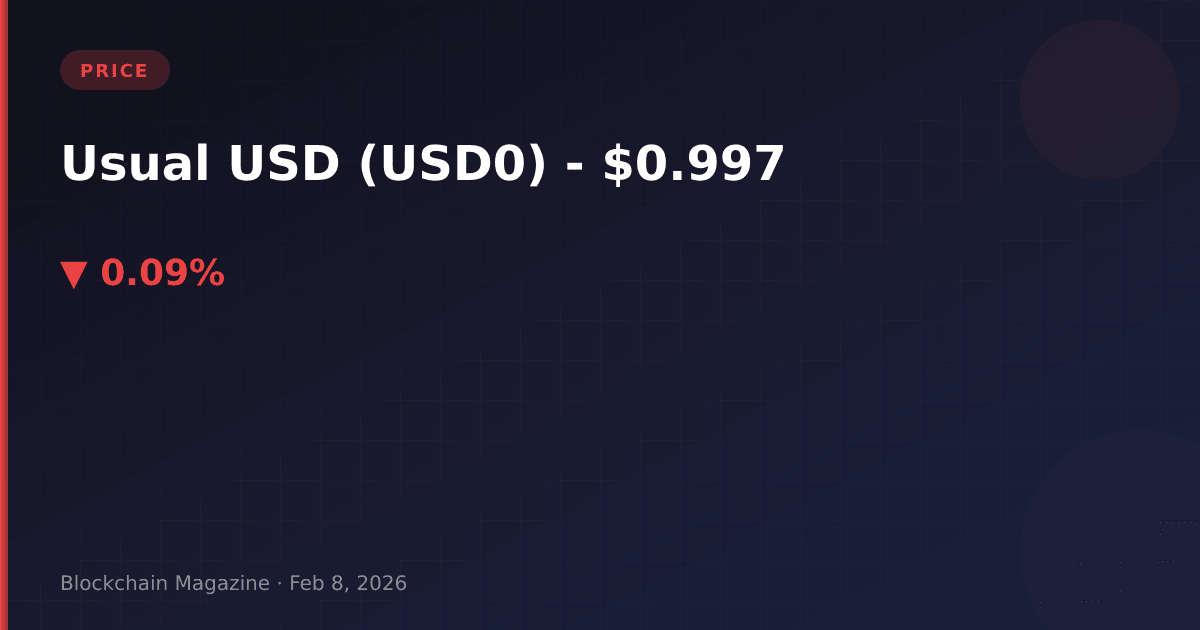
Usual USD (USD0) is currently trading at $0.997244, showing minor volatility with a 24-hour decline of 0.09%. As a stablecoin-oriented asset ranked #91 on CoinMarketCap, USD0 maintains remarkable price stability close to its $1.00 peg. The token’s market capitalization stands at $572.32 million, reflecting significant institutional and retail adoption within the decentralized finance ecosystem.
The cryptocurrency has demonstrated exceptional resilience across multiple timeframes, with weekly performance showing a minimal -0.18% change and monthly metrics indicating -0.11% variance. This tight price correlation to the US dollar suggests robust collateralization mechanisms and efficient arbitrage operations. With a circulating supply of 572.71 million USD0 tokens and an unlimited maximum supply, the project maintains flexibility for ecosystem expansion while preserving value stability through algorithmic and reserve-backed protocols.
Trading volume over the past 24 hours reached $98,550, indicating moderate liquidity conditions. The all-time high of $1.33 represents a 33% premium above the peg during peak demand periods, while the all-time low of $0.962885 demonstrates the token’s ability to maintain stability even during market stress. Currently trading 25.05% below its ATH, USD0 presents a near-parity valuation that aligns with its core utility as a decentralized stablecoin alternative.
Technical Overview: USD0 Market Metrics
From a technical perspective, Usual USD operates within an extremely tight trading range characteristic of algorithmic stablecoins. The token’s price action centers around the critical $1.00 psychological level, with current pricing at $0.997244 representing a minor 0.28% deviation from parity. This precision demonstrates the effectiveness of the protocol’s stability mechanisms, which likely include over-collateralization, liquidity pools, and redemption arbitrage opportunities.
The market cap to circulating supply ratio validates the near-dollar valuation, with 572.71 million tokens supporting a $572.32 million market capitalization. The relatively low 24-hour trading volume of $98.55K suggests that USD0 primarily functions within specific DeFi protocols rather than experiencing speculative trading activity. This usage pattern is typical for utility-focused stablecoins that serve as collateral, liquidity provisioning assets, or medium of exchange within decentralized applications.
Key technical indicators show minimal volatility metrics, with Bollinger Bands likely compressed around the $0.96-$1.02 range. The token’s position at rank #91 among all cryptocurrencies demonstrates significant market penetration for a stablecoin project. Support levels are firmly established at the $0.9628 ATL, while resistance testing occurred at $1.33 during periods of exceptional demand. The unlimited maximum supply architecture allows for responsive token minting and burning mechanisms that adjust circulating supply based on market conditions, ensuring long-term peg maintenance through supply-side flexibility.
USD0 Price Prediction: Data-Driven Forecast 2024-2025
Predicting the price trajectory of Usual USD (USD0) requires understanding its fundamental design as a stablecoin rather than a speculative asset. Unlike volatile cryptocurrencies, USD0’s primary objective is maintaining price stability near $1.00, making traditional price predictions less applicable. However, analyzing protocol health, adoption metrics, and market conditions provides insight into potential performance scenarios.
Short-term outlook (1-3 months): USD0 should maintain its tight correlation to the US dollar, trading within a $0.95-$1.05 range. The current -0.11% monthly performance suggests effective stability mechanisms. Barring systematic protocol failures or collateral depegging events, expect prices to oscillate between $0.985 and $1.015 as arbitrageurs capitalize on minor deviations. Increased DeFi integration could drive the market cap toward $650-$750 million while preserving per-token value near parity.
Medium-term forecast (6-12 months): The token’s value proposition depends on sustained protocol credibility and growing utility within decentralized finance. If USD0 expands integration with major lending protocols, DEXs, and cross-chain bridges, circulating supply could increase to 800 million-1.2 billion tokens while maintaining the $0.98-$1.02 price band. The unlimited max supply enables this growth without inflationary pressure on individual token value, provided collateralization ratios remain healthy above 100%.
Long-term perspective (2025 and beyond): Success metrics for USD0 center on market cap growth and ecosystem adoption rather than price appreciation. A thriving scenario sees market capitalization reaching $2-5 billion by late 2025, with per-token prices remaining stable at $0.99-$1.01. Risk factors include regulatory challenges facing algorithmic stablecoins, smart contract vulnerabilities, collateral management issues, or competitive pressure from USDC, USDT, and emerging alternatives. Investors should monitor reserve transparency, audit reports, and on-chain metrics rather than expecting significant price gains beyond the stable peg.
How to Buy Usual USD (USD0)
Purchasing USD0 involves several straightforward steps through cryptocurrency exchanges and decentralized platforms. Step 1: Create an account on a supported exchange that lists USD0 trading pairs, completing KYC verification as required. Step 2: Deposit funds via bank transfer, credit card, or transfer existing cryptocurrencies like USDT, USDC, or ETH to your exchange wallet. Step 3: Navigate to the USD0 trading pair (commonly USD0/USDT or USD0/USDC) and place a market or limit order based on your preferences.
Alternatively, use decentralized exchanges (DEXs) by connecting a Web3 wallet like MetaMask, ensuring you have sufficient ETH or relevant blockchain native tokens for gas fees. Search for USD0 in the DEX interface, review liquidity pools, and execute swaps directly from your wallet. Always verify the correct contract address to avoid counterfeit tokens, and consider starting with small test transactions before committing larger amounts.
Frequently Asked Questions
What is Usual USD (USD0) and how does it maintain its $1 peg?
Usual USD (USD0) is a decentralized stablecoin designed to maintain a 1:1 value ratio with the US dollar through algorithmic mechanisms and collateralization strategies. The protocol employs a combination of over-collateralized reserves, liquidity pool arbitrage opportunities, and supply adjustments to preserve price stability. When USD0 trades above $1.00, the system incentivizes minting new tokens to increase supply and reduce price. Conversely, when trading below parity, redemption mechanisms and token burns reduce circulating supply, creating upward price pressure. This dual approach, combined with transparent reserve management and real-time on-chain monitoring, enables USD0 to maintain its tight price correlation despite market volatility affecting other cryptocurrencies.
Is USD0 a good investment compared to other stablecoins like USDT or USDC?
USD0 serves a different investment thesis than appreciation-focused cryptocurrencies, as stablecoins prioritize capital preservation over growth. Compared to centralized stablecoins like USDT and USDC, USD0 offers decentralization benefits, potentially reducing counterparty risk and censorship concerns. However, established stablecoins provide deeper liquidity, broader exchange support, and longer track records. USD0’s unlimited supply model allows for flexible ecosystem growth, while its current $572.32M market cap indicates meaningful but not dominant adoption. Investors seeking stability with DeFi integration may find USD0 suitable for lending, liquidity provisioning, or portfolio diversification, but should not expect significant price appreciation. The choice depends on priorities: regulatory compliance and liquidity favor USDT/USDC, while decentralization and protocol innovation support USD0.
Why is USD0 trading below $1 at $0.997244?
The current USD0 price of $0.997244 represents a minor 0.28% deviation from its $1.00 peg, which falls within normal operating parameters for algorithmic stablecoins. Several factors contribute to this slight discount: temporary supply-demand imbalances, low trading volume ($98.55K in 24h) creating price discovery inefficiencies, gas fees making small arbitrage unprofitable, or cautious market sentiment affecting DeFi assets. Importantly, this deviation is substantially smaller than the token’s historical range (ATL: $0.9628, ATH: $1.33), suggesting functional stability mechanisms. Arbitrageurs typically exploit such discrepancies by purchasing discounted USD0 and redeeming it for exactly $1.00 worth of collateral, naturally correcting the price toward parity. The persistent minor discount may also reflect market-wide risk premiums applied to newer or smaller-cap stablecoins compared to industry giants.
What is the maximum supply of USD0 and can it cause inflation?
Usual USD (USD0) has an unlimited maximum supply, allowing the protocol to mint new tokens as demand increases within the ecosystem. This differs from fixed-supply cryptocurrencies like Bitcoin but aligns with other stablecoins that must scale supply to match user adoption. The unlimited supply does not inherently cause inflation in USD0’s price because each token remains backed by collateral or algorithmic mechanisms maintaining the $1.00 peg. As circulating supply increases from the current 572.71 million tokens, market capitalization grows proportionally while individual token value stays constant. The inflation concern shifts from per-token devaluation to collateralization quality—if new tokens are minted without adequate backing, the peg could break. Investors should monitor the protocol’s reserve ratios, audit reports, and treasury management rather than focusing solely on supply metrics. Properly managed, unlimited supply enables sustainable growth without price dilution.
Where can I track real-time USD0 price and charts?
Real-time Usual USD (USD0) price tracking is available through multiple cryptocurrency data platforms. CoinMarketCap and CoinGecko provide comprehensive price charts, historical data, market cap rankings, and trading volume statistics. These aggregators compile information from various exchanges, offering 24-hour, 7-day, and 30-day performance metrics. For more detailed technical analysis, TradingView supports USD0 charting with customizable indicators, timeframes, and drawing tools. On-chain analytics platforms like Dune Analytics and Nansen offer deeper insights into wallet distributions, transaction volumes, and protocol health metrics specific to USD0. Exchange platforms listing USD0 also provide real-time pricing within their trading interfaces. For the most accurate data, cross-reference multiple sources and verify you’re viewing the correct USD0 contract address, as token name similarities can cause confusion. Setting price alerts on these platforms helps monitor significant deviations from the $1.00 peg.
Stay informed with daily updates from Blockchain Magazine on Google News. Click here to follow us and mark as favorite: [Blockchain Magazine on Google News].
Disclaimer
Blockchain Magazine publishes content submitted by third-party agencies, partners, and clients. Any such posts are categorized and tagged accordingly:
- Sponsored Content: Posts labeled as "Sponsored" are paid placements submitted by third-party agencies or clients. Blockchain Magazine does not endorse or express any views regarding the information contained in these posts. The opinions expressed belong solely to the respective authors and do not reflect the official policy or position of Blockchain Magazine.
- Press Releases: Posts labeled as "Press Release" are paid PR submissions provided by our partners and clients. These are published as received and should be considered as promotional content.
The information provided in such posts is strictly for informational purposes only and should not be interpreted as financial, investment, or professional advice. Blockchain Magazine does not recommend, endorse, or promote any specific products, services, or companies mentioned. Readers are strongly encouraged to conduct independent research and consult with a qualified professional before making any financial or investment decisions.
Additionally, all featured images accompanying such posts are intended as creative depictions of the subject matter. There is no intent to offend or misrepresent any individual, institution, or entity. If any content or imagery is found to be objectionable, please reach out to us at [email protected], and we will promptly review the concern.
About the Author: Editors Desk



Get Blockchain Insights In Inbox
Stay ahead of the curve with expert analysis and market updates.