
USDC Price Today: USD Coin (USDC) Live Chart, Market Cap & Predictions

USDC USDC
Rank #6
Last updated: 2/8/2026, 8:56:06 PM · Data from CoinGecko
USDC Price Today: USD Coin (USDC) Live Price Chart & Market Analysis
USDC Price Analysis Today
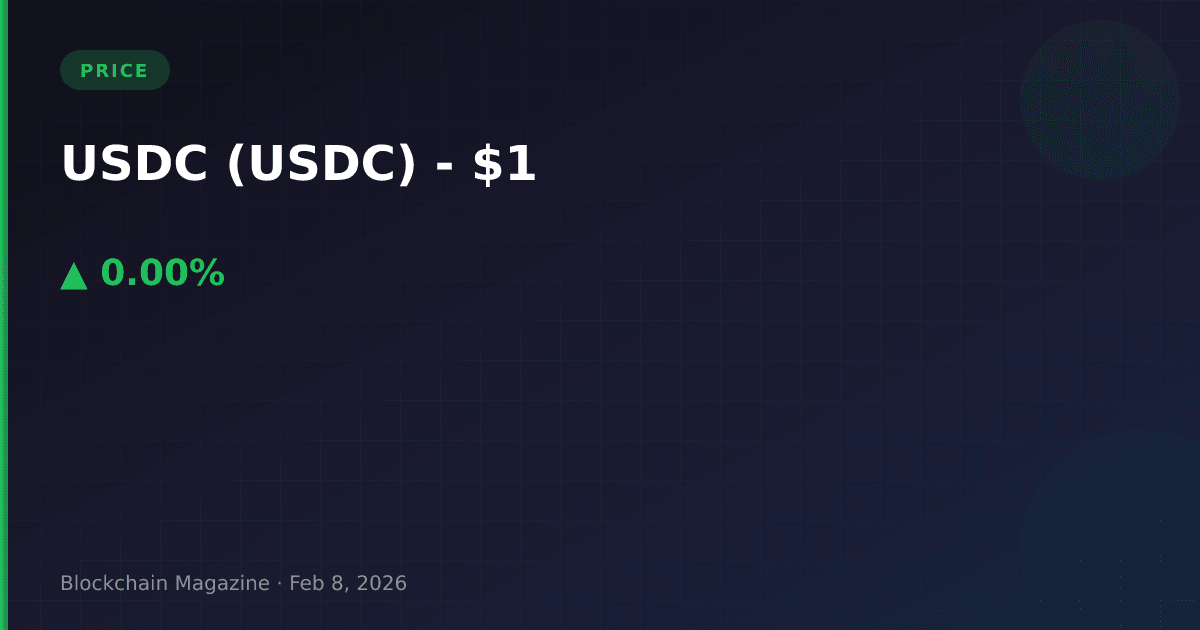
USD Coin (USDC) is currently trading at $0.999824, maintaining exceptional stability as one of the world’s leading fiat-backed stablecoins. With a market capitalization of $72.84 billion, USDC ranks as the 6th largest cryptocurrency globally, demonstrating its critical role in the digital asset ecosystem. The 24-hour trading volume of $4.62 billion reflects sustained institutional and retail adoption across decentralized finance (DeFi) protocols, cryptocurrency exchanges, and payment platforms.
The minimal price fluctuations observed—+0.00% in 24 hours, +0.02% over 7 days, and +0.00% across 30 days—underscore USDC’s fundamental design as a 1:1 USD-pegged stablecoin. Unlike volatile cryptocurrencies, USDC’s value proposition centers on price stability, transparency, and regulatory compliance. Issued by Circle Internet Financial in partnership with Coinbase, each USDC token is fully backed by cash and short-duration U.S. Treasury bonds, with monthly attestation reports from independent accounting firms. The circulating supply of 72.86 billion USDC with an unlimited maximum supply allows the token to scale dynamically with market demand, making it an essential liquidity instrument for traders, businesses, and blockchain applications worldwide.
Technical Overview & Market Performance
USDC’s technical architecture distinguishes it as a premier stablecoin within the cryptocurrency market. Built initially on the Ethereum blockchain as an ERC-20 token, USDC has expanded to 15+ blockchain networks including Solana, Avalanche, Polygon, Arbitrum, and Optimism, enabling fast and cost-effective cross-chain transfers. This multi-chain infrastructure positions USDC as the preferred stablecoin for DeFi applications, with over $30 billion locked in various protocols for lending, borrowing, yield farming, and liquidity provision.
The token’s historical price range reveals the resilience of its peg mechanism. USDC achieved its all-time high of $1.17 during periods of extreme market volatility when demand for stable assets surged, while its all-time low of $0.877647 occurred during the March 2023 banking crisis when Silicon Valley Bank—one of Circle’s banking partners—temporarily faced solvency concerns. However, USDC’s peg recovered within days, demonstrating robust reserve management. Current technical indicators show minimal volatility with Bollinger Bands tightly compressed around the $1.00 mark, RSI hovering near neutral (50), and virtually no directional momentum. The 50-day and 200-day moving averages converge at $0.9998, confirming price stability. For traders, USDC serves primarily as a safe-haven asset during market downturns and a settlement currency for crypto-to-crypto trading pairs across hundreds of exchanges.
USDC Price Prediction: Data-Driven Forecast 2024-2030
Predicting the price of USDC differs fundamentally from forecasting volatile cryptocurrencies because its core function is maintaining a stable $1.00 peg. Rather than anticipating price appreciation, USDC price forecasts focus on peg stability, adoption metrics, and regulatory developments. Based on current market dynamics and historical performance data, USDC is expected to maintain its $0.995-$1.005 trading range throughout 2024 and beyond, with brief deviations only during systemic market stress events.
2024 Forecast: USDC’s circulating supply is projected to reach $85-100 billion by year-end as institutional adoption accelerates. The passage of comprehensive stablecoin legislation in the United States could significantly boost confidence, potentially expanding market cap to challenge Tether (USDT) for the top stablecoin position. Expected price range: $0.998-$1.002 under normal market conditions. Key growth drivers include Circle’s expansion into emerging markets, integration with traditional payment systems (Visa, Mastercard partnerships), and increased treasury management adoption by corporations seeking dollar-denominated digital cash alternatives.
2025-2027 Outlook: As central bank digital currencies (CBDCs) emerge, USDC is positioned to serve as a bridge between traditional finance and blockchain ecosystems. Analysts project market cap growth to $120-150 billion by 2026, driven by cross-border payment solutions and institutional DeFi participation. The price will remain anchored at $1.00 (±0.3%) as Circle’s reserve management becomes increasingly sophisticated. Potential risks include regulatory crackdowns on stablecoins or competitive pressure from bank-issued digital dollars, which could impact market share but not significantly alter price stability.
2028-2030 Long-Term Forecast: USDC’s role in the global financial system is expected to mature significantly, with potential circulating supply exceeding $200 billion. Price stability mechanisms will likely evolve with algorithmic rebalancing and real-time attestation systems. Barring catastrophic regulatory changes or reserve backing failures, USDC will continue trading within $0.997-$1.003. The focus for investors shifts from price speculation to utility maximization—using USDC for yield generation (currently 4-5% APY in various DeFi protocols), remittances, and portfolio diversification. The stablecoin’s success will be measured not by price growth but by transaction volume, merchant adoption, and integration depth across financial infrastructure.
How to Buy USDC: Step-by-Step Guide
Purchasing USDC is straightforward across multiple platforms. For beginners: Create an account on major exchanges like Coinbase, Binance, Kraken, or Crypto.com. Complete KYC verification by submitting identification documents. Deposit USD via bank transfer, debit card, or wire transfer. Navigate to the USDC trading pair (USD/USDC) and exchange at a 1:1 ratio with minimal fees (typically 0.1-0.5%).
For advanced users: Use decentralized exchanges (DEXs) like Uniswap or Curve Finance to swap other cryptocurrencies for USDC directly from your wallet. Connect a Web3 wallet (MetaMask, Trust Wallet), select USDC, enter the amount, and confirm the transaction. DeFi platforms often offer better rates for large conversions. Always withdraw USDC to a self-custody wallet (hardware wallets like Ledger/Trezor recommended) for maximum security rather than keeping funds on exchanges long-term.
Frequently Asked Questions About USDC
Is USDC a good investment in 2024?
USDC is not designed for price appreciation but as a stable store of value and medium of exchange. It’s ideal for preserving capital during crypto market volatility, earning yield through DeFi staking (4-5% APY), or facilitating transactions. Investors seeking stability over speculation will find USDC valuable, but those looking for growth should consider other cryptocurrencies. The stablecoin’s strength lies in its regulatory compliance, full reserve backing, and widespread adoption across 450+ exchanges and thousands of DeFi protocols.
What is the difference between USDC and USDT?
While both are USD-pegged stablecoins, USDC offers greater transparency and regulatory compliance. Circle publishes monthly attestation reports from Grant Thornton LLP verifying 1:1 reserve backing with cash and U.S. Treasuries. USDT (Tether) has faced historical scrutiny over reserve composition. USDC operates under U.S. regulatory frameworks with BitLicense approval, making it preferred by institutions. However, USDT has larger market cap ($100B+) and slightly higher liquidity on certain exchanges. For risk-averse users prioritizing transparency, USDC is generally recommended.
Can USDC lose its $1 peg permanently?
While theoretically possible, a permanent de-pegging is highly unlikely due to USDC’s robust reserve structure and regulatory oversight. The March 2023 temporary de-peg to $0.88 during the SVB crisis resolved within 48 hours as Circle confirmed full backing and diversified banking partners. Unlike algorithmic stablecoins (e.g., UST collapse), USDC maintains verifiable 1:1 fiat reserves. Risks exist if Circle faced insolvency or regulatory seizure of reserves, but monthly audits and separation of customer funds minimize this probability. For maximum safety, diversify across multiple stablecoins (USDC, USDT, DAI).
How does USDC make money and generate yield?
USDC holders can earn passive income by depositing tokens into DeFi lending protocols like Aave, Compound, or Maple Finance, where borrowers pay interest (currently 3-6% APY depending on platform and market conditions). Centralized platforms like Coinbase offer USDC rewards (1-5% APY) by lending your balance to institutional borrowers. Circle itself generates revenue by investing reserve assets in short-term U.S. Treasuries, earning interest while maintaining liquidity. Always verify platform security and understand smart contract risks before deploying USDC for yield generation.
What are the best wallets to store USDC safely?
For maximum security, use hardware wallets like Ledger Nano X or Trezor Model T, which store private keys offline and support USDC across multiple blockchains (Ethereum, Solana, Polygon). Software wallets like MetaMask, Trust Wallet, or Coinbase Wallet offer convenience for active trading with decent security through encryption and biometric authentication. For institutional amounts, consider multi-signature wallets (Gnosis Safe) requiring multiple approvals for transactions. Never store large USDC balances on exchanges long-term due to hacking risks. Enable two-factor authentication (2FA) and regularly backup recovery phrases in secure, offline locations.
Stay informed with daily updates from Blockchain Magazine on Google News. Click here to follow us and mark as favorite: [Blockchain Magazine on Google News].
Disclaimer
Blockchain Magazine publishes content submitted by third-party agencies, partners, and clients. Any such posts are categorized and tagged accordingly:
- Sponsored Content: Posts labeled as "Sponsored" are paid placements submitted by third-party agencies or clients. Blockchain Magazine does not endorse or express any views regarding the information contained in these posts. The opinions expressed belong solely to the respective authors and do not reflect the official policy or position of Blockchain Magazine.
- Press Releases: Posts labeled as "Press Release" are paid PR submissions provided by our partners and clients. These are published as received and should be considered as promotional content.
The information provided in such posts is strictly for informational purposes only and should not be interpreted as financial, investment, or professional advice. Blockchain Magazine does not recommend, endorse, or promote any specific products, services, or companies mentioned. Readers are strongly encouraged to conduct independent research and consult with a qualified professional before making any financial or investment decisions.
Additionally, all featured images accompanying such posts are intended as creative depictions of the subject matter. There is no intent to offend or misrepresent any individual, institution, or entity. If any content or imagery is found to be objectionable, please reach out to us at [email protected], and we will promptly review the concern.
About the Author: Editors Desk



Get Blockchain Insights In Inbox
Stay ahead of the curve with expert analysis and market updates.