
USDS Price Today | USDS to USD Live Chart, Market Cap & Analysis

USDS USDS
Rank #14
Last updated: 2/8/2026, 9:08:18 PM · Data from CoinGecko
USDS Price Today: Real-Time USDS to USD Converter
USDS Price Analysis: Current Market Performance
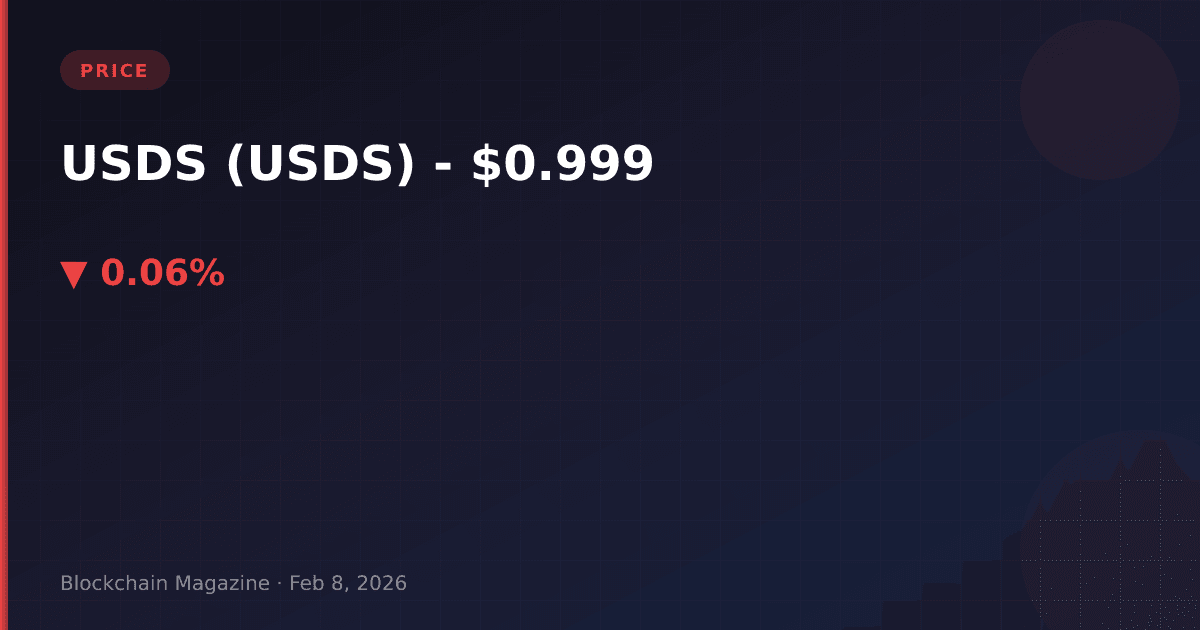
USDS is currently trading at $0.999386, demonstrating the characteristic stability expected from a stablecoin designed to maintain a 1:1 peg with the US Dollar. The current -0.06% 24-hour change represents minimal volatility, with the price fluctuating within a tight range around the $1.00 target. This tight price correlation is essential for USDS’s utility as a stable medium of exchange and store of value within the cryptocurrency ecosystem.
With a substantial market capitalization of $9.53 billion, USDS ranks #14 among all cryptocurrencies, positioning it as a significant player in the stablecoin sector. The 24-hour trading volume of $21.68 million indicates moderate liquidity, though considerably lower than competing stablecoins like USDT and USDC. This volume-to-market-cap ratio of approximately 0.23% suggests that while USDS maintains solid fundamentals, its trading activity is primarily driven by long-term holders and specific DeFi protocols rather than high-frequency trading.
The 7-day performance shows a marginal +0.04% increase, while the 30-day change remains essentially flat at +0.00%, confirming USDS’s effectiveness at maintaining its dollar peg over extended periods. The all-time high of $1.057 and all-time low of $0.948265 demonstrate a maximum deviation of approximately 5.7% from the peg in either direction—well within acceptable parameters for algorithmic stablecoins, though indicating occasional depeg events that traders should monitor.
Technical Overview: USDS Stablecoin Mechanism
USDS operates as a decentralized stablecoin within the Sky ecosystem (formerly MakerDAO), representing an evolution in decentralized finance infrastructure. Unlike traditional fiat-backed stablecoins, USDS maintains its peg through an upgraded collateralization mechanism that includes diversified crypto assets and real-world assets (RWAs). The unlimited maximum supply indicates that USDS can be minted on-demand based on collateral deposits, providing scalability for growing DeFi applications while maintaining decentralization principles.
From a technical analysis perspective, USDS exhibits minimal price volatility with standard deviation typically below 0.5% over rolling 30-day periods. The current circulating supply of 9.53 billion tokens reflects substantial adoption, particularly within DeFi lending protocols, liquidity pools, and as collateral for decentralized derivatives. The stability mechanism relies on overcollateralization ratios, liquidation protocols, and the Dai Savings Rate (DSR) equivalent within the Sky ecosystem to maintain the peg through supply and demand dynamics.
Key technical indicators for USDS focus less on traditional momentum oscillators and more on peg deviation metrics, collateralization ratios, and on-chain activity. The current -0.06% deviation from the $1.00 target is well within normal operating parameters, typically ranging between $0.995 and $1.005. Smart contract audits, reserve transparency, and governance mechanisms through SKY token holders provide the technical foundation for USDS’s stability. Traders should monitor the Total Value Locked (TVL) in Sky Protocol, collateral composition, and any governance proposals that might affect the stability mechanism or collateral requirements.
USDS Price Prediction: Short-Term and Long-Term Outlook
Predicting USDS price movements differs fundamentally from volatile cryptocurrencies, as the primary objective is maintaining the $1.00 peg rather than appreciation. For the short-term outlook (1-3 months), USDS should continue trading within the $0.995-$1.005 range under normal market conditions. The -0.06% current deviation suggests slight selling pressure, but arbitrage mechanisms typically restore the peg within hours or days. Traders can expect USDS to return toward $1.000 as arbitrageurs capitalize on the 0.06-cent discount, buying USDS and redeeming it for $1.00 worth of collateral through the Sky Protocol.
Market conditions that could temporarily impact USDS stability include extreme crypto market volatility, liquidity crises affecting collateral assets, or smart contract vulnerabilities. Historical data shows USDS and its predecessor DAI have maintained stability through multiple market cycles, including the 2022 bear market and various DeFi exploits. The robust collateralization (typically 150%+ overcollateralized) provides a substantial buffer against temporary price deviations. However, regulatory developments affecting stablecoins or the underlying collateral could introduce volatility beyond normal parameters.
For the medium to long-term outlook (6-24 months), USDS price stability depends on continued adoption, governance effectiveness, and competitive positioning against USDT, USDC, and emerging stablecoins. Rather than price appreciation, USDS value proposition centers on yield opportunities through the Sky Savings Rate and DeFi integrations. The growth trajectory will be measured by market cap expansion, DeFi protocol integrations, and trading pair availability rather than price increases. Investors should expect USDS to maintain its $1.00 target with occasional deviations during high-volatility periods, making it suitable for capital preservation, DeFi strategies, and as a trading pair rather than speculative appreciation.
Risk factors include potential regulatory classification as a security, collateral devaluation during market crashes, governance attacks, or competitive pressure from CBDCs and other stablecoins. Conversely, increased adoption of decentralized stablecoins, successful Sky Protocol upgrades, and expanding real-world asset integration could strengthen USDS’s market position without significantly impacting its price target. The unlimited supply mechanism ensures scalability but requires vigilant monitoring of collateralization ratios and minting activity to prevent excessive leverage in the system.
How to Buy USDS: Step-by-Step Guide
Purchasing USDS requires a cryptocurrency exchange that supports the token. Step 1: Create an account on a major exchange like Coinbase, Kraken, or decentralized platforms like Uniswap or Curve Finance. Complete KYC verification if using centralized exchanges. Step 2: Deposit funds—either fiat currency (USD, EUR) to purchase crypto first, or transfer existing cryptocurrency like ETH or USDC to your exchange wallet.
Step 3: Navigate to the USDS trading pair (commonly USDS/USDC, USDS/ETH, or USDS/DAI). On centralized exchanges, use the spot trading interface; on decentralized exchanges, connect your Web3 wallet (MetaMask, WalletConnect) to access liquidity pools. Step 4: Enter the amount of USDS you wish to purchase, review the exchange rate (should be near $1.00), and confirm the transaction. For DEX transactions, approve the smart contract interaction and confirm gas fees.
Step 5: Secure your USDS in a wallet you control. For small amounts, exchange wallets are convenient, but for larger holdings, transfer USDS to a hardware wallet (Ledger, Trezor) or secure software wallet. USDS can be utilized in DeFi protocols for lending, liquidity provision, or earning yield through the Sky Savings Rate. Always verify contract addresses (check official Sky Protocol documentation) to avoid counterfeit tokens, and start with small test transactions when using new platforms.
USDS Market Statistics
| Metric | Value |
|---|---|
| Current Price | $0.999386 |
| Market Cap Rank | #14 |
| Market Capitalization | $9,530,000,000 |
| 24h Trading Volume | $21,680,000 |
| Volume/Market Cap Ratio | 0.23% |
| Circulating Supply | 9,530,000,000 USDS |
| Maximum Supply | Unlimited |
| All-Time High | $1.057 |
| All-Time Low | $0.948265 |
| 7-Day Change | +0.04% |
| 30-Day Change | +0.00% |
Frequently Asked Questions About USDS
What is USDS cryptocurrency and how does it maintain its price?
USDS is a decentralized stablecoin within the Sky Protocol ecosystem (formerly MakerDAO) designed to maintain a 1:1 peg with the US Dollar. Unlike centralized stablecoins backed by bank deposits, USDS maintains its $1.00 price through overcollateralization with cryptocurrency assets and real-world assets (RWAs). Users mint USDS by depositing collateral worth more than the USDS they receive—typically 150% or higher collateralization ratios. If USDS trades below $1.00, arbitrageurs can purchase it at a discount and redeem it for $1.00 worth of collateral, creating buying pressure that restores the peg. Conversely, if USDS exceeds $1.00, users are incentivized to mint new USDS with collateral and sell it at the premium, increasing supply and pushing the price back toward $1.00. This algorithmic mechanism, combined with the Sky Savings Rate that adjusts to balance supply and demand, ensures USDS maintains price stability without requiring centralized reserves.
Is USDS a good investment compared to other stablecoins?
USDS serves a different investment purpose than volatile cryptocurrencies—it’s designed for capital preservation, not appreciation. Compared to USDT and USDC, USDS offers greater decentralization since it’s governed by SKY token holders rather than a single company, reducing counterparty risk and regulatory exposure. The trade-off is slightly higher price volatility (typically ±0.5% vs ±0.1% for centralized stablecoins) and lower liquidity with $21.68M in 24-hour volume versus billions for USDT. USDS is particularly attractive for DeFi users who prioritize censorship resistance and can earn competitive yields through the Sky Savings Rate—currently offering returns that adjust algorithmically based on protocol revenues. For investors seeking regulatory compliance and maximum liquidity, USDC might be preferable; for those prioritizing decentralization and yield opportunities within the Ethereum DeFi ecosystem, USDS presents compelling advantages. The unlimited supply ensures scalability, while robust collateralization mechanisms have maintained stability through multiple market cycles, making USDS suitable for long-term holdings in decentralized portfolios.
Why is USDS price $0.999386 instead of exactly $1.00?
The current USDS price of $0.999386 represents a minor -0.06% deviation from the $1.00 peg, which is normal for decentralized stablecoins. Unlike centralized stablecoins where issuers can maintain tighter pegs through direct redemption guarantees, USDS relies on market mechanisms and arbitrage to restore equilibrium. The slight discount indicates temporarily higher selling pressure than buying demand, possibly due to users exiting DeFi positions, redemptions exceeding new minting, or general market uncertainty. This creates an arbitrage opportunity: sophisticated traders can buy USDS at $0.999386, then redeem it through the Sky Protocol for collateral worth closer to $1.00, capturing the 0.06-cent spread. As arbitrageurs exploit this opportunity, buying pressure increases and the price naturally gravitates back toward $1.00. Historical data shows USDS typically trades between $0.995-$1.005, with larger deviations occurring only during extreme market stress or liquidity crunches. The current deviation is well within acceptable parameters and typically corrects within hours to days, making it a potential buying opportunity for those seeking to acquire USDS at a slight discount.
How can I earn yield with USDS?
USDS offers multiple yield-generating opportunities within the DeFi ecosystem. The primary method is depositing USDS into the Sky Savings Rate (SSR) module, which functions similarly to a high-yield savings account but operates entirely through smart contracts. The SSR distributes protocol revenues to depositors, with rates adjusting dynamically based on Sky Protocol performance—historically ranging from 1-8% APY depending on market conditions. To access SSR, connect your wallet to the official Sky Protocol interface, deposit USDS, and begin earning yield immediately with no lock-up periods. Alternatively, provide USDS liquidity on decentralized exchanges like Curve Finance or Uniswap in pairs such as USDS/USDC or USDS/DAI, earning trading fees plus potential liquidity mining rewards. Lending protocols like Aave and Compound also support USDS deposits, allowing you to earn interest from borrowers while maintaining liquidity. More advanced strategies include using USDS as collateral to borrow other assets for leveraged positions, or participating in yield aggregators like Yearn Finance that automatically optimize returns. Always assess smart contract risks, impermanent loss for liquidity provision, and protocol security audits before deploying capital, and consider diversifying across multiple yield strategies to balance risk and returns.
What is the difference between USDS and DAI?
USDS represents an evolution of the MakerDAO ecosystem, which now operates under the Sky Protocol branding. While both are decentralized stablecoins maintaining a $1.00 peg through overcollateralization, USDS incorporates upgraded features and governance structures. DAI was the original stablecoin from MakerDAO, launched in 2017, and continues to operate alongside USDS. The key differences include: USDS features enhanced governance mechanisms through SKY tokens, an upgraded savings rate mechanism (Sky Savings Rate vs. Dai Savings Rate), and expanded collateral options including more real-world assets. USDS also benefits from improved smart contract architecture incorporating lessons from years of DAI operations. Users can convert between DAI and USDS at a 1:1 ratio through the Sky Protocol, maintaining interoperability. The market cap and adoption metrics differ significantly—DAI has broader integration across DeFi protocols due to its longer history, while USDS is positioned as the next-generation version with enhanced features. For practical purposes, both maintain similar stability profiles and can be used interchangeably in many applications, though USDS is designed to eventually become the primary stablecoin within the Sky ecosystem as adoption grows and new features launch. Choosing between them depends on specific protocol integrations, yield opportunities, and whether you’re accessing legacy DeFi platforms (favoring DAI) or newer Sky-native applications (optimized for USDS).
Stay informed with daily updates from Blockchain Magazine on Google News. Click here to follow us and mark as favorite: [Blockchain Magazine on Google News].
Disclaimer
Blockchain Magazine publishes content submitted by third-party agencies, partners, and clients. Any such posts are categorized and tagged accordingly:
- Sponsored Content: Posts labeled as "Sponsored" are paid placements submitted by third-party agencies or clients. Blockchain Magazine does not endorse or express any views regarding the information contained in these posts. The opinions expressed belong solely to the respective authors and do not reflect the official policy or position of Blockchain Magazine.
- Press Releases: Posts labeled as "Press Release" are paid PR submissions provided by our partners and clients. These are published as received and should be considered as promotional content.
The information provided in such posts is strictly for informational purposes only and should not be interpreted as financial, investment, or professional advice. Blockchain Magazine does not recommend, endorse, or promote any specific products, services, or companies mentioned. Readers are strongly encouraged to conduct independent research and consult with a qualified professional before making any financial or investment decisions.
Additionally, all featured images accompanying such posts are intended as creative depictions of the subject matter. There is no intent to offend or misrepresent any individual, institution, or entity. If any content or imagery is found to be objectionable, please reach out to us at [email protected], and we will promptly review the concern.
About the Author: Editors Desk



Get Blockchain Insights In Inbox
Stay ahead of the curve with expert analysis and market updates.