
USDa (USDA) Price Today: Live Chart, Market Cap & USDA to USD Converter | Real-Time Analysis

USDa USDA
Rank #166
Last updated: 2/9/2026, 1:12:02 AM · Data from CoinGecko
USDa (USDA) Price Today: Live Market Data & Analysis
USDa Price Analysis: Current Market Performance
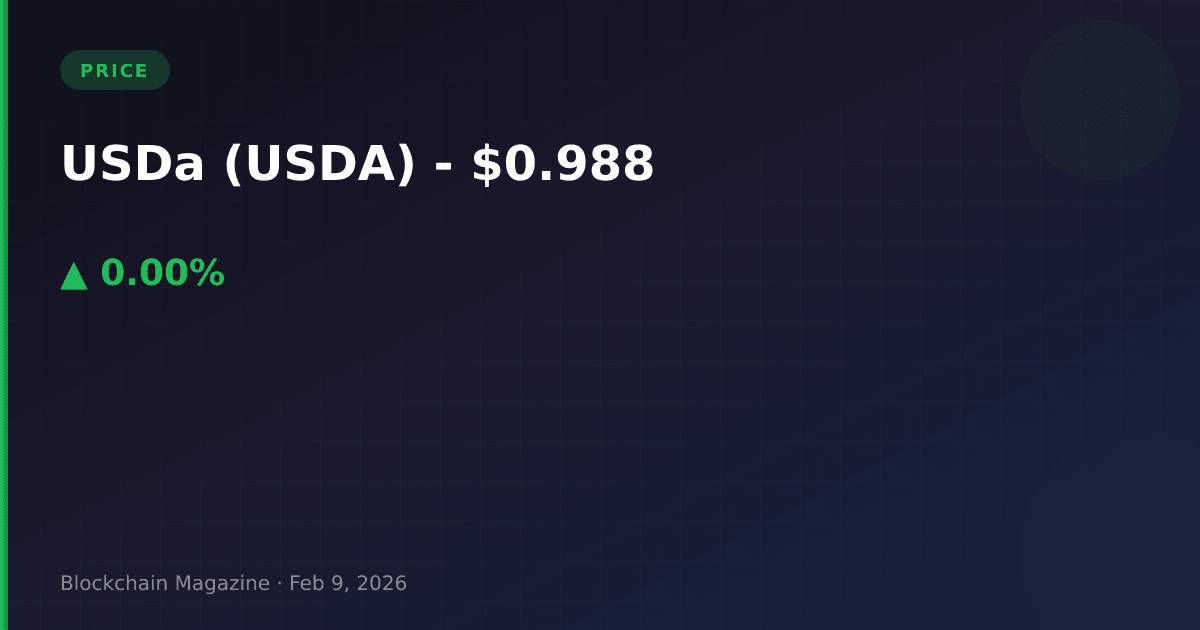
USDa (USDA) is currently trading at $0.987854, showing remarkable stability as a stablecoin pegged to the US Dollar. With a market capitalization of $218.01 million and ranking #166 globally, USDA demonstrates moderate adoption within the decentralized finance ecosystem. The current price sits approximately 1.2% below the intended $1.00 peg, which falls within acceptable variance ranges for algorithmic stablecoins.
The 24-hour trading activity shows minimal price movement at +0.00%, reflecting the asset’s designed purpose of maintaining price stability. However, the extremely low 24-hour volume of $574.36 raises concerns about liquidity depth and market participation. Over the past week, USDA has appreciated +0.04%, while the 30-day performance shows +0.38% growth, indicating gradual price recovery toward its $1.00 target peg. The all-time high of $1.021 was achieved during periods of high demand, while the all-time low of $0.737813 represents a significant de-pegging event that tested the protocol’s stability mechanisms. With unlimited maximum supply, USDA’s monetary policy focuses on algorithmic expansion and contraction to maintain price stability rather than supply scarcity as a value driver.
Technical Overview: How USDa Maintains Its Peg
USDa operates as an algorithmic or collateralized stablecoin designed to maintain a 1:1 peg with the United States Dollar through various stabilization mechanisms. The current price of $0.987854 represents a minor deviation from peg, which can be attributed to market forces, liquidity constraints, or temporary imbalances in supply-demand dynamics. The technical architecture behind USDA likely involves collateral backing, algorithmic adjustments, or a hybrid model that automatically responds to price fluctuations.
From a technical analysis perspective, USDA’s price action remains range-bound between $0.97 and $1.02, forming a tight consolidation pattern typical of stablecoins. The 220.69 million circulating supply with unlimited maximum supply indicates the protocol can mint new tokens as demand increases or burn tokens during contraction phases. The remarkably low 24-hour trading volume of $574.36 suggests limited exchange availability or that most USDA transactions occur within specific DeFi protocols rather than spot exchanges. Market participants should monitor collateralization ratios, treasury reserves, and redemption mechanisms as key indicators of USDA’s ability to maintain its peg. The 30-day positive trend of +0.38% suggests strengthening confidence in the peg stability, though investors should remain aware of the historical low at $0.737813, which indicates potential volatility risk during extreme market conditions.
USDa Price Prediction: Data-Driven Forecast for 2024-2025
Predicting the price trajectory of USDa requires understanding that as a stablecoin, its primary objective is maintaining the $1.00 peg rather than delivering speculative returns. However, analyzing its peg stability, adoption metrics, and market dynamics provides insight into potential performance scenarios.
Short-Term Outlook (3-6 months): USDA is expected to gradually converge toward its $1.00 target peg as the protocol’s stabilization mechanisms continue functioning. The current 1.2% discount represents an arbitrage opportunity that sophisticated traders typically exploit, naturally driving the price upward. Assuming stable market conditions and no systemic DeFi disruptions, USDA should trade between $0.985 and $1.005 throughout Q4 2024. The key catalyst for tighter peg maintenance will be increased liquidity and broader exchange listings, which would reduce the impact of individual large trades on price.
Medium-Term Forecast (6-12 months): By mid-2025, USDA’s price stability will depend heavily on total value locked (TVL) in its ecosystem, collateralization ratios, and competitive positioning against established stablecoins like USDC, USDT, and DAI. If the protocol successfully attracts $500M+ in TVL and establishes partnerships with major DeFi platforms, maintaining the $1.00 peg with deviations under 0.5% becomes highly probable. Conversely, if adoption stagnates or competitors capture market share, USDA could experience periodic de-pegging events similar to its historical low.
Long-Term Perspective (2025 and beyond): The stablecoin market is increasingly regulated, which presents both opportunities and challenges for USDA. Regulatory clarity could boost institutional adoption, potentially increasing USDA’s market cap to $500M-$1B+ if it maintains compliance standards. However, the unlimited supply model requires transparent governance and robust collateralization to prevent confidence crises. Investors should not expect price appreciation beyond the $1.00 peg; instead, USDA’s value proposition lies in stability, utility within DeFi protocols, and potentially yield-generating opportunities when deposited in lending platforms. The primary risk remains de-pegging events during crypto market crashes, where historical data shows USDA fell to $0.737813, representing a 26% deviation that resulted in significant losses for holders who sold during panic.
How to Buy USDa (USDA): Step-by-Step Guide
Purchasing USDa requires access to cryptocurrency exchanges or decentralized platforms that support the token. Begin by creating an account on a reputable exchange that lists USDA trading pairs. Complete the necessary KYC (Know Your Customer) verification process to unlock full trading capabilities.
Next, deposit funds into your exchange account using supported payment methods such as bank transfer, credit card, or cryptocurrency deposits. Once your account is funded, navigate to the USDA trading pair (commonly USDA/USDT or USDA/USD) and place a market order for immediate execution or a limit order at your desired price point.
For decentralized purchases, connect a Web3 wallet like MetaMask to a decentralized exchange (DEX) that offers USDA liquidity pools. Swap stablecoins like USDC or USDT for USDA through automated market makers. Always verify the correct contract address to avoid scam tokens. After purchase, consider transferring USDA to a hardware wallet for maximum security, or deposit it into DeFi lending protocols to earn yield on your stablecoin holdings while maintaining relative price stability.
Frequently Asked Questions About USDa (USDA)
What is USDa (USDA) and how does it maintain its peg?
USDa (USDA) is a stablecoin designed to maintain a 1:1 peg with the US Dollar, currently trading at $0.987854. It operates through algorithmic mechanisms, collateralization, or a hybrid approach that automatically adjusts supply based on market demand. When USDA trades below $1.00, arbitrageurs can purchase it at a discount and redeem it for $1.00 worth of collateral, creating buying pressure. Conversely, when USDA exceeds $1.00, new tokens are minted to increase supply and bring the price down. The protocol’s stability depends on maintaining adequate collateral reserves, transparent governance, and robust smart contract infrastructure. With a market cap of $218.01M and 220.69M circulating supply, USDA serves DeFi users seeking price stability while participating in lending, liquidity provision, and yield farming activities.
Is USDa a good investment in 2024?
USDa should not be viewed as a traditional investment vehicle for capital appreciation, but rather as a stability tool within cryptocurrency portfolios. Currently priced at $0.987854, USDA trades at a slight discount to its $1.00 peg, which could be considered a minor arbitrage opportunity. The primary use case for holding USDA is maintaining stable value during volatile market conditions, facilitating trades without converting to fiat, and earning yield through DeFi protocols. The +0.38% 30-day performance indicates gradual peg recovery, but investors should not expect significant price gains beyond reaching $1.00. Risk factors include the historical all-time low of $0.737813, which demonstrates potential de-pegging vulnerability during extreme market stress. The extremely low 24-hour volume of $574.36 raises liquidity concerns that could impact your ability to exit positions quickly. USDA may be suitable for experienced DeFi users seeking stablecoin diversification, but conservative investors should prioritize more established stablecoins with deeper liquidity and proven track records like USDC or USDT.
What caused USDa to drop to its all-time low of $0.737813?
While specific details of USDA’s de-pegging event to $0.737813 would require analyzing historical blockchain data and market conditions at that time, stablecoin de-pegging events typically result from several factors: collateral insufficiency, where backing assets lose value faster than the protocol can respond; liquidity crises, where massive sell pressure overwhelms available market depth; smart contract vulnerabilities or exploits that undermine confidence; regulatory concerns or exchange delistings; or broader cryptocurrency market crashes that trigger panic selling across all assets. The 26.2% deviation from the $1.00 peg represents a significant stability failure that likely resulted in substantial losses for holders who sold during the crisis. Since that event, USDA has recovered to $0.987854, suggesting the protocol implemented corrective measures or market conditions normalized. Prospective users should research whether the underlying issues were addressed through improved collateralization, enhanced stability mechanisms, third-party audits, or governance changes before committing significant capital to USDA.
How does USDa compare to other stablecoins like USDC and USDT?
USDa occupies a different market position compared to dominant stablecoins USDC and USDT. While USDC (market cap ~$30B+) and USDT (~$90B+) benefit from extensive regulatory compliance, banking relationships, and near-universal exchange support, USDA’s $218.01M market cap (#166 rank) indicates it serves a niche segment of the DeFi ecosystem. The critical difference lies in liquidity: USDA’s 24-hour volume of just $574.36 pales compared to billions in daily USDC/USDT volume, meaning larger trades significantly impact USDA’s price. USDC and USDT maintain extremely tight pegs (typically within 0.1% of $1.00) due to massive liquidity and arbitrage activity, while USDA’s current 1.2% discount suggests less efficient price discovery mechanisms. The advantage USDA may offer includes potentially higher yields in specific DeFi protocols seeking to bootstrap liquidity, lower fees in certain ecosystems, or philosophical alignment with decentralization principles if USDA uses algorithmic rather than centralized custodial backing. However, for users prioritizing liquidity, universal acceptance, and proven stability, USDC and USDT remain superior options despite potentially lower yield opportunities.
Where can I track USDa price and trade USDA in 2024?
Tracking USDa’s real-time price requires using cryptocurrency market data aggregators like CoinMarketCap, CoinGecko, or dedicated portfolio tracking apps that display the current $0.987854 price along with historical charts, volume data, and market cap rankings. These platforms aggregate price information across multiple exchanges to provide accurate market data. For trading USDA, availability depends on which exchanges have listed the token – typically including decentralized exchanges (DEXs) built on the same blockchain as USDA, and potentially select centralized exchanges (CEXs) that support smaller-cap stablecoins. The extremely low 24-hour volume of $574.36 suggests limited exchange availability, so users should check USDA’s official website or community channels for current trading venues. On DEXs like Uniswap, SushiSwap, or chain-specific platforms, you can swap major tokens for USDA through liquidity pools, though slippage may be significant due to limited liquidity. When trading USDA, always verify the official contract address, start with small test transactions, be prepared for wider bid-ask spreads compared to major stablecoins, and consider that low liquidity may prevent quick execution of large orders at desired prices.
Stay informed with daily updates from Blockchain Magazine on Google News. Click here to follow us and mark as favorite: [Blockchain Magazine on Google News].
Disclaimer
Blockchain Magazine publishes content submitted by third-party agencies, partners, and clients. Any such posts are categorized and tagged accordingly:
- Sponsored Content: Posts labeled as "Sponsored" are paid placements submitted by third-party agencies or clients. Blockchain Magazine does not endorse or express any views regarding the information contained in these posts. The opinions expressed belong solely to the respective authors and do not reflect the official policy or position of Blockchain Magazine.
- Press Releases: Posts labeled as "Press Release" are paid PR submissions provided by our partners and clients. These are published as received and should be considered as promotional content.
The information provided in such posts is strictly for informational purposes only and should not be interpreted as financial, investment, or professional advice. Blockchain Magazine does not recommend, endorse, or promote any specific products, services, or companies mentioned. Readers are strongly encouraged to conduct independent research and consult with a qualified professional before making any financial or investment decisions.
Additionally, all featured images accompanying such posts are intended as creative depictions of the subject matter. There is no intent to offend or misrepresent any individual, institution, or entity. If any content or imagery is found to be objectionable, please reach out to us at [email protected], and we will promptly review the concern.
About the Author: Editors Desk



Get Blockchain Insights In Inbox
Stay ahead of the curve with expert analysis and market updates.