
Superstate Short Duration U.S. Government Securities Fund Price Today | USTB to USD Live Chart & Market Cap

Superstate Short Duration U.S. Government Securities Fund (USTB) USTB
Rank #71
Last updated: 2/8/2026, 10:41:59 PM · Data from CoinGecko
Superstate Short Duration U.S. Government Securities Fund (USTB) Price
USTB Price Analysis Today
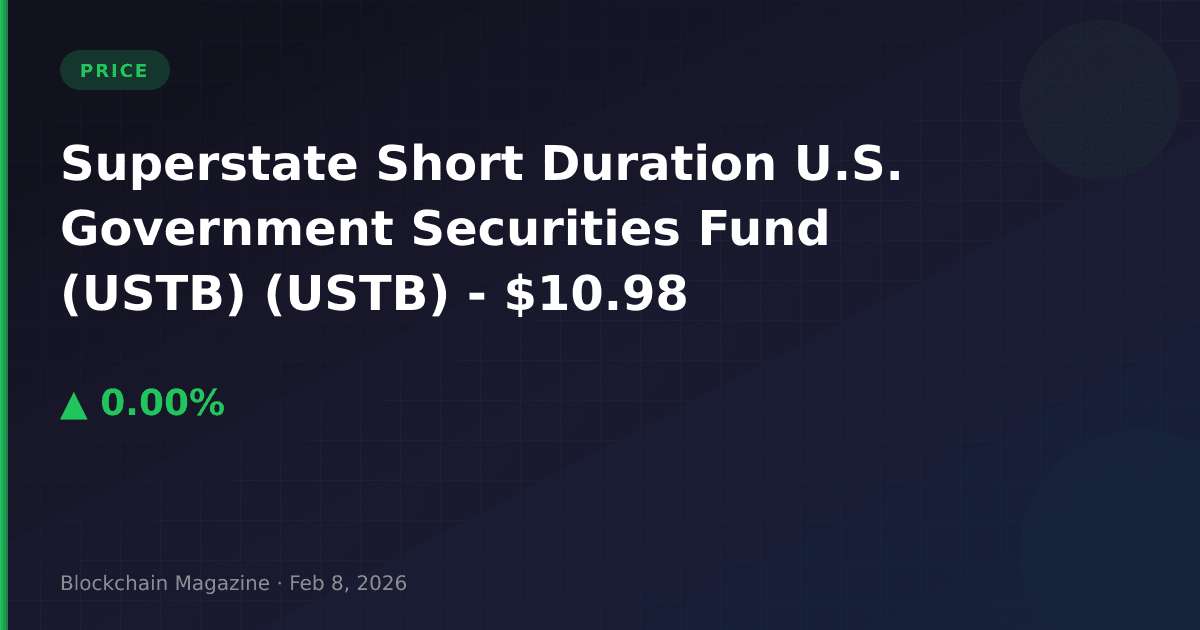
The Superstate Short Duration U.S. Government Securities Fund (USTB) is currently trading at $10.98 USD, maintaining remarkable price stability characteristic of tokenized U.S. government securities. With a market capitalization of $936.52 million, USTB ranks #71 among all cryptocurrencies, representing a significant institutional presence in the tokenized real-world assets (RWA) sector.
Over the past 24 hours, USTB has shown a negligible change of +0.00%, reflecting its nature as a stable, yield-bearing tokenized security backed by short-duration U.S. Treasury bills and government securities. The 7-day performance shows a modest gain of +0.07%, while the 30-day trajectory reveals a +0.27% appreciation, demonstrating consistent value accrual aligned with short-term Treasury yields.
Currently trading at its all-time high of $10.98, USTB has appreciated approximately 6.7% from its all-time low of $10.29. This upward trajectory reflects the accumulation of yield distributions and the fund’s performance tracking short-duration government securities. The circulating supply stands at 85.28 million USTB tokens with an unlimited maximum supply, allowing the fund to scale according to investor demand while maintaining its peg to the underlying asset value.
The absence of 24-hour trading volume ($0.00) suggests that USTB operates primarily through authorized participants and institutional channels rather than open-market secondary trading, typical of tokenized securities funds with regulated distribution mechanisms.
Technical Overview and Market Metrics
USTB represents a pioneering approach to blockchain-based investment products, offering exposure to U.S. government securities through tokenization. Unlike traditional stablecoins that maintain a fixed $1.00 peg, USTB’s price appreciates gradually over time as it accumulates yield from its underlying portfolio of short-duration U.S. Treasury securities, similar to a traditional money market fund’s net asset value (NAV).
The token’s technical infrastructure is built on blockchain technology, enabling 24/7 settlement, transparent on-chain verification of holdings, and programmable compliance features. This structure provides institutional investors with the benefits of traditional fixed-income securities combined with the efficiency and accessibility of digital assets.
From a market positioning perspective, USTB’s $936.52 million market cap places it among the largest tokenized Treasury products in the cryptocurrency ecosystem. The fund’s ranking at #71 reflects growing institutional adoption of blockchain-based securities, competing directly with other tokenized Treasury products while offering distinct advantages in terms of regulatory compliance and operational transparency.
The price stability within a narrow range (ATH: $10.98, ATL: $10.29) demonstrates effective portfolio management and risk mitigation. The 30-day gain of +0.27% translates to an annualized yield approximation, though actual returns vary based on the underlying Treasury securities’ performance and prevailing interest rate environments. Technical indicators for USTB focus less on momentum or volatility metrics and more on tracking error relative to comparable Treasury indices and yield curve positioning.
USTB Price Prediction and Future Outlook
Predicting the price trajectory for USTB requires a fundamentally different analytical framework compared to speculative cryptocurrencies. As a tokenized securities fund backed by U.S. government debt instruments, USTB’s price movements correlate directly with short-term Treasury yields, Federal Reserve monetary policy, and the fund’s operational efficiency rather than market sentiment or technical chart patterns.
Short-term outlook (3-6 months): USTB’s price is expected to continue its gradual appreciation trajectory, with projected values reaching approximately $11.03-$11.08 by Q2 2025. This forecast assumes current Federal Reserve interest rate policy remains relatively stable, with short-term Treasury yields maintaining levels between 4.25%-4.75%. The fund’s design to distribute accrued interest through NAV appreciation means each day’s yield contribution compounds into the token price, creating a predictable upward slope absent of significant interest rate disruptions.
Medium-term outlook (6-12 months): Looking toward late 2025, USTB could trade in the $11.10-$11.25 range, assuming normalized monetary policy conditions. This projection incorporates potential Federal Reserve rate adjustments, which could either compress or expand yields depending on economic conditions. If the Fed implements rate cuts as some analysts anticipate, short-term yields may decline, moderating USTB’s appreciation rate. Conversely, persistent inflation requiring sustained higher rates would benefit USTB holders through enhanced yield accrual.
Long-term outlook (1-2 years): By 2026-2027, USTB’s value could reach $11.35-$11.60, representing cumulative yield accumulation over the period. However, this projection carries significant uncertainty tied to macroeconomic variables including inflation trajectories, fiscal policy decisions, and global economic growth patterns. The tokenized Treasury sector is also experiencing rapid innovation and competition, which could influence USTB’s market share and operational dynamics.
Key factors influencing USTB price: Federal Reserve interest rate decisions remain the primary driver, with each 25 basis point adjustment in short-term rates directly impacting the underlying portfolio’s yield. Regulatory developments surrounding tokenized securities could enhance or constrain adoption. Growing institutional acceptance of blockchain-based financial products may drive increased demand, expanding the circulating supply while maintaining stable per-token pricing. Competitive pressure from alternative tokenized Treasury products could impact fee structures and net yields delivered to token holders.
How to Buy USTB
Purchasing USTB differs from acquiring typical cryptocurrencies due to its regulated securities nature. Investors typically access USTB through authorized financial platforms and qualified custodians that have integrated Superstate’s distribution infrastructure. The process generally requires completing KYC (Know Your Customer) verification and meeting accredited investor criteria depending on jurisdiction.
To buy USTB: (1) Register with a platform supporting USTB, such as institutional crypto custody services or integrated brokerage platforms. (2) Complete identity verification and investor qualification processes, which may include accreditation verification for U.S. investors. (3) Fund your account with USD or stablecoins, depending on the platform’s accepted deposit methods. (4) Execute a purchase order for USTB at the current NAV price. (5) Store USTB in a compatible wallet or institutional custody solution that supports tokenized securities with proper compliance features.
Note that USTB is designed primarily for institutional investors and qualified purchasers, with minimum investment thresholds and holding requirements that may apply. Always consult with financial and tax advisors before investing in tokenized securities products.
Live USTB Market Data
About Superstate Short Duration U.S. Government Securities Fund
The Superstate Short Duration U.S. Government Securities Fund (USTB) represents an innovative intersection of traditional finance and blockchain technology, offering investors exposure to U.S. government securities through tokenized fund shares. Developed by Superstate, a registered investment adviser, USTB provides institutional-grade access to short-duration Treasury securities with the operational advantages of blockchain infrastructure.
The fund invests exclusively in U.S. Treasury bills, government agency securities, and repurchase agreements backed by U.S. government collateral, maintaining a portfolio duration typically under one year. This conservative investment mandate provides capital preservation with yield generation, positioning USTB as a cash-equivalent alternative for digital asset investors seeking stable, yield-bearing instruments.
Key differentiators include regulatory compliance as a registered fund, transparent on-chain verification of net asset value, programmable compliance features enabling automated regulatory reporting, and seamless integration with DeFi protocols while maintaining traditional securities law compliance. USTB’s structure addresses institutional requirements for legal clarity, custody standards, and investor protections while delivering the efficiency benefits of blockchain technology.
Investment Considerations for USTB
Advantages: USTB offers several compelling benefits for institutional investors. The fund provides exposure to U.S. government securities with superior liquidity compared to traditional fund structures, enabling 24/7 tokenized settlement. Yield generation occurs automatically through NAV appreciation, eliminating distribution complexity. The blockchain infrastructure enables transparent verification of holdings and real-time NAV calculation. Regulatory compliance provides legal clarity superior to unregulated stablecoins. Integration capabilities with institutional custody and compliance systems facilitate operational efficiency.
Risks: Investors should consider several risk factors. Interest rate risk affects the underlying portfolio, with rising rates potentially creating mark-to-market losses on existing holdings, though short duration limits this exposure. Regulatory uncertainty surrounding tokenized securities could impact operational flexibility or market access. Smart contract risks exist despite auditing, with potential technical vulnerabilities in the tokenization infrastructure. Liquidity constraints may emerge during market stress, particularly given limited secondary market trading. Opportunity cost considerations arise when Treasury yields decline, reducing the fund’s attractiveness relative to alternative investments.
Ideal investor profile: USTB suits institutional investors, corporate treasuries managing digital asset holdings, crypto-native organizations seeking yield on stable assets, and qualified purchasers requiring short-term cash management solutions with blockchain integration. The product is particularly relevant for entities operating in the digital asset ecosystem who require regulatory-compliant, yield-bearing cash alternatives without converting back to traditional banking infrastructure.
Frequently Asked Questions
What is USTB cryptocurrency and how does it work?
USTB is not a traditional cryptocurrency but rather a tokenized securities fund representing shares in the Superstate Short Duration U.S. Government Securities Fund. Each USTB token represents a proportional interest in a portfolio of short-duration U.S. Treasury securities and government-backed instruments. Unlike fixed-value stablecoins, USTB’s price appreciates gradually over time as it accumulates yield from the underlying Treasury portfolio, similar to how a money market fund’s NAV increases. The fund is structured as a registered investment product with regulatory compliance, offering institutional investors blockchain-based access to government securities with transparent on-chain verification and 24/7 settlement capabilities.
Is USTB a good investment in 2025?
USTB serves a specific investment objective as a cash-equivalent, yield-bearing instrument rather than a growth investment. For 2025, USTB’s attractiveness depends on prevailing interest rate environments and investor objectives. With current short-term Treasury yields remaining elevated by historical standards, USTB provides competitive yield (approximately 4-5% annualized based on recent performance) with minimal credit risk and capital preservation. It’s particularly suitable for institutional investors seeking stable returns on cash holdings within the digital asset ecosystem, corporate treasuries managing blockchain-based operations, or investors requiring regulatory-compliant alternatives to traditional stablecoins. However, if interest rates decline significantly, USTB’s yield advantage diminishes. It’s not designed for capital appreciation or speculative returns but rather for stable, predictable income generation with high credit quality.
How much yield does USTB generate and how is it distributed?
USTB generates yield corresponding to the performance of its underlying portfolio of short-duration U.S. Treasury securities, typically ranging from 4-5% annualized depending on prevailing interest rates. Unlike traditional funds that distribute dividends, USTB accrues yield directly into the token’s net asset value (NAV), causing the price to appreciate gradually over time. This means holders automatically receive the benefit of yield generation through price appreciation rather than separate income distributions. Based on recent performance showing a +0.27% gain over 30 days, this translates to approximately 3.2% annualized, though actual yields fluctuate with Treasury rates. The fund’s expense ratio and operational costs are deducted from gross yields before NAV calculation. This structure provides tax efficiency advantages in certain jurisdictions and simplifies operational complexity for institutional holders.
Where can I buy USTB and what are the requirements?
USTB is available through authorized platforms that have integrated Superstate’s distribution infrastructure, primarily targeting institutional and qualified investors. Unlike retail cryptocurrencies available on public exchanges, USTB access typically requires completing accredited investor verification (for U.S. investors) or meeting qualified purchaser standards depending on jurisdiction. Purchase channels include institutional cryptocurrency custody platforms, integrated brokerage services supporting tokenized securities, and directly through authorized Superstate distribution partners. The acquisition process involves KYC/AML verification, investor qualification confirmation, and often minimum investment thresholds. Secondary market trading is limited compared to typical cryptocurrencies, with most transactions occurring through primary issuance and redemption mechanisms. Retail investors may face restrictions based on regulatory requirements governing securities offerings.
What’s the difference between USTB and stablecoins like USDC or USDT?
USTB and traditional stablecoins serve different purposes with distinct structural differences. Stablecoins like USDC and USDT maintain a fixed $1.00 peg and are designed as transactional mediums or trading pairs, with backing mechanisms varying by issuer. USTB, conversely, is a regulated securities fund with a gradually appreciating NAV that reflects accumulated Treasury yields. Key differences: (1) Regulatory status – USTB operates as a registered fund under securities laws while stablecoins exist in a gray regulatory area. (2) Yield generation – USTB provides explicit yield from Treasury securities while stablecoin yields depend on external lending or staking. (3) Price behavior – USTB appreciates over time while stablecoins maintain $1.00 parity. (4) Investor access – USTB requires qualification/accreditation while stablecoins are broadly accessible. (5) Use cases – Stablecoins facilitate transactions and DeFi activity while USTB serves as a cash management and yield-generation tool. Both provide stability compared to volatile cryptocurrencies but through fundamentally different mechanisms.
Stay informed with daily updates from Blockchain Magazine on Google News. Click here to follow us and mark as favorite: [Blockchain Magazine on Google News].
Disclaimer
Blockchain Magazine publishes content submitted by third-party agencies, partners, and clients. Any such posts are categorized and tagged accordingly:
- Sponsored Content: Posts labeled as "Sponsored" are paid placements submitted by third-party agencies or clients. Blockchain Magazine does not endorse or express any views regarding the information contained in these posts. The opinions expressed belong solely to the respective authors and do not reflect the official policy or position of Blockchain Magazine.
- Press Releases: Posts labeled as "Press Release" are paid PR submissions provided by our partners and clients. These are published as received and should be considered as promotional content.
The information provided in such posts is strictly for informational purposes only and should not be interpreted as financial, investment, or professional advice. Blockchain Magazine does not recommend, endorse, or promote any specific products, services, or companies mentioned. Readers are strongly encouraged to conduct independent research and consult with a qualified professional before making any financial or investment decisions.
Additionally, all featured images accompanying such posts are intended as creative depictions of the subject matter. There is no intent to offend or misrepresent any individual, institution, or entity. If any content or imagery is found to be objectionable, please reach out to us at [email protected], and we will promptly review the concern.
About the Author: Editors Desk



Get Blockchain Insights In Inbox
Stay ahead of the curve with expert analysis and market updates.