
Jupiter (JUP) Price Today, Live Chart & Market Cap | JUP to USD Converter

Jupiter JUP
Rank #96
Last updated: 2/8/2026, 11:22:26 PM · Data from CoinGecko
Jupiter (JUP) Price Today
Jupiter Price Analysis
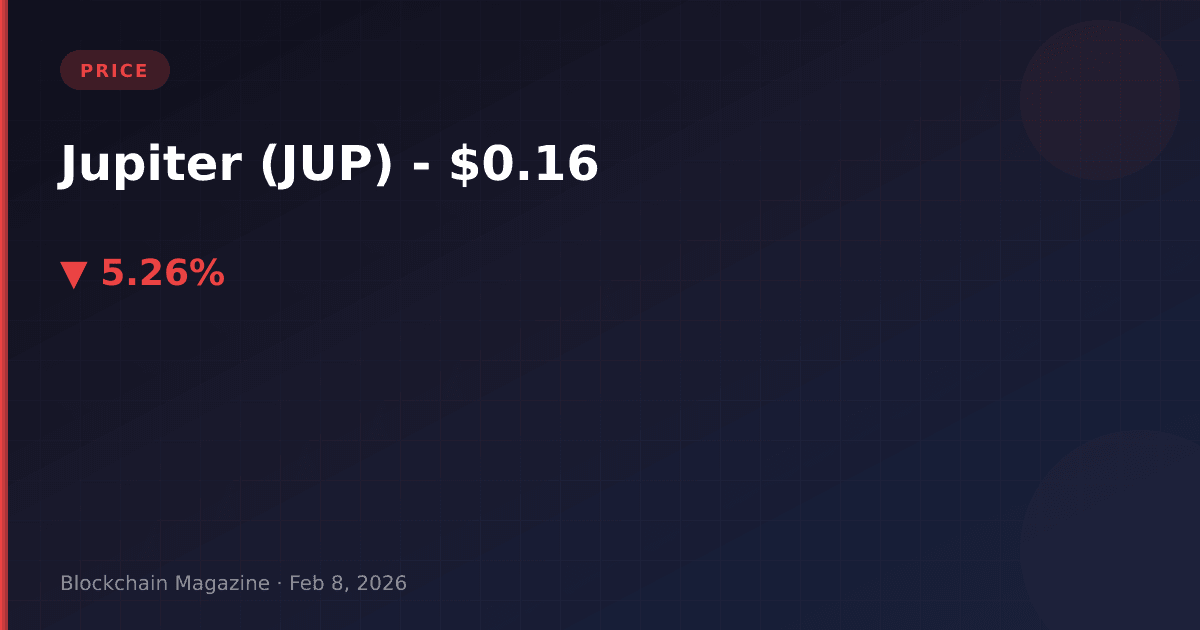
Jupiter (JUP) is currently trading at $0.15996, reflecting a bearish trend with a 5.26% decline in the last 24 hours. The Solana-based decentralized exchange aggregator has experienced significant downward pressure across multiple timeframes, showing an 8.16% weekly decline and a more substantial 24.42% monthly drop. This price action places JUP approximately 92% below its all-time high of $2.00, though it remains just above its all-time low of $0.144411, suggesting potential support levels in this price zone.
With a market capitalization of $519.03 million, Jupiter maintains its position as the 96th largest cryptocurrency by market cap. The 24-hour trading volume of $25.51 million represents approximately 4.9% of its market cap, indicating moderate liquidity conditions. The current circulating supply of 3.24 billion JUP tokens represents 32.4% of the maximum supply of 10 billion tokens, meaning significant token unlocks could impact future price dynamics. The proximity to all-time lows combined with strong fundamental technology positions Jupiter at a critical technical juncture where buyers may find value or further capitulation could occur.
Technical Overview and Market Metrics
From a technical perspective, Jupiter’s price structure reveals a cryptocurrency in a pronounced downtrend across all major timeframes. The token’s 92% retracement from its all-time high of $2.00 demonstrates severe bearish momentum, typical of many altcoins following major exchange listings or token generation events. The current price of $0.15996 sits precariously close to the all-time low of $0.144411, establishing this zone as a critical support level that has held historically. A breakdown below this level could trigger additional selling pressure and establish new lows.
The market cap to volume ratio of approximately 20:1 suggests reasonable but not exceptional trading activity for a top-100 cryptocurrency. Jupiter’s tokenomics reveal that only 32.4% of the maximum supply is currently circulating, which presents both opportunities and risks. On one hand, limited circulating supply can create scarcity-driven price appreciation; on the other, scheduled token unlocks or vesting periods could introduce significant selling pressure. As a DEX aggregator on Solana, Jupiter’s fundamental value proposition remains strong, offering users optimal trade routing and competitive rates. The disconnect between technical price performance and fundamental utility suggests the current bearish sentiment may be driven by broader market conditions, token unlock schedules, or profit-taking from early investors rather than deteriorating platform fundamentals.
Jupiter Price Prediction: Data-Driven Analysis
Predicting Jupiter’s price trajectory requires analyzing multiple factors including token economics, platform adoption, Solana ecosystem growth, and broader cryptocurrency market conditions. In the short term (1-3 months), JUP faces technical headwinds with the price compressed near all-time lows and negative momentum across weekly and monthly timeframes. The immediate support zone between $0.144-$0.160 represents a critical level; holding above this range could establish a base for recovery, while breakdown could see prices test the $0.12-$0.13 range, representing an additional 20-25% downside.
For a bullish scenario in 2024, several catalysts could drive Jupiter higher. If Solana continues gaining market share in DeFi and Jupiter captures increased trading volume, a recovery to the $0.25-$0.35 range (56-119% upside) appears achievable within 6-12 months. This would require improved market sentiment, successful platform upgrades, and potential exchange listings. The mid-term target of $0.50 (212% gain) becomes viable if Jupiter demonstrates sustained revenue growth and the broader crypto market enters a bull phase. However, this requires overcoming significant resistance levels and improved tokenomics sentiment.
Long-term projections (2-3 years) depend heavily on Jupiter’s ability to maintain its position as Solana’s premier DEX aggregator. With only 32.4% of tokens in circulation, the path to previous highs faces substantial dilution headwinds. A realistic bull case targets $0.75-$1.00, contingent on exceptional platform growth, strategic token burns, or supply mechanisms that offset inflation. Reaching the previous all-time high of $2.00 would require extraordinary circumstances including massive Solana ecosystem expansion and Jupiter achieving dominant market share. Conservative investors should recognize the high-risk nature of tokens with significant unlocks ahead, while the current valuation may represent opportunity for those with high risk tolerance and belief in Solana’s long-term success.
How to Buy Jupiter (JUP)
Purchasing Jupiter tokens involves several straightforward steps. First, create an account on a major cryptocurrency exchange that lists JUP, such as Binance, Bybit, OKX, or Gate.io. Complete the exchange’s KYC (Know Your Customer) verification process by submitting identification documents. Once verified, deposit funds into your account using bank transfer, credit card, or by transferring existing cryptocurrencies like Bitcoin or USDT.
Navigate to the JUP trading pair (typically JUP/USDT or JUP/USD), enter the amount you wish to purchase, and execute your market or limit order. For enhanced security, consider transferring your JUP tokens to a Solana-compatible wallet like Phantom, Solflare, or Ledger hardware wallet. Since Jupiter operates on the Solana blockchain, you’ll need a small amount of SOL for transaction fees. Always enable two-factor authentication on your exchange account and never share your private keys or seed phrases with anyone.
Investment Considerations for Jupiter
Jupiter represents the leading DEX aggregator on Solana, providing genuine utility by routing trades across multiple decentralized exchanges to find optimal prices for users. This fundamental value proposition distinguishes JUP from purely speculative tokens. The platform has demonstrated strong product-market fit with significant trading volume and user adoption within the Solana ecosystem.
However, potential investors must weigh several risk factors. The current price represents a 92% decline from all-time highs, and only 32.4% of total token supply is circulating. Scheduled token unlocks or vesting releases could create substantial selling pressure. Additionally, Jupiter’s performance is intrinsically tied to Solana’s ecosystem health and DeFi activity levels. Competition from other DEX aggregators and direct DEXs also presents ongoing challenges.
The cryptocurrency remains highly volatile with significant downside protection limited by the proximity to all-time lows. Risk-tolerant investors might view current levels as a potential accumulation zone, while conservative investors may prefer waiting for clear trend reversal signals. Always conduct thorough research and never invest more than you can afford to lose in cryptocurrency markets.
Historical Price Performance
Jupiter’s price history shows typical patterns of newly launched tokens in the cryptocurrency market. The all-time high of $2.00 likely occurred during initial listing excitement or during favorable market conditions for Solana ecosystem tokens. The subsequent 92% decline to current levels reflects a combination of factors including initial distribution to early investors, broader market corrections, and the maturation phase following launch hype.
The establishment of an all-time low at $0.144411 creates an important historical support level. The token’s ability to hold above this level despite continued selling pressure suggests potential accumulation by longer-term holders. The 24.42% decline over the past 30 days indicates accelerating bearish momentum, possibly triggered by specific events such as token unlocks, broader market weakness, or Solana ecosystem challenges. Understanding these historical patterns helps investors contextualize current price action and make more informed decisions about entry and exit points.
Understanding Jupiter’s Role in Solana DeFi
Jupiter functions as a critical infrastructure component within the Solana decentralized finance ecosystem. As a DEX aggregator, Jupiter doesn’t operate its own liquidity pools but instead routes trades across multiple Solana-based decentralized exchanges including Orca, Raydium, Serum, and others. This aggregation provides users with optimal pricing by splitting orders across venues and finding the most efficient execution paths.
The JUP token serves multiple functions within this ecosystem. Token holders may receive governance rights to vote on protocol upgrades and parameter changes. Jupiter has also implemented various token utility mechanisms that could include fee discounts, staking rewards, or participation in platform revenue sharing, depending on governance decisions. The platform’s success directly correlates with Solana’s DeFi growth, as increased trading volume translates to more routing opportunities and platform revenue.
Jupiter’s competitive advantages include superior routing algorithms, low latency execution leveraging Solana’s high-performance blockchain, and strong integration with the broader Solana wallet and DeFi ecosystem. As Solana continues to attract developers and users with its low fees and fast transactions, Jupiter stands positioned to capture significant value as the ecosystem’s primary trade routing infrastructure. However, the platform must continuously innovate to maintain its technological edge against emerging competitors.
Jupiter Tokenomics and Supply Dynamics
Understanding Jupiter’s tokenomics is essential for evaluating its investment potential. With a maximum supply capped at 10 billion JUP tokens and a current circulating supply of 3.24 billion, only 32.4% of total tokens are currently in circulation. This substantial gap between circulating and maximum supply represents one of the most critical factors influencing price projections and investment risk assessment.
The remaining 67.6% of tokens (approximately 6.76 billion JUP) are presumably allocated to team members, early investors, ecosystem development, treasury reserves, and future incentive programs. The vesting schedule and unlock timeline for these tokens significantly impacts price dynamics. Large unlock events can flood the market with supply, creating downward pressure even if fundamental demand remains constant. Prospective investors should research the specific vesting schedule and unlock dates to anticipate potential supply shocks.
The current market cap of $519.03 million represents the fully diluted value of only 32.4% of supply. The fully diluted valuation (FDV) would be approximately $1.6 billion if all 10 billion tokens were circulating at the current price. This FDV metric provides important context for comparing Jupiter’s valuation to competitors and assessing whether the current price offers value relative to platform utility and revenue generation. Token burns, staking mechanisms, or other supply reduction strategies could improve tokenomics over time, but investors should base decisions on current documented mechanisms rather than speculative future changes.
Stay informed with daily updates from Blockchain Magazine on Google News. Click here to follow us and mark as favorite: [Blockchain Magazine on Google News].
Disclaimer
Blockchain Magazine publishes content submitted by third-party agencies, partners, and clients. Any such posts are categorized and tagged accordingly:
- Sponsored Content: Posts labeled as "Sponsored" are paid placements submitted by third-party agencies or clients. Blockchain Magazine does not endorse or express any views regarding the information contained in these posts. The opinions expressed belong solely to the respective authors and do not reflect the official policy or position of Blockchain Magazine.
- Press Releases: Posts labeled as "Press Release" are paid PR submissions provided by our partners and clients. These are published as received and should be considered as promotional content.
The information provided in such posts is strictly for informational purposes only and should not be interpreted as financial, investment, or professional advice. Blockchain Magazine does not recommend, endorse, or promote any specific products, services, or companies mentioned. Readers are strongly encouraged to conduct independent research and consult with a qualified professional before making any financial or investment decisions.
Additionally, all featured images accompanying such posts are intended as creative depictions of the subject matter. There is no intent to offend or misrepresent any individual, institution, or entity. If any content or imagery is found to be objectionable, please reach out to us at [email protected], and we will promptly review the concern.
About the Author: Editors Desk



Get Blockchain Insights In Inbox
Stay ahead of the curve with expert analysis and market updates.