
Ethereum (ETH) Price Today, Live Chart & Market Cap | ETH to USD Converter

Ethereum ETH
Rank #2
Last updated: 2/8/2026, 8:50:20 PM · Data from CoinGecko
Ethereum (ETH) Price Today
Ethereum Price Analysis
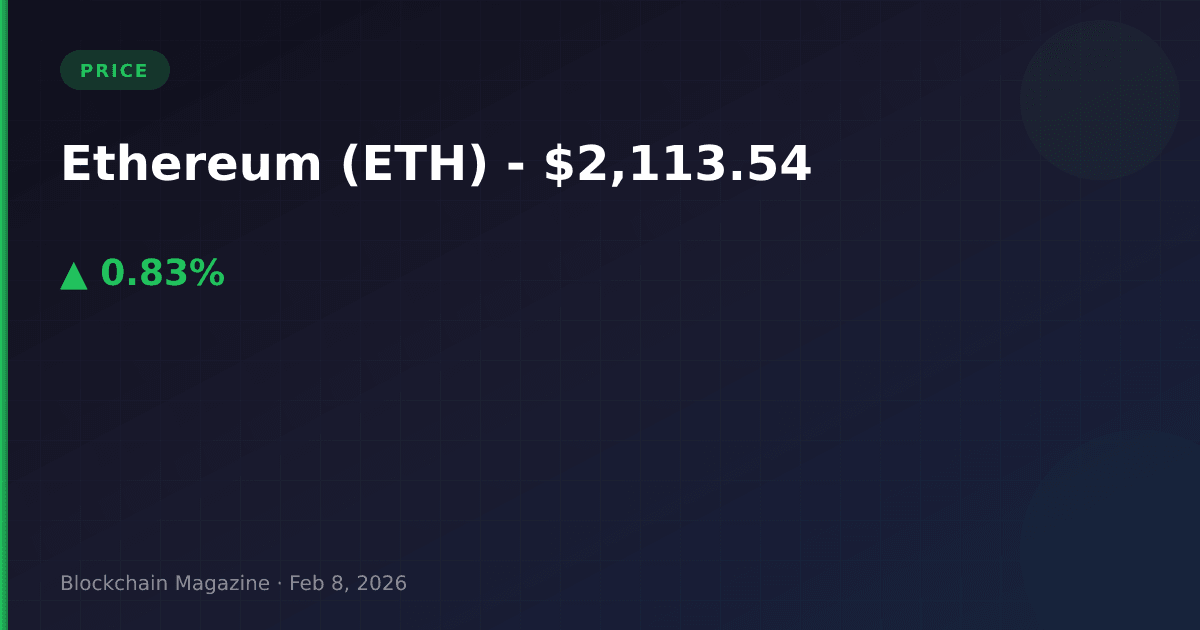
Ethereum is currently trading at $2,113.54, showing a modest 24-hour gain of +0.83% with substantial trading volume of $18.97 billion. As the second-largest cryptocurrency by market capitalization at $255.19 billion, ETH maintains its position as the dominant smart contract platform. However, the broader trend reveals selling pressure, with ETH down -8.77% over the past week and -31.30% over the last 30 days, reflecting the current market correction phase.
The current price sits approximately 57.3% below its all-time high of $4,946.05, indicating significant room for potential recovery during the next bull cycle. Trading 488,111% above its all-time low of $0.432979, Ethereum has demonstrated exceptional long-term growth since its 2015 launch. With 120.69 million ETH in circulation and no maximum supply cap, the asset’s inflation dynamics have fundamentally changed post-Merge, with some periods experiencing net deflationary pressure through EIP-1559 fee burning. Today’s price action suggests consolidation as traders assess Ethereum’s positioning amid regulatory clarity, scaling improvements, and institutional adoption trends.
Technical Overview & Market Metrics
Ethereum’s technical profile presents a mixed outlook as it navigates key support and resistance levels. The current price of $2,113.54 places ETH in a critical zone where historical volume clusters suggest strong buyer interest. The 24-hour trading volume of $18.97 billion represents healthy liquidity, essential for institutional participation and indicating sustained market interest despite recent downward price pressure. The volume-to-market-cap ratio stands at approximately 7.4%, demonstrating active trading relative to its $255.19 billion market capitalization.
From a network fundamentals perspective, Ethereum continues to dominate decentralized finance (DeFi) with over 60% total value locked (TVL) market share and processes the majority of NFT transactions. The transition to Proof-of-Stake has reduced ETH issuance by approximately 90%, fundamentally altering supply dynamics. The circulating supply of 120.69 million ETH grows at a reduced rate, with burn mechanisms occasionally creating deflationary periods during high network activity. Key resistance levels to watch include the psychological $2,500 mark and the 200-day moving average, while support appears solid around $2,000. On-chain metrics show accumulation by long-term holders, suggesting conviction despite short-term volatility. The Ethereum network continues processing 1+ million transactions daily, with Layer 2 solutions handling additional throughput, strengthening the value proposition for ETH as gas fees and the settlement layer for an expanding ecosystem.
Ethereum Price Prediction: Data-Driven Outlook
Analyzing Ethereum’s price trajectory requires examining multiple fundamental and technical factors that drive valuation. At the current price of $2,113.54, ETH presents an interesting risk-reward profile for both short-term traders and long-term investors. Short-term outlook (1-3 months): Technical indicators suggest ETH may test the $1,900-$2,000 support zone before establishing a foundation for recovery. The -8.77% weekly decline indicates bearish momentum that typically requires 2-4 weeks to fully exhaust. However, the relatively modest 24-hour gain of +0.83% with strong volume suggests buying interest at current levels. A break above $2,300 would invalidate the bearish scenario and could trigger a rally toward $2,600.
Medium-term outlook (3-12 months): Several catalysts could drive ETH toward the $3,000-$3,800 range within this timeframe. The approval and launch of spot Ethereum ETFs in major markets could inject billions in new capital, similar to Bitcoin’s ETF impact. Additionally, the Dencun upgrade has successfully reduced Layer 2 transaction costs by over 90%, making Ethereum’s ecosystem more competitive and potentially increasing network usage and ETH burn rates. The continued growth of real-world asset (RWA) tokenization, with major financial institutions building on Ethereum, provides fundamental support for higher valuations. Market cap reaching $350-450 billion in a moderate bull scenario appears achievable.
Long-term outlook (1-4 years): Ethereum’s position as the settlement layer for Web3, DeFi, and tokenized assets suggests significant upside potential. Conservative models project ETH could reach $5,000-$7,000 in the next bull cycle, representing 135-230% gains from current levels. More optimistic scenarios, assuming widespread institutional adoption and successful scaling through Layer 2 ecosystems, place ETH between $8,000-$12,000, which would value the network at $900B-$1.4T. These projections factor in ETH’s deflationary mechanics, where high network activity burns more ETH than is issued. The unlimited supply concern is mitigated by burn rates that could make ETH net-deflationary during peak adoption phases. Key risks include regulatory challenges, competition from alternative Layer 1 blockchains, and macroeconomic headwinds affecting risk assets broadly.
How to Buy Ethereum (ETH)
Purchasing Ethereum is straightforward through multiple channels. Cryptocurrency exchanges like Coinbase, Binance, Kraken, and Gemini offer ETH trading pairs against USD, EUR, and other fiat currencies. Create an account, complete KYC verification, deposit funds via bank transfer or card, and execute a market or limit order for ETH. Brokerage apps such as Robinhood and eToro provide simplified ETH purchasing for beginners, though with limited withdrawal options. Decentralized exchanges (DEXs) like Uniswap allow direct wallet-to-wallet trading without intermediaries, ideal for experienced users prioritizing privacy. For long-term holders, transfer your ETH to a hardware wallet (Ledger, Trezor) or self-custody software wallet (MetaMask, Rainbow) to maintain full control. Dollar-cost averaging (DCA) by purchasing fixed amounts regularly can mitigate volatility risk. Always secure your accounts with two-factor authentication and never share private keys or seed phrases.
Is Ethereum a Good Investment?
Ethereum represents the leading smart contract platform with the most developed ecosystem, including DeFi protocols managing over $50 billion in TVL, the dominant NFT marketplace infrastructure, and emerging use cases in gaming, identity, and real-world asset tokenization. The network’s transition to Proof-of-Stake reduced energy consumption by 99.95% while improving security and enabling staking yields of 3-5% APR for holders. Institutional adoption continues accelerating, with major corporations like Microsoft, JPMorgan, and Visa building on or integrating Ethereum technology.
However, investors should consider risks: cryptocurrency markets are highly volatile, regulatory frameworks remain evolving, and Ethereum faces competition from newer blockchains offering faster transactions and lower fees. The -31.30% decline over 30 days demonstrates this volatility. Ethereum works best as part of a diversified portfolio, with most financial advisors recommending limiting cryptocurrency exposure to 5-10% of investment capital. The asset’s long-term potential depends on continued developer activity, successful scaling solutions, and broader blockchain adoption across industries. For those with higher risk tolerance and belief in decentralized technology’s future, Ethereum’s established network effects and continuous innovation provide compelling investment thesis.
Ethereum Network Fundamentals
Technology Foundation: Ethereum is a decentralized blockchain platform enabling smart contracts—self-executing agreements coded directly into the blockchain. Launched in 2015 by Vitalik Buterin and co-founders, Ethereum introduced programmability to blockchain technology, creating the foundation for decentralized applications (dApps). The September 2022 Merge transitioned Ethereum from energy-intensive Proof-of-Work to efficient Proof-of-Stake consensus, fundamentally changing network economics.
Tokenomics & Supply: Unlike Bitcoin’s fixed 21 million cap, Ethereum has no maximum supply limit. Currently, 120.69 million ETH circulates with new issuance reduced to approximately 0.5-1% annually post-Merge. The EIP-1559 upgrade implemented fee burning, where a portion of transaction fees is permanently removed from circulation. During high network activity, burn rates can exceed issuance, making ETH deflationary. This creates potential scarcity despite unlimited theoretical supply.
Use Cases: ETH serves multiple functions: (1) Gas fees for transaction processing and smart contract execution, (2) Collateral in DeFi lending and borrowing protocols, (3) Staking to secure the network and earn yields, (4) Medium of exchange in NFT marketplaces, (5) Reserve asset in decentralized stablecoins like DAI, and (6) Governance token for various protocols. This utility creates constant demand regardless of speculative price movements.
Ethereum in Current Market Context
At rank #2 with a $255.19 billion market cap, Ethereum maintains approximately 18-20% of the total cryptocurrency market capitalization, second only to Bitcoin. The ETH/BTC ratio, currently around 0.024, serves as a key metric for assessing Ethereum’s relative strength. Historically, this ratio expands during altcoin seasons when investors rotate from Bitcoin into higher-risk assets with growth potential.
The current market phase reflects broader macroeconomic conditions, with risk assets facing pressure from interest rate policies and regulatory uncertainty. However, Ethereum benefits from several differentiating factors: measurable network usage, revenue generation through fees, and real economic activity beyond speculation. Unlike many cryptocurrencies, Ethereum can be valued using traditional metrics like price-to-fees ratio and network transaction value, providing fundamental anchors beyond pure sentiment.
Compared to competitors like Solana, Cardano, and Avalanche, Ethereum maintains significant advantages in developer activity (over 4,000 active developers monthly), total value locked, and established network effects. While these alternatives may offer technical improvements in specific areas, Ethereum’s first-mover advantage in smart contracts, extensive tooling, and battle-tested security continue attracting the majority of serious development projects and institutional interest.
Trading Strategies for ETH
For Long-Term Investors (HODLing): Accumulating ETH during market corrections and holding through cycles has historically produced strong returns. The -31.30% monthly decline presents potential entry opportunities for those with multi-year time horizons. Consider dollar-cost averaging to build positions gradually, reducing timing risk. Staking your ETH through exchanges or independently can generate 3-5% annual yields while supporting network security.
For Active Traders: ETH’s high liquidity and $18.97 billion daily volume support various trading strategies. Key technical levels include support at $2,000-$2,050 and resistance at $2,250-$2,300. The current +0.83% daily movement suggests range-bound trading conditions suitable for mean reversion strategies. Monitor correlation with Bitcoin, as ETH typically follows BTC direction but with amplified volatility. Use stop-losses religiously, as cryptocurrency markets can move 10-20% rapidly.
Yield Strategies: Beyond holding, ETH can generate returns through DeFi protocols. Lending platforms like Aave and Compound offer 2-4% APY on ETH deposits. Liquidity provision in automated market makers (AMMs) like Uniswap can yield higher returns but carries impermanent loss risk. Staking directly through validators requires 32 ETH but offers maximum returns without intermediaries. Always assess smart contract risks before deploying capital into DeFi protocols.
Stay informed with daily updates from Blockchain Magazine on Google News. Click here to follow us and mark as favorite: [Blockchain Magazine on Google News].
Disclaimer
Blockchain Magazine publishes content submitted by third-party agencies, partners, and clients. Any such posts are categorized and tagged accordingly:
- Sponsored Content: Posts labeled as "Sponsored" are paid placements submitted by third-party agencies or clients. Blockchain Magazine does not endorse or express any views regarding the information contained in these posts. The opinions expressed belong solely to the respective authors and do not reflect the official policy or position of Blockchain Magazine.
- Press Releases: Posts labeled as "Press Release" are paid PR submissions provided by our partners and clients. These are published as received and should be considered as promotional content.
The information provided in such posts is strictly for informational purposes only and should not be interpreted as financial, investment, or professional advice. Blockchain Magazine does not recommend, endorse, or promote any specific products, services, or companies mentioned. Readers are strongly encouraged to conduct independent research and consult with a qualified professional before making any financial or investment decisions.
Additionally, all featured images accompanying such posts are intended as creative depictions of the subject matter. There is no intent to offend or misrepresent any individual, institution, or entity. If any content or imagery is found to be objectionable, please reach out to us at [email protected], and we will promptly review the concern.
About the Author: Editors Desk



Get Blockchain Insights In Inbox
Stay ahead of the curve with expert analysis and market updates.