
Ethereum Classic (ETC) Price Today, Live Chart & Market Cap | ETC to USD Converter

Ethereum Classic ETC
Rank #56
Last updated: 2/8/2026, 10:16:56 PM · Data from CoinGecko
Ethereum Classic (ETC) Price Today
Ethereum Classic Price Analysis
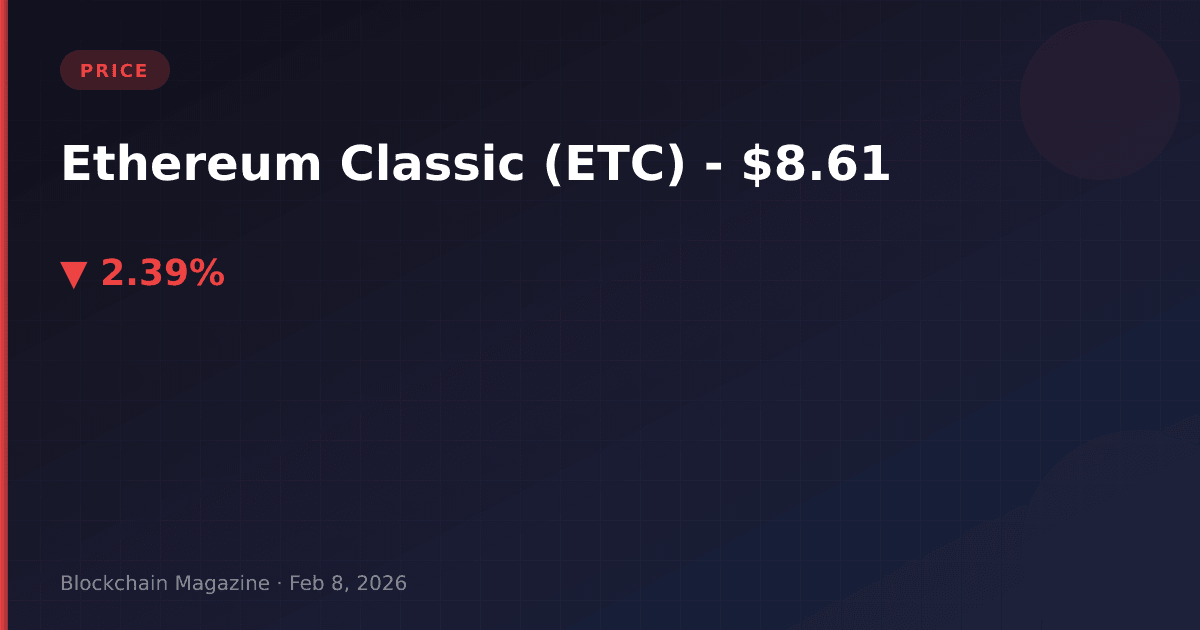
Ethereum Classic (ETC) is currently trading at $8.61, reflecting a bearish sentiment across multiple timeframes. The cryptocurrency has experienced a -2.39% decline in the last 24 hours, with selling pressure intensifying over the weekly period showing a -9.79% decrease. The monthly performance reveals deeper concerns with a substantial -31.38% drop, indicating a sustained downtrend that has tested investor confidence.
Trading at $8.61, ETC is positioned significantly below its all-time high of $167.09, representing a 94.85% decline from peak levels. However, the current price remains substantially above its all-time low of $0.615038, showing a gain of approximately 1,300% from the bottom. With a market capitalization of $1.34 billion, Ethereum Classic maintains its position as the #56 ranked cryptocurrency, demonstrating continued relevance despite recent price weakness. The 24-hour trading volume of $42.26M suggests moderate liquidity, though traders should monitor volume trends as indicators of potential reversals or continued pressure.
Technical Overview & Market Metrics
Ethereum Classic’s technical structure reveals several key metrics worth examining. The circulating supply stands at 155.45 million ETC tokens, representing approximately 73.8% of the maximum supply cap of 210.70 million tokens. This fixed supply mechanism, inherited from Bitcoin’s monetary policy, creates a deflationary aspect that distinguishes ETC from its Ethereum (ETH) counterpart, which has no maximum supply cap. The remaining 55.25 million tokens will be gradually released through mining rewards until the cap is reached, potentially impacting long-term price dynamics.
From a market structure perspective, ETC’s current positioning shows signs of consolidation at lower levels. The volume-to-market cap ratio of approximately 3.15% indicates moderate trading activity relative to its market size. Key resistance levels for traders include the psychological $10 mark and previous support zones around $12-$15. Support appears established near the $8 level, though a breach could test lower zones around $6-$7. The token’s proof-of-work consensus mechanism continues to secure the network, maintaining its original Ethereum vision following the 2016 DAO hard fork. Technical traders should monitor moving average convergences and RSI indicators for potential momentum shifts in this established blockchain platform.
Ethereum Classic Price Prediction: Data-Driven Perspective
Forecasting Ethereum Classic’s price trajectory requires analyzing multiple fundamental and technical factors. In the short term (3-6 months), ETC faces headwinds from the current bearish momentum, with the -31.38% monthly decline suggesting continued pressure. If support at $8 holds, a consolidation phase between $7.50-$10.00 appears likely. A recovery toward $12-$15 would require renewed buying interest and broader crypto market improvement. The key catalyst would be Bitcoin’s performance, as altcoins typically follow BTC’s directional movements with amplified volatility.
For medium-term outlook (6-12 months), several factors could influence ETC’s trajectory. The continued development of the Ethereum Classic ecosystem, including potential protocol upgrades and DApp deployment, may provide fundamental support. Historical patterns show ETC tends to experience significant volatility around Bitcoin halving cycles and broader market sentiment shifts. A conservative estimate places ETC potentially ranging between $8-$20, with upside potential if crypto markets enter a bullish phase. The $15-$18 range represents a critical resistance cluster from previous consolidation patterns.
Looking at long-term projections (2025-2026), Ethereum Classic’s fate depends on its ability to maintain relevance in an evolving blockchain landscape. Bulls argue that ETC’s commitment to immutability and proof-of-work consensus provides unique value propositions. If the broader crypto market cap expands significantly and ETC captures even modest investment flows, a return to $25-$40 levels becomes mathematically feasible, though this requires substantial market recovery. Bears point to intense competition from modern layer-1 blockchains and limited developer activity as constraints. Realistic long-term targets based on supply dynamics and historical performance suggest a range between $15-$50, heavily dependent on Bitcoin’s trajectory and whether crypto experiences another major bull cycle. Investors should note that ETC remains 94.85% below its ATH, requiring extraordinary circumstances for a return to previous highs.
How to Buy Ethereum Classic (ETC)
Purchasing Ethereum Classic is straightforward through major cryptocurrency exchanges. Step 1: Create an account on reputable exchanges like Coinbase, Binance, Kraken, or Gemini, completing KYC verification. Step 2: Deposit funds via bank transfer, debit card, or wire transfer. Step 3: Navigate to the ETC trading pair (ETC/USD or ETC/USDT), enter your desired purchase amount, and execute the market or limit order. Step 4: For enhanced security, transfer your ETC to a hardware wallet like Ledger or Trezor rather than keeping funds on exchanges.
Alternative methods include decentralized exchanges (DEXs) like Uniswap for users with existing crypto holdings, or peer-to-peer platforms. Always verify you’re purchasing genuine ETC (not Ethereum/ETH) by confirming the ticker symbol and contract address. Transaction fees vary by exchange and payment method, typically ranging from 0.1-1.5% per trade. Consider dollar-cost averaging for long-term positions to mitigate volatility risk.
Frequently Asked Questions
What is Ethereum Classic (ETC) and how is it different from Ethereum?
Ethereum Classic is the original Ethereum blockchain that maintained the unaltered history following the 2016 DAO hack controversy. While Ethereum (ETH) hard forked to reverse the hack and return stolen funds, Ethereum Classic continued on the original chain, adhering to the principle of “code is law” and immutability. The key differences include: ETC uses proof-of-work mining (like Bitcoin) while ETH transitioned to proof-of-stake; ETC has a fixed maximum supply of 210.7 million coins while ETH has no supply cap; and ETC maintains the original blockchain history. Both support smart contracts and DApps, but Ethereum has significantly larger developer activity and ecosystem adoption. ETC appeals to cryptocurrency purists who value immutability and decentralization principles above all else.
Is Ethereum Classic a good investment in 2024?
Ethereum Classic presents a high-risk, high-reward investment proposition. Potential advantages include: its fixed supply creating scarcity similar to Bitcoin, significantly discounted price from its $167 ATH offering recovery potential, established history and network security, and proof-of-work consensus attracting miners seeking alternatives. Significant risks include: the -31.38% monthly decline indicating bearish momentum, strong competition from modern blockchains, limited developer activity compared to Ethereum, and multiple 51% attacks in its history raising security concerns. At $8.61 with a $1.34B market cap, ETC may appeal to contrarian investors betting on a crypto market recovery and PoW blockchain resurgence. However, it should represent only a small portion of a diversified portfolio. The investment thesis depends on believing ETC’s immutability principles will attract long-term value despite technological competition. Conservative investors may prefer more established assets, while risk-tolerant traders might find opportunities in ETC’s volatility.
What is the maximum supply of Ethereum Classic?
Ethereum Classic has a maximum supply cap of 210.7 million ETC tokens, implemented through the ECIP-1017 monetary policy proposal. This deflationary mechanism mirrors Bitcoin’s approach and distinguishes ETC from Ethereum, which has no maximum supply limit. Currently, 155.45 million ETC are in circulation (73.8% of max supply), meaning approximately 55.25 million tokens remain to be mined. The emission schedule reduces mining rewards by 20% every 5 million blocks (roughly every 2.5 years), creating gradually decreasing inflation until the cap is reached. This fixed supply creates scarcity economics, potentially supporting long-term value appreciation if demand increases. The supply cap was a deliberate design choice to establish ETC as “sound money” within the cryptocurrency ecosystem, appealing to investors who value predictable monetary policy and protection against inflation through unlimited token creation.
How high can Ethereum Classic price go?
Ethereum Classic’s price potential depends on multiple variables, making precise predictions challenging. Historical context: ETC reached an all-time high of $167.09 in May 2021 during the crypto bull market, proving it can achieve significant valuations under favorable conditions. From the current $8.61 price, returning to ATH would require a 1,840% increase. Realistic scenarios: Conservative estimates for the next bull cycle (2024-2025) suggest potential ranges of $20-$50 if crypto markets recover broadly, requiring 2-6x gains. Optimistic projections reaching $75-$100 would need exceptional circumstances including major protocol adoption, significant Bitcoin rallies, and renewed interest in proof-of-work blockchains. Theoretical maximum: If ETC captured just 0.5% of the global store-of-value market, prices could theoretically exceed previous highs, though this requires widespread adoption unlikely in the near term. Key factors influencing upside potential include: Bitcoin’s performance (strongest correlation), overall crypto market capitalization, ETC ecosystem development, mining profitability, and macroeconomic conditions. Investors should maintain realistic expectations given the -94.85% decline from ATH and strong competition in the smart contract platform space.
Where can I buy Ethereum Classic (ETC)?
Ethereum Classic is widely available on major cryptocurrency exchanges worldwide. Top centralized exchanges: Coinbase, Binance, Kraken, Gemini, KuCoin, Crypto.com, OKX, and Huobi all offer ETC trading with various fiat and crypto pairs. US-based traders can use Coinbase, Kraken, and Gemini with full regulatory compliance. Decentralized options: ETC can be traded on DEXs including Uniswap (wrapped ETC) and other DeFi platforms, though liquidity may be lower. Payment methods: Most exchanges accept bank transfers, debit/credit cards, PayPal (on some platforms), and cryptocurrency deposits. Exchange selection factors: Consider trading fees (typically 0.1-0.5%), withdrawal fees, available trading pairs (ETC/USD, ETC/USDT, ETC/BTC), security features (2FA, insurance), and geographic restrictions. For large purchases, OTC (over-the-counter) desks provide better pricing with reduced slippage. After purchase, consider transferring ETC to a secure wallet—hardware wallets (Ledger, Trezor) for long-term holdings or software wallets (Trust Wallet, MetaMask with ETC support) for active use. Always verify you’re purchasing Ethereum Classic (ETC) and not Ethereum (ETH) by confirming the ticker symbol.
Disclaimer: Cryptocurrency prices are extremely volatile. This content is for informational purposes only and should not be considered financial advice. The price data presented ($8.61) represents a specific point in time and changes continuously. Always conduct thorough research and consider consulting with financial advisors before making investment decisions. Past performance does not guarantee future results.
Stay informed with daily updates from Blockchain Magazine on Google News. Click here to follow us and mark as favorite: [Blockchain Magazine on Google News].
Disclaimer
Blockchain Magazine publishes content submitted by third-party agencies, partners, and clients. Any such posts are categorized and tagged accordingly:
- Sponsored Content: Posts labeled as "Sponsored" are paid placements submitted by third-party agencies or clients. Blockchain Magazine does not endorse or express any views regarding the information contained in these posts. The opinions expressed belong solely to the respective authors and do not reflect the official policy or position of Blockchain Magazine.
- Press Releases: Posts labeled as "Press Release" are paid PR submissions provided by our partners and clients. These are published as received and should be considered as promotional content.
The information provided in such posts is strictly for informational purposes only and should not be interpreted as financial, investment, or professional advice. Blockchain Magazine does not recommend, endorse, or promote any specific products, services, or companies mentioned. Readers are strongly encouraged to conduct independent research and consult with a qualified professional before making any financial or investment decisions.
Additionally, all featured images accompanying such posts are intended as creative depictions of the subject matter. There is no intent to offend or misrepresent any individual, institution, or entity. If any content or imagery is found to be objectionable, please reach out to us at [email protected], and we will promptly review the concern.
About the Author: Editors Desk



Get Blockchain Insights In Inbox
Stay ahead of the curve with expert analysis and market updates.