
Avalanche (AVAX) Price Today, Live Chart & Market Cap | AVAX to USD Converter

Avalanche AVAX
Rank #27
Last updated: 2/8/2026, 9:30:30 PM · Data from CoinGecko
Avalanche (AVAX) Price
Avalanche Price Analysis Today
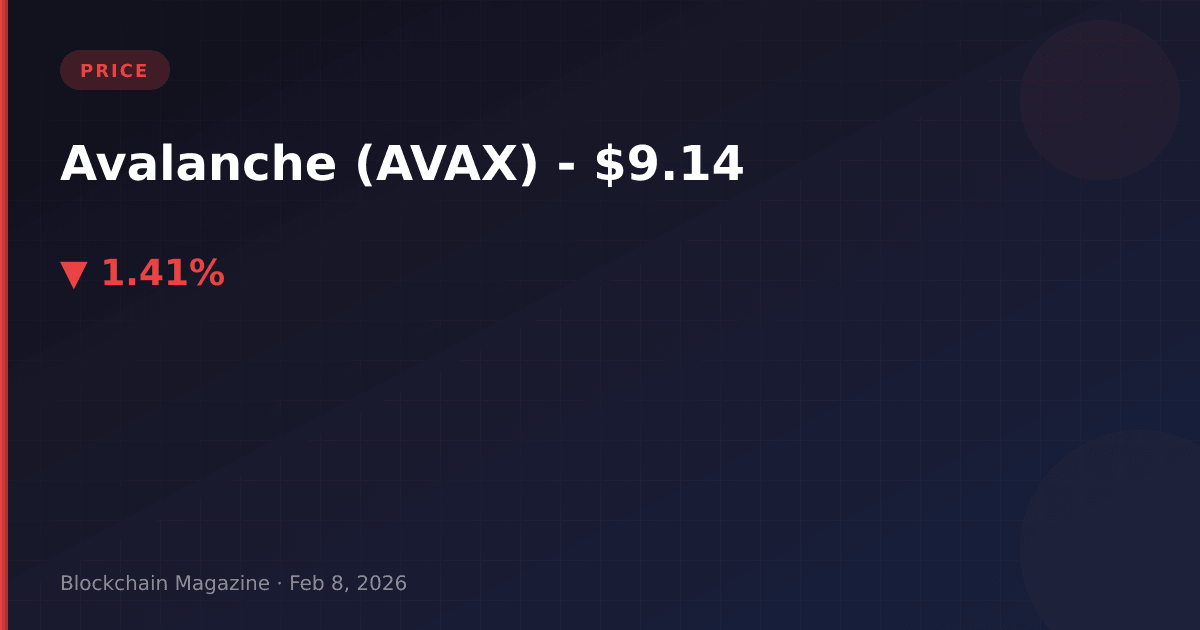
Avalanche (AVAX) is currently trading at $9.14 USD, experiencing a slight decline of 1.41% over the past 24 hours. The current price represents a significant correction from its all-time high of $144.96, trading approximately 93.7% below that peak level. With a market capitalization of $3.95 billion, AVAX maintains its position as the 27th largest cryptocurrency by market cap.
The recent price action shows bearish momentum across multiple timeframes, with AVAX down 7.42% over the past week and 33.63% over the last 30 days. The 24-hour trading volume stands at $208.81 million, indicating moderate liquidity and active trading interest despite the recent downtrend. This volume-to-market-cap ratio of approximately 5.3% suggests healthy trading activity for a top-30 cryptocurrency.
Currently, 431.77 million AVAX tokens are in circulation out of a maximum supply of 720 million, meaning approximately 60% of the total supply is already circulating. This leaves room for potential supply expansion, which investors should consider when evaluating long-term price prospects. The all-time low of $2.80 provides a historical support level, with AVAX trading 226% above that bottom, suggesting the token has maintained substantial value despite recent corrections.
Technical Overview & Market Metrics
From a technical perspective, Avalanche’s current price action reflects broader cryptocurrency market sentiment and specific ecosystem developments. The token’s positioning at $9.14 places it in a critical zone above psychological support at $9.00, with immediate resistance levels forming around $10.00. The consistent decline over weekly and monthly periods indicates a prevailing downtrend that technical traders should monitor carefully.
The market cap to volume ratio demonstrates that AVAX maintains institutional and retail interest, with the $208.81M daily volume representing significant liquidity for entry and exit positions. Compared to its market cap of $3.95B, this 5.3% turnover rate is above average for established layer-1 blockchain projects, suggesting active speculation and trading despite negative price momentum.
Key technical indicators to monitor include the distance from ATH (93.7% down) and ATL (226% up), which positions AVAX in a mid-range valuation zone historically. The circulating supply dynamics show that with 60% of max supply already circulating, AVAX has moderate inflation pressure compared to cryptocurrencies with lower circulation percentages. Supply inflation will continue as the network releases tokens for staking rewards and ecosystem development, potentially creating selling pressure if not offset by demand growth from network adoption and DeFi activity on the Avalanche C-Chain.
AVAX Price Prediction: Data-Driven Analysis
Forecasting Avalanche’s price requires analyzing multiple fundamental and technical factors. The current price of $9.14 sits at a critical juncture, with historical support established above the $8.00 level during previous consolidation phases. Based on current market structure and on-chain metrics, AVAX faces several scenarios over different timeframes.
Short-term outlook (1-3 months): The immediate price trajectory depends heavily on Bitcoin and overall crypto market sentiment. If market conditions stabilize, AVAX could test resistance at $11.50-$12.50, representing a potential 25-37% upside from current levels. However, continuation of the bearish trend visible in the 30-day decline could push AVAX toward the $7.50-$8.00 support zone, representing 15-18% downside risk. The technical bias remains neutral to slightly bearish until AVAX reclaims the $10.00 psychological level with sustained volume.
Medium-term outlook (6-12 months): Avalanche’s price potential hinges on ecosystem growth, DeFi TVL (Total Value Locked), and subnet adoption. If the network successfully expands its institutional partnerships and gaming/metaverse integrations, a recovery toward $15-$22 is achievable, representing 64-141% upside. This scenario assumes broader crypto market recovery and increased network activity. Conversely, extended bear market conditions or competitive pressure from rival L1s could keep AVAX range-bound between $7-$12.
Long-term outlook (2-5 years): The maximum supply of 720M AVAX and current circulation of 431.77M means approximately 288M tokens remain to enter circulation. For AVAX to revisit its ATH of $144.96, the market cap would need to exceed $62 billion at current supply—a 15.7x increase from today’s $3.95B. While ambitious, this isn’t impossible if Avalanche captures significant market share in enterprise blockchain adoption, gaming, and DeFi. More conservative long-term targets of $30-$50 represent 228-447% upside and appear achievable if the network maintains top-10 status and TVL growth. Risk factors include technological competition, regulatory challenges, and the ongoing token emission schedule.
How to Buy Avalanche (AVAX)
Purchasing AVAX is straightforward through major cryptocurrency exchanges. Step 1: Create an account on a reputable exchange like Coinbase, Binance, Kraken, or KuCoin that supports AVAX trading. Complete identity verification (KYC) as required. Step 2: Deposit funds via bank transfer, debit card, or cryptocurrency transfer. Most exchanges support USD, EUR, and other fiat currencies. Step 3: Navigate to the AVAX trading pair (AVAX/USD or AVAX/USDT), enter your desired purchase amount, and execute a market or limit order. Step 4: For enhanced security, withdraw your AVAX to a personal wallet such as the Core Wallet (Avalanche’s official wallet), Ledger hardware wallet, or MetaMask configured for the Avalanche C-Chain. Always enable two-factor authentication and store your private keys securely. AVAX can be used for staking, DeFi protocols, or held as a long-term investment.
Understanding Avalanche’s Market Position
Avalanche operates as a layer-1 blockchain platform competing with Ethereum, Solana, and other smart contract networks. Its consensus mechanism, Avalanche Consensus, enables high throughput with sub-second finality, positioning it as a scalable solution for DeFi, NFTs, and enterprise applications. The network’s subnet architecture allows customized blockchain deployments, attracting gaming and institutional projects.
AVAX’s rank at #27 reflects its established position in the competitive L1 landscape, though it faces challenges from both Ethereum’s continued dominance and emerging competitors. The network’s total value locked (TVL) in DeFi protocols and the number of active subnets serve as key metrics for fundamental valuation. Current price levels may represent accumulation opportunities for investors who believe in the long-term thesis of multi-chain ecosystems where Avalanche serves specialized use cases.
The tokenomics of AVAX include a deflationary mechanism where transaction fees are burned, creating potential supply reduction over time. However, this must be balanced against ongoing token emissions from staking rewards. Staking AVAX currently offers APY returns, providing an income stream for long-term holders who believe in network growth. The percentage of AVAX staked versus circulating serves as an indicator of holder conviction and network security.
Trading Strategies for AVAX
Dollar-Cost Averaging (DCA): Given AVAX’s volatility and 33.63% decline over 30 days, systematic purchases at regular intervals can help smooth entry points and reduce timing risk. Setting up weekly or biweekly purchases of $50-$200 allows accumulation through various price levels without attempting to time the bottom.
Range Trading: AVAX has established trading ranges historically. Active traders might consider buying near support levels ($8.50-$9.00) and selling near resistance ($10.50-$11.00), with strict stop-losses below $8.00. This strategy requires monitoring 4-hour and daily charts for range confirmation.
Staking Strategy: Long-term holders can stake AVAX to earn yields while waiting for price appreciation. This converts idle holdings into productive assets, earning additional tokens that compound over time. Minimum staking requirements and lock-up periods vary by platform, with native Avalanche staking offering higher decentralization versus exchange staking programs.
Risk Management: Position sizing is critical given AVAX’s 93.7% decline from ATH. Never allocate more than 5-10% of a crypto portfolio to a single asset. Set stop-losses at personal risk tolerance levels, typically 15-25% below entry prices. Monitor Bitcoin correlation, as AVAX tends to follow broader crypto market trends with amplified volatility.
AVAX vs. Competing Layer-1 Blockchains
Understanding AVAX’s competitive positioning helps contextualize its price potential. Versus Ethereum (ETH): While Ethereum maintains dominant market cap and developer mindshare, Avalanche offers faster transaction finality and lower fees, positioning it as an alternative for cost-sensitive applications. However, ETH’s established network effects and upcoming upgrades present formidable competition.
Versus Solana (SOL): Both networks emphasize high throughput, but Avalanche’s subnet architecture offers customization advantages for enterprise deployments. Solana has experienced network outages affecting reliability perceptions, while Avalanche has maintained better uptime statistics. Price comparison shows both have corrected significantly from ATHs, trading in similar relative drawdown zones.
Versus Cardano (ADA) and Polkadot (DOT): These academic-focused blockchains compete on the basis of research-driven development and governance models. Avalanche’s faster deployment speed and EVM compatibility attract developers seeking Ethereum alternatives without learning new programming languages. Market caps and price action across these L1s show high correlation, suggesting investors view them as interchangeable portfolio positions.
AVAX’s market cap of $3.95B positions it between mid-tier and major L1s, smaller than Ethereum, BNB Chain, and Cardano, but larger than newer entrants. This middle positioning creates both opportunity (room for growth) and risk (vulnerable to competition from above and below).
Frequently Asked Questions
What is the Avalanche (AVAX) price prediction for 2025?
Avalanche price predictions for 2025 vary widely among analysts, ranging from conservative estimates of $15-$25 to optimistic targets of $40-$60, depending on crypto market conditions and network adoption. At the current price of $9.14, reaching $20 would represent 119% upside. Key factors influencing 2025 price include: Bitcoin’s market cycle trajectory, Avalanche’s subnet adoption rate, DeFi TVL growth on the network, regulatory developments affecting smart contract platforms, and competition from other L1 blockchains. The most data-driven approach considers that AVAX would need sustained network growth metrics—including active addresses, transaction volume, and developer activity—to justify valuations above $30. Historical patterns suggest L1 tokens often reach 40-60% of their previous ATH in the next bull cycle, which would place AVAX between $58-$87, though this is speculative. Investors should monitor quarterly network statistics and ecosystem developments rather than relying solely on price predictions.
Is Avalanche (AVAX) a good investment right now?
Whether AVAX is a good investment depends on individual risk tolerance, investment timeline, and portfolio strategy. Current considerations include: Positives: AVAX is trading 93.7% below its ATH, potentially offering value for long-term believers in multi-chain ecosystems; the network maintains active development with subnet launches and institutional partnerships; staking provides passive income opportunities (typically 6-10% APY); and #27 market cap ranking suggests established market presence. Negatives: The 33.63% decline over 30 days indicates bearish momentum; competition from Ethereum’s Layer 2 solutions and other L1s is intensifying; ongoing token emissions create selling pressure; and broader crypto market uncertainty affects all altcoins. AVAX may suit investors who: believe in the long-term multi-chain thesis, can tolerate 50%+ volatility, plan to hold for 2+ years, and want exposure beyond Bitcoin and Ethereum. It’s less suitable for risk-averse investors or those needing short-term returns. As with all crypto investments, never invest more than you can afford to lose, and consider AVAX as part of a diversified portfolio rather than a concentrated position.
How high can Avalanche (AVAX) go?
Avalanche’s price ceiling depends on adoption metrics, competitive positioning, and overall crypto market size. Mathematical maximums: With 720M max supply, each dollar in AVAX price represents $720M in fully diluted market cap. For AVAX to reach $100, it would need a $72B market cap—approximately 18x from current levels. This would place it near current Solana or BNB Chain valuations. Reaching the previous ATH of $144.96 would require $104B market cap, positioning it among the top 5 cryptocurrencies. Realistic scenarios: In a strong bull market with significant network adoption, $25-$50 (2.7-5.5x) appears achievable within 2-3 years based on comparable L1 valuations and historical crypto cycles. This assumes Avalanche maintains top-20 status and grows DeFi TVL substantially. Bull case scenario: If Avalanche captures significant enterprise market share, becomes a preferred gaming blockchain via subnets, and benefits from a generational crypto bull run, $75-$125 is possible (8-13.7x), though this represents an optimistic outlier scenario. The key limitation is competition—for AVAX to reach extreme valuations, it must take market share from established players, which historically proves difficult. Token emission schedule and selling pressure from ecosystem incentives also cap price appreciation velocity.
Where can I buy Avalanche (AVAX) cryptocurrency?
AVAX is available on virtually all major cryptocurrency exchanges, providing extensive purchasing options: Top-tier exchanges: Binance (highest AVAX trading volume globally), Coinbase and Coinbase Pro (best for US users, regulated), Kraken (strong security reputation, fiat on-ramps), KuCoin (wide trading pair selection), OKX, and Bybit. Decentralized exchanges: AVAX can be traded on Trader Joe, Pangolin, and other Avalanche-native DEXs, plus cross-chain DEXs supporting Avalanche network. Payment methods: Most exchanges accept bank transfers (ACH, SEPA, wire), debit/credit cards (higher fees, typically 3-4%), cryptocurrency deposits (BTC, ETH, USDT), and some support PayPal or other payment processors. Purchasing process: Create exchange account → Complete KYC verification (1-48 hours) → Deposit funds → Navigate to AVAX trading pair → Place market or limit order → Withdraw to personal wallet for security. Regional considerations: Availability varies by jurisdiction; US users should verify their state allows AVAX trading. Binance.US differs from international Binance. Some regions have restrictions requiring VPN or alternative exchanges. Always use exchanges with strong security track records, two-factor authentication, and withdrawal whitelist features.
What makes Avalanche different from other cryptocurrencies?
Avalanche distinguishes itself through several technical and strategic differentiators: Avalanche Consensus: Unlike Proof-of-Work (Bitcoin) or traditional Proof-of-Stake, Avalanche uses a novel consensus mechanism combining Classical and Nakamoto consensus properties, achieving sub-second finality with thousands of validators—faster than Ethereum (12-15 seconds) or Bitcoin (60+ minutes). Subnet architecture: Avalanche’s unique feature allowing customized blockchains (subnets) with tailored virtual machines, validator sets, and rules while maintaining interoperability with the main network. This enables compliant, permissioned chains for enterprises alongside public chains—something competitors like Ethereum or Solana don’t natively offer. Three built-in blockchains: X-Chain (asset exchange), C-Chain (smart contracts, EVM-compatible), and P-Chain (validator coordination) provide specialized functionality rather than forcing all operations through a single chain. EVM compatibility: Developers can deploy Ethereum smart contracts on Avalanche with minimal modifications, lowering migration barriers and accessing Ethereum’s developer ecosystem. Low fees and energy efficiency: Transaction costs typically under $0.50 and PoS consensus consume far less energy than PoW chains. AVAX token utility: Used for transaction fees (which are burned, creating deflation), staking security, subnet creation fees, and governance. These differentiators position Avalanche for enterprise adoption, gaming applications, and as an Ethereum scaling alternative, though execution risk remains in converting technical advantages to market share.
Investment Risks & Considerations
Volatility Warning: AVAX has declined 33.63% in 30 days and 93.7% from ATH, demonstrating extreme volatility typical of cryptocurrency markets. Price swings of 10-20% within 24 hours are common and should be expected. This volatility can result in significant losses, especially for leveraged positions or poorly timed entries.
Regulatory Risk: Global cryptocurrency regulation remains uncertain and evolving. Adverse regulatory decisions affecting smart contract platforms, DeFi, or crypto assets generally could negatively impact AVAX price and utility. SEC classification decisions, tax treatment changes, or outright restrictions in major markets represent ongoing risks.
Technology Risk: While Avalanche has maintained strong uptime, all blockchain networks face risks of critical bugs, consensus failures, or security vulnerabilities. A major exploit of the network or prominent DeFi protocol built on Avalanche could trigger significant price declines.
Competition Risk: The L1 blockchain space is intensely competitive with well-funded rivals. Ethereum’s Layer 2 scaling solutions, emerging high-performance chains, and potential technology shifts could reduce Avalanche’s competitive advantages and market share.
Market Correlation: AVAX demonstrates high correlation with Bitcoin and overall crypto markets. Macroeconomic factors affecting risk assets generally—including interest rates, inflation, and recession risks—impact AVAX regardless of network-specific developments.
Liquidity Risk: While current 24h volume of $208.81M indicates healthy liquidity, market stress periods can see liquidity evaporate rapidly, causing slippage and difficulty exiting positions at desired prices.
Stay informed with daily updates from Blockchain Magazine on Google News. Click here to follow us and mark as favorite: [Blockchain Magazine on Google News].
Disclaimer
Blockchain Magazine publishes content submitted by third-party agencies, partners, and clients. Any such posts are categorized and tagged accordingly:
- Sponsored Content: Posts labeled as "Sponsored" are paid placements submitted by third-party agencies or clients. Blockchain Magazine does not endorse or express any views regarding the information contained in these posts. The opinions expressed belong solely to the respective authors and do not reflect the official policy or position of Blockchain Magazine.
- Press Releases: Posts labeled as "Press Release" are paid PR submissions provided by our partners and clients. These are published as received and should be considered as promotional content.
The information provided in such posts is strictly for informational purposes only and should not be interpreted as financial, investment, or professional advice. Blockchain Magazine does not recommend, endorse, or promote any specific products, services, or companies mentioned. Readers are strongly encouraged to conduct independent research and consult with a qualified professional before making any financial or investment decisions.
Additionally, all featured images accompanying such posts are intended as creative depictions of the subject matter. There is no intent to offend or misrepresent any individual, institution, or entity. If any content or imagery is found to be objectionable, please reach out to us at [email protected], and we will promptly review the concern.
About the Author: Editors Desk



Get Blockchain Insights In Inbox
Stay ahead of the curve with expert analysis and market updates.