
Unveiling the Power of Merkle Trees in Blockchain Technology
Blockchain technology has taken the world by storm, bringing a revolution in how we perceive security, transparency, and decentralization. At the core of this innovation lies an unsung hero—the Merkle tree. If you’ve ever dived deep into how blockchain keeps data secure and tamper-proof, you’ve probably heard this term thrown around. But what exactly is a Merkle tree, and why does it play such a crucial role in blockchain?
The Backbone of Blockchain Security
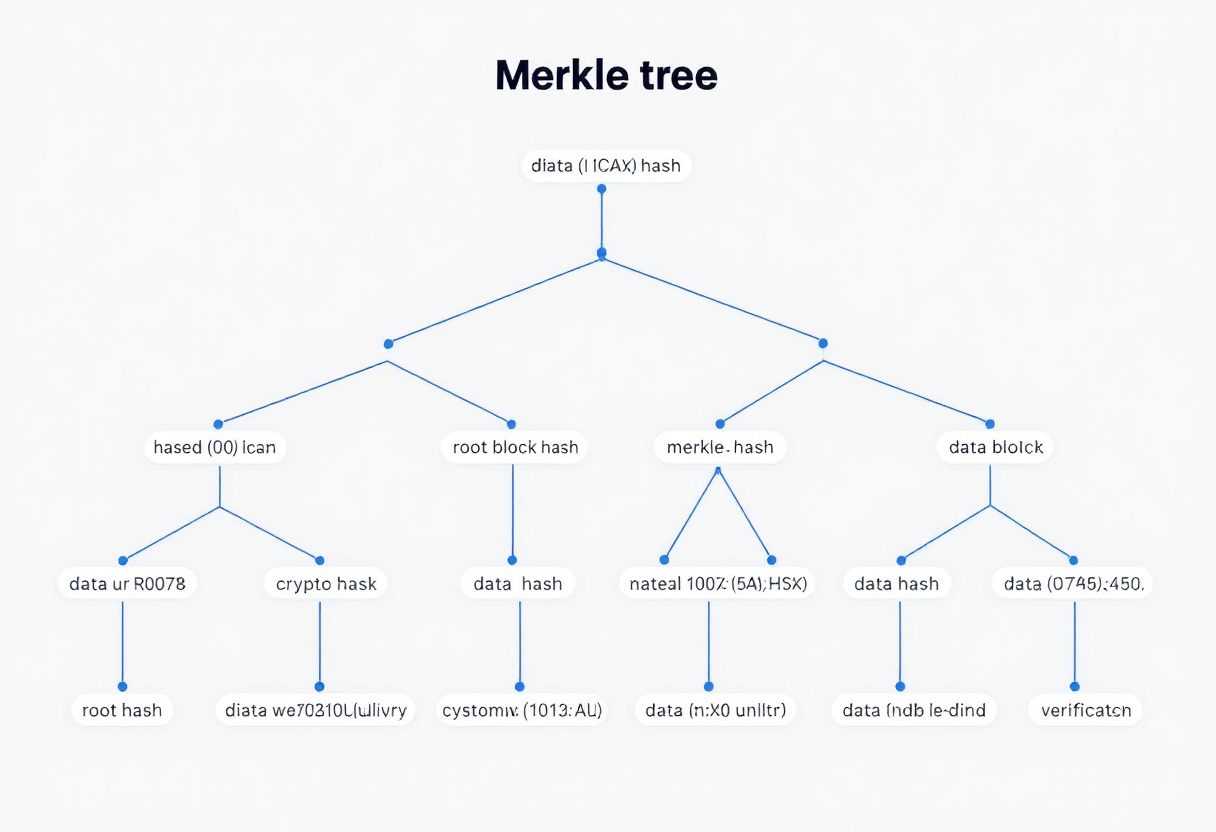
A Merkle tree, also known as a hash tree, is a data structure that enables quick and efficient verification of large amounts of data. It organizes data into a tree-like format where each leaf node represents a cryptographic hash of a transaction, and every non-leaf node is a hash of its child nodes. At the top of this tree sits the Merkle root—a single hash that represents the integrity of the entire data structure.
This design makes it easy to validate the authenticity of individual transactions without needing to process the entire blockchain. That’s a game-changer for scalability, especially in networks like Bitcoin and Ethereum, where thousands of transactions happen every second.
How Merkle Trees Work in Blockchain
Imagine a scenario where we have four transactions labeled as A, B, C, and D. Each transaction undergoes hashing, producing hash values HA, HB, HC, and HD. These hashes are then paired and hashed together, forming H(AB) and H(CD). Finally, these two are hashed again to create the Merkle root H(ABCD).
This hierarchical structure allows users to verify the authenticity of a single transaction by checking only a few hash values instead of scanning the entire blockchain. It’s an elegant and efficient method that ensures security while optimizing performance.
Why Merkle Trees Are Essential for Blockchain
1. Data Integrity and Tamper Resistance
Blockchain is all about immutability, and Merkle trees are a key component that ensures transactions remain untampered. If someone tries to modify a transaction, its hash will change, causing a ripple effect up the tree and altering the Merkle root. This makes it nearly impossible to alter a past transaction without detection.
2. Efficient Data Verification
Merkle trees enable lightweight verification, which is especially useful for Simplified Payment Verification (SPV) nodes. Instead of downloading the entire blockchain, an SPV node only needs the block headers and a small portion of the Merkle tree to verify transactions.
3. Scalability in Large Networks
With thousands of transactions occurring simultaneously in blockchain networks, efficiency is paramount. Merkle trees allow nodes to store only the necessary hash information while ensuring quick validation and minimal computational overhead.
Applications of Merkle Trees in Blockchain
Merkle trees aren’t just theoretical—they’re actively implemented in various blockchain applications. Here are a few notable use cases:
– Bitcoin and Ethereum: Both networks use Merkle trees to organize and verify transactions within a block, enhancing security and efficiency.
– IPFS (InterPlanetary File System): Merkle trees help structure distributed data storage, ensuring integrity in a decentralized system.
– Smart Contracts: Many blockchain-based smart contracts leverage Merkle proofs to verify the authenticity of specific data points without exposing the entire dataset.
– NFTs and Digital Assets: Merkle trees help verify ownership and authenticity of digital collectibles, ensuring provable scarcity.
Future of Merkle Trees in Blockchain
The role of Merkle trees in blockchain isn’t just limited to transaction verification. As technology evolves, new enhancements such as Verkle Trees—a more storage-efficient variation—are emerging. These could potentially revolutionize Ethereum’s scalability, reducing data size while maintaining the cryptographic security that Merkle trees offer. Moreover, the concept of zero-knowledge proofs (ZKPs) is closely tied to Merkle trees, allowing secure, private transactions without revealing unnecessary information. With these advancements, the blockchain space is set to become more secure, efficient, and scalable.
Wrapping Up
Merkle trees might not be the flashiest aspect of blockchain, but they are one of its most vital components. Without them, blockchain networks would struggle with data integrity, security, and scalability. Whether you’re a developer, an investor, or just a blockchain enthusiast, understanding the power of Merkle trees gives you a deeper appreciation of how this revolutionary technology works.
As blockchain continues to evolve, so too will the role of Merkle trees in ensuring data verification, reducing storage needs, and improving overall network efficiency. So, the next time you hear about transactions being “hashed” in a block, remember—the Merkle tree is quietly working behind the scenes, making sure everything stays secure and verifiable.
Stay informed with daily updates from Blockchain Magazine on Google News. Click here to follow us and mark as favorite: [Blockchain Magazine on Google News].
Disclaimer
Blockchain Magazine publishes content submitted by third-party agencies, partners, and clients. Any such posts are categorized and tagged accordingly:
- Sponsored Content: Posts labeled as "Sponsored" are paid placements submitted by third-party agencies or clients. Blockchain Magazine does not endorse or express any views regarding the information contained in these posts. The opinions expressed belong solely to the respective authors and do not reflect the official policy or position of Blockchain Magazine.
- Press Releases: Posts labeled as "Press Release" are paid PR submissions provided by our partners and clients. These are published as received and should be considered as promotional content.
The information provided in such posts is strictly for informational purposes only and should not be interpreted as financial, investment, or professional advice. Blockchain Magazine does not recommend, endorse, or promote any specific products, services, or companies mentioned. Readers are strongly encouraged to conduct independent research and consult with a qualified professional before making any financial or investment decisions.
Additionally, all featured images accompanying such posts are intended as creative depictions of the subject matter. There is no intent to offend or misrepresent any individual, institution, or entity. If any content or imagery is found to be objectionable, please reach out to us at [email protected], and we will promptly review the concern.
About the Author: Anna Woods





Get Blockchain Insights In Inbox
Stay ahead of the curve with expert analysis and market updates.