
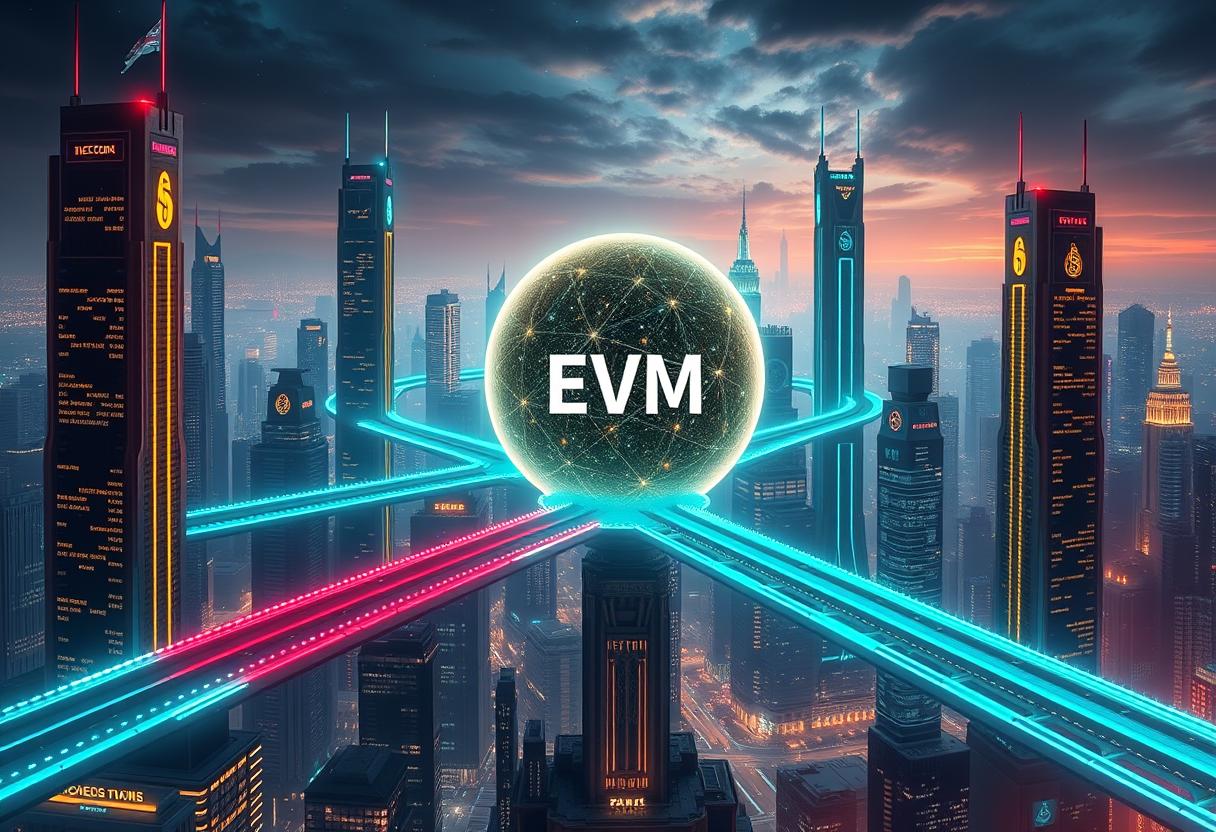
Building Bridges: How EVM Interoperability is Revolutionizing Cross-Chain Blockchain Communication
Imagine a world where every city had its own unique currency, language, and transport system with no way to travel between them. Chaos, right? That’s what the blockchain space looked like before Ethereum Virtua lMachine (EVM) interoperability entered the game. Each blockchain operated in its own bubble, making it nearly impossible to transfer assets or interact across networks. But that’s changing fast! Ethereum Virtual Machine (EVM) interoperability is smashing these barriers, creating a hyper-connected ecosystem where blockchains can finally talk to each other.
EVM: The Secret Sauce of Blockchain Compatibility
Think of the EVM as the brain that powers Ethereum and a growing list of other blockchains. It’s like the Android OS for smartphones—if your blockchain supports EVM, it can run Ethereum-based applications with zero modifications. This is a game-changer because it allows developers to build decentralized applications (dApps) that work seamlessly across multiple chains, unlocking endless possibilities for users and businesses alike.
Welcome to the Age of Cross-Chain Freedom
The dream of one blockchain to rule them all is dead. The future is multi-chain, where different blockchains serve different purposes but still communicate effortlessly. EVM interoperability makes this possible by allowing assets, data, and smart contracts to move between networks without friction. But how does this magic happen? Let’s dive in!
The Superheroes of Cross-Chain Connectivity
1. Cross-Chain Bridges: The Blockchain Highways
Ever used a toll bridge to cross a river? That’s what cross-chain bridges do for blockchains. They connect different networks, allowing users to transfer tokens and execute smart contracts across multiple chains. Popular blockchain bridges like Chainlink’s CCIP and Polygon’s zkEVM Bridge are making cross-chain transactions smoother and more secure than ever.
2. Sidechains: The Fast Lanes of Blockchain Traffic
Main blockchains, like Ethereum, often get congested. Sidechains act as express lanes, offering faster transactions at lower costs while staying connected to the main network. Polygon, Optimism, and Arbitrum are perfect examples of EVM-compatible sidechains that supercharge Ethereum without breaking its core structure.
3. The Inter-Blockchain Communication (IBC) Protocol: The Ultimate Translator
Not all blockchains speak the same language, but IBC is like Google Translate for crypto networks. Originally built for Cosmos, this protocol is now expanding to EVM-compatible chains, allowing them to exchange data and assets effortlessly.
Mechanisms Facilitating EVM Interoperability
Cross-chain bridges are protocols that enable the transfer of assets and data between different blockchain networks. For EVM-compatible chains, these bridges facilitate seamless token transfers and contract calls, effectively linking separate ecosystems. For instance, Chainlink’s Cross-Chain Interoperability Protocol (CCIP) provides a secure framework for enabling token transfers and messaging across blockchains, fostering the development of cross-chain applications.
Sidechains are separate blockchains that run parallel to the main chain (mainnet) and are often used to offload transactions, thereby reducing congestion. EVM-compatible sidechains allow developers to deploy their Ethereum-based dApps on these auxiliary networks, benefiting from faster transaction speeds and lower fees while maintaining interoperability with the mainnet.
Real-World Chaos Turned into Cross-Chain Magic
DeFi Goes Cross-Chain – More Money, More Power
DeFi is evolving beyond single-chain limitations. Imagine borrowing crypto on Ethereum and repaying it on BNB Chain. Sounds insane? With cross-chain liquidity pools and lending protocols, it’s now a reality! Platforms like Aave, SushiSwap, and Thorchain are leveraging EVM interoperability to make DeFi bigger, better, and borderless.
NFTs That Travel Across Blockchains – Welcome to the Multiverse
What if you could mint an NFT on Ethereum, sell it on Solana, and use it in a Polygon-based game? That’s exactly what cross-chain NFT marketplaces like Rarible and Magic Eden are making possible. Interoperability is giving digital assets superpowers, making them usable across multiple ecosystems.
Businesses Finally Get Blockchain Without the Headache
Corporations hate complexity, and blockchain used to be a logistical nightmare for enterprises. Thanks to EVM interoperability, businesses can now connect private and public blockchains effortlessly. From supply chain tracking to global payments, companies are using hybrid blockchain models to streamline operations like never before.
The Dark Side: What Could Go Wrong?
Even superheroes have weaknesses. While EVM interoperability is revolutionizing the blockchain world, there are risks:
Security Threats – Cross-chain bridges have been juicy targets for hackers, leading to billion-dollar heists (think of the Ronin and Wormhole hacks).
Standardization Struggles – Not all blockchains play nice with each other. Without universal standards, interoperability can get messy.
Speed vs. Decentralization – Some solutions favor speed over security, which could compromise blockchain integrity.
The Future: One Giant, Interconnected Crypto Universe
The race to build the ultimate blockchain network is on. Ethereum 2.0, Layer 2 scaling, and emerging cross-chain protocols are paving the way for a truly decentralized, borderless financial system. The future isn’t about one blockchain winning over others—it’s about them working together. And with EVM interoperability, that future is closer than ever.
Stay informed with daily updates from Blockchain Magazine on Google News. Click here to follow us and mark as favorite: [Blockchain Magazine on Google News].
Disclaimer
Blockchain Magazine publishes content submitted by third-party agencies, partners, and clients. Any such posts are categorized and tagged accordingly:
- Sponsored Content: Posts labeled as "Sponsored" are paid placements submitted by third-party agencies or clients. Blockchain Magazine does not endorse or express any views regarding the information contained in these posts. The opinions expressed belong solely to the respective authors and do not reflect the official policy or position of Blockchain Magazine.
- Press Releases: Posts labeled as "Press Release" are paid PR submissions provided by our partners and clients. These are published as received and should be considered as promotional content.
The information provided in such posts is strictly for informational purposes only and should not be interpreted as financial, investment, or professional advice. Blockchain Magazine does not recommend, endorse, or promote any specific products, services, or companies mentioned. Readers are strongly encouraged to conduct independent research and consult with a qualified professional before making any financial or investment decisions.
Additionally, all featured images accompanying such posts are intended as creative depictions of the subject matter. There is no intent to offend or misrepresent any individual, institution, or entity. If any content or imagery is found to be objectionable, please reach out to us at [email protected], and we will promptly review the concern.
About the Author: Peter Raid





Get Blockchain Insights In Inbox
Stay ahead of the curve with expert analysis and market updates.