
XRP and Saudi Aramco – Debunking the Partnership Rumors
In late May 2025, social media buzzed with claims that Saudi Aramco, the world’s largest oil company, was partnering with XRP, the cryptocurrency developed by Ripple, to tokenize oil reserves on the XRP Ledger (XRPL). Fueled by posts on social media and a 50% surge in the obscure $WHITE token, the rumors suggested a groundbreaking blockchain deal. However, a closer look reveals no credible evidence linking XRP and Saudi Aramco directly. Let us break it down for you as to why these partnership claims are likely misinformation.
The Rumor – XRP and Saudi Aramco’s Alleged Partnership
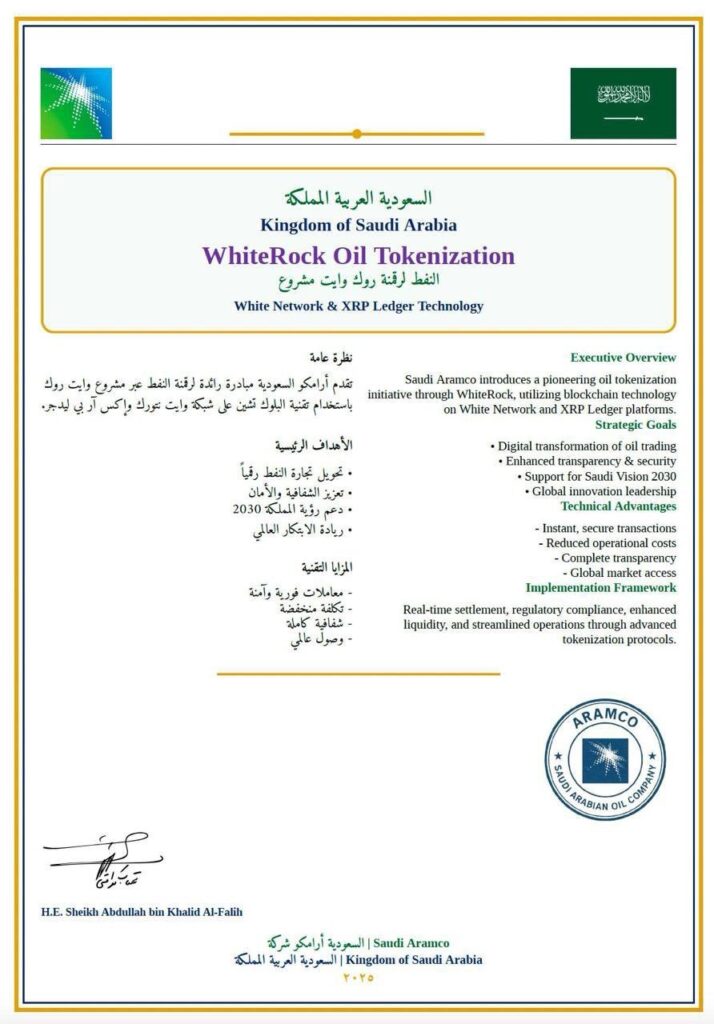
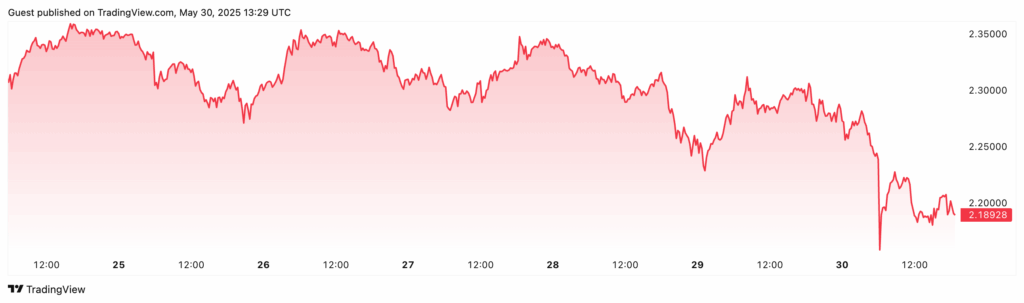
The speculation began on May 29, 2025, when a pseudonymous X user posted a document claiming Saudi Aramco was collaborating with a project called WhiteRock to tokenize oil on the XRP Ledger, describing it as “the biggest deal in blockchain tokenization history.” The post amplified by users sparked excitement, with $WHITE surging 116% and XRP climbing 4.3% to $2.20. The document, purportedly signed by a “Sheikh Abdullah bin Khalid Al-Falih,” outlined a partnership between Aramco, WhiteRock, and Ripple to digitize oil supply chains.
However, red flags quickly emerged:
-
Unverified Document: A reverse image search revealed the document’s signature resembled that of Iranian actress Mahtab Keramati, casting doubt on its authenticity. No “Sheikh Abdullah bin Khalid Al-Falih” exists in official Saudi records.
-
No Official Confirmation: Neither Saudi Aramco, Ripple, nor WhiteRock issued statements confirming the deal. Aramco’s official channels remained silent, and Ripple’s focus was on recent UAE partnerships with Zand Bank and Mamo.
-
Market Manipulation Concerns: The $WHITE token’s rapid surge suggested pump-and-dump tactics, a common scam in crypto where hype drives prices before insiders sell.
Read More: What is Blockchain ? What’s the fuss ?
Origins of the Confusion: Aramco’s SBI Holdings Deal
The rumors likely stem from a misinterpretation of a 2023 agreement between Saudi Aramco and SBI Holdings, a Japanese financial firm with ties to Ripple. In December 2023, Aramco signed a memorandum of understanding (MoU) with SBI Holdings to explore blockchain and digital asset investments as part of Saudi Arabia’s Vision 2030 diversification plan. This deal focused on general digital transformation, not XRP or oil tokenization.
XRP’s Real Use Cases – Cross Border Payments, Not Oil
XRP, created by Ripple, is designed for fast, low-cost cross-border payments, not commodity tokenization like oil. With a $128 billion market cap in May 2025, XRP ranks as the fourth-largest cryptocurrency. Ripple’s On-Demand Liquidity (ODL) service uses XRP as a bridge currency to convert fiat currencies instantly, processing over $70 billion in transactions across 90 markets. Recent partnerships with UAE based Zand Bank and Mamo highlight XRP’s role in real-time payment platforms, not energy sector applications.
While the XRP Ledger supports tokenization (e.g., for NFTs or stablecoins), no credible reports link it to oil tokenization. Ripple’s focus remains on financial institutions, with clients like Wellgistics Health adopting XRP for payment reserves, not commodity markets.
Saudi Aramco’s Blockchain Initiatives
Saudi Aramco, the backbone of Saudi Arabia’s economy, is indeed exploring blockchain as part of Vision 2030, which aims to diversify beyond oil. However, its efforts are unrelated to XRP:
-
Aramco Digital: In 2025, Aramco Digital partnered with LTIMindtree to launch NextEra, an IT services firm focused on AI, cloud, and hybrid cloud security, not cryptocurrencies.
-
AI and Data Centers: Aramco Digital collaborated with Cerebras Systems and Groq to deploy AI infrastructure and the Norous generative AI model, emphasizing high-performance computing over blockchain tokenization.
-
Investment in Tech: Aramco’s Wa’ed Ventures invested $19 million in Graphiant, a U.S. network connectivity startup, showing interest in digital infrastructure but not XRP.
Aramco’s blockchain explorations, like the 2023 SBI Holdings MoU, are broad and non-specific, focusing on digital transformation rather than direct crypto partnerships. Claims of XRP involvement appear to be speculative leaps by the crypto community.
The VivoPower Connection (A Separate Saudi-XRP Link)
Adding to the confusion, VivoPower International, a Nasdaq-listed energy firm, announced a $121 million private placement in May 2025 to build an XRP focused treasury strategy, led by Saudi Prince Abdulaziz bin Turki Abdulaziz Al Saud. The deal, backed by former SBI Ripple Asia executive Adam Traidman, aims to support XRPL ecosystem growth and DeFi projects.
While this move signals Saudi interest in XRP, it involves VivoPower, not Aramco, and focuses on corporate treasury, not oil tokenization.
Why the Rumors Persist if it so obvious ?
The XRP-Aramco rumors thrive due to:
-
Community Enthusiasm: XRP’s passionate community often amplifies unverified claims, driving market speculation.
-
Market Dynamics: XRP’s 4.3% price surge and $WHITE’s 116% spike show how rumors can move markets, attracting bad actors pushing pump and dump schemes.
-
Saudi’s Crypto Push: Saudi Arabia’s Vision 2030 and deals like VivoPower’s fuel speculation about broader crypto adoption, even without evidence.
-
Media Amplification: Sensationalized articles getting posted to cover it first leads to chaos like this.
Reuters noted in 2023 that crypto markets are vulnerable to misinformation, with exchange failures like FTX costing billions due to unchecked hype. The XRP-Aramco rumor fits this pattern, driven by unverified documents and community fervor.
Future of XRP and Aramco’s Blockchain – Independently !
XRP continues to thrive in cross-border payments, with Ripple’s UAE expansion and $2.20 price in May 2025 signaling strong institutional adoption. However, its role in oil tokenization remains speculative without evidence. Saudi Aramco, meanwhile, is advancing Vision 2030 through AI and IT partnerships, not XRP-based projects. The VivoPower deal shows Saudi interest in XRP, but Aramco’s focus is elsewhere, likely on energy and tech diversification.
As crypto markets mature, distinguishing hype from reality is crucial. Regulatory clarity, like the EU’s MiCA framework, may reduce misinformation, but investor diligence remains key.
Stay informed with daily updates from Blockchain Magazine on Google News. Click here to follow us and mark as favorite: [Blockchain Magazine on Google News].
Disclaimer
Blockchain Magazine publishes content submitted by third-party agencies, partners, and clients. Any such posts are categorized and tagged accordingly:
- Sponsored Content: Posts labeled as "Sponsored" are paid placements submitted by third-party agencies or clients. Blockchain Magazine does not endorse or express any views regarding the information contained in these posts. The opinions expressed belong solely to the respective authors and do not reflect the official policy or position of Blockchain Magazine.
- Press Releases: Posts labeled as "Press Release" are paid PR submissions provided by our partners and clients. These are published as received and should be considered as promotional content.
The information provided in such posts is strictly for informational purposes only and should not be interpreted as financial, investment, or professional advice. Blockchain Magazine does not recommend, endorse, or promote any specific products, services, or companies mentioned. Readers are strongly encouraged to conduct independent research and consult with a qualified professional before making any financial or investment decisions.
Additionally, all featured images accompanying such posts are intended as creative depictions of the subject matter. There is no intent to offend or misrepresent any individual, institution, or entity. If any content or imagery is found to be objectionable, please reach out to us at [email protected], and we will promptly review the concern.
About the Author: Lily Thompson

editor's pick



Get Blockchain Insights In Inbox
Stay ahead of the curve with expert analysis and market updates.