
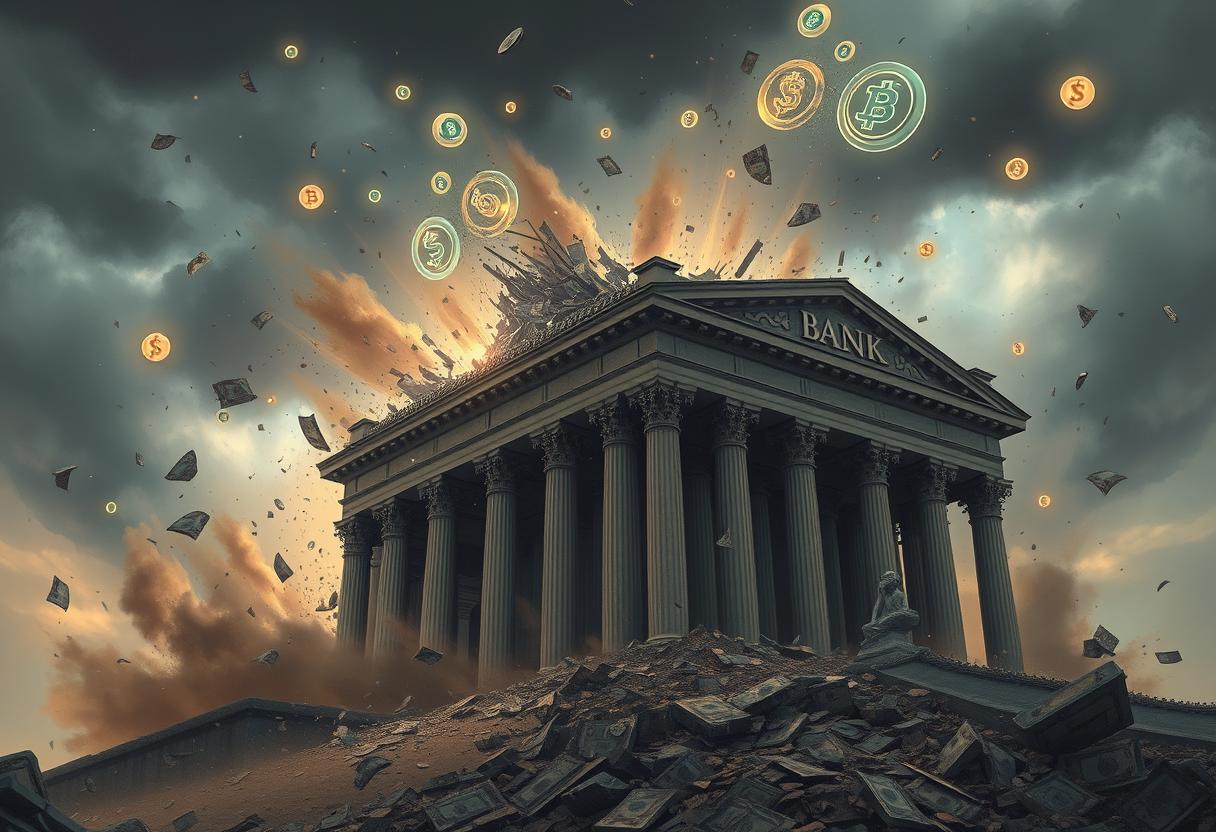
System Collapse Warning Protect Your Savings- Banks Launching Stablecoins For Survival
The financial landscape in 2025 is undergoing a seismic shift, driven by the rapid rise of stablecoins—digital currencies pegged to stable assets like the U.S. dollar or government securities. A compelling thread on X by GC Cooke (@thegrahamcooke), posted on March 3, 2025, highlights this transformation, warning of an urgent need to protect savings as major banks like JP Morgan, Citi, and Charles Schwab launch their own stablecoins to survive an impending systemic collapse. This article delves into the explosive growth of stablecoins, their impact on traditional banking, and why they’re poised to redefine money as we know it.
The Surge of Stablecoins: A $33 Trillion Market
Stablecoins have emerged as a cornerstone of the cryptocurrency ecosystem, processing a staggering $33 trillion in transactions in 2024 alone—outpacing traditional payment giants like Visa and Mastercard combined, according to data cited by Cooke. These digital assets, designed to maintain a stable value by being pegged 1:1 to assets like the U.S. dollar or Treasury bills, offer the speed and efficiency of crypto with the reliability of fiat currency. Their appeal lies in near-instant global transfers, negligible fees, and 24/7 accessibility, making them a formidable alternative to legacy banking systems.
This growth isn’t accidental. Stablecoins like USDT (Tether) and USDC (Circle) have become the backbone of decentralized finance (DeFi), enabling seamless cross-border payments and liquidity for blockchain-based applications. In 2025, their adoption is accelerating, driven by regulatory clarity and technological advancements, positioning them as the future of financial transactions.
Why Banks Are Scrambling to Launch Stablecoins
Cooke’s thread underscores a critical shift: traditional banks, once skeptical of cryptocurrency, are now racing to launch their own stablecoins to stay relevant. On February 26, 2025, Bank of America’s CEO publicly acknowledged the inevitability of stablecoins, reversing earlier dismissals of crypto as “dangerous.” JP Morgan, Citi, and Charles Schwab are following suit, driven by mounting pressures:
- Operating Costs: Traditional banks face astronomical expenses—$149.6 billion annually on salaries alone, per Cooke’s data—while stablecoin transactions cost a fraction, often 1/100th of traditional systems.
- DeFi Competition: Decentralized platforms process transactions instantly and at minimal cost, eroding banks’ market share.
- Customer Demand: Consumers and businesses crave the speed and transparency of stablecoins, pushing banks to adapt or risk obsolescence.
This desperation isn’t just strategic—it’s existential. Banks see stablecoins as a lifeline to remain competitive in a digital-first world, even as they grapple with the irony of adopting the very technology they once derided.
The Legislative Boost: Stablecoin Regulation in 2025
A major catalyst for stablecoins’ rise is the U.S. Congress’s groundbreaking legislation, announced in Trump’s first 100 days of 2025. This bipartisan framework, detailed in Cooke’s thread, mandates that stablecoins be 100% backed by real assets, undergo regular audits, and fall under federal oversight for transparency. Described as a “complete replacement of the old system” by advocates, this regulation aims to make stablecoins bulletproof, enhancing their appeal for mainstream adoption.
The legislation also drives demand for U.S. Treasuries, as stablecoins are often backed by these securities, reinforcing the dollar’s global dominance. For banks, this creates both opportunity and urgency: join the stablecoin revolution or fade into irrelevance.
Stablecoins vs. Traditional Banking: A New Paradigm
Stablecoins aren’t just an alternative—they’re a paradigm shift. Here’s how they stack up against traditional banking:
- Speed: Stablecoin transactions settle in seconds, compared to days for bank transfers.
- Cost: Fees are nearly zero, versus banks’ often steep charges for international transactions.
- Accessibility: Available 24/7, unlike banks with limited hours and branches.
- Transparency: Blockchain’s public ledger ensures every transaction is verifiable, reducing fraud risks.
Cooke’s thread highlights a grim reality for banks: their trillion-dollar infrastructure is becoming obsolete as DeFi platforms and stablecoins offer superior efficiency. With operating costs ballooning and crypto platforms gaining traction, banks face an existential crisis—hence their frantic pivot to stablecoins.
Risks and Challenges
Despite their promise, stablecoins aren’t without risks. Regulatory uncertainty, as seen in past controversies like Tether’s reserve audits, could undermine trust. Market volatility in backing assets, such as U.S. Treasuries, poses another challenge. Additionally, the potential for systemic collapse, as Cooke warns, hinges on banks’ ability to adapt without destabilizing the broader financial system.
The Future of Money: Stablecoins as Digital Dollars
Stablecoins are poised to become the “digital dollars” of the future, supercharged by blockchain technology. Backed by real assets and audited regularly, they offer stability akin to fiat currency but with the agility of crypto. Cooke’s assertion that “the old system is dying” resonates, as stablecoins promise to replace bloated, inefficient banking with a decentralized, user-centric model.
In 2025, the implications are staggering. Stablecoins could enable instant global payments for businesses, financial inclusion for the unbanked, and a new era of economic sovereignty for individuals. As banks like JP Morgan and Citi launch their own versions, the race is on to dominate this emerging market.
Summing Up
The rise of stablecoins, as highlighted in GC Cooke’s March 2025 X thread, marks a financial revolution that’s reshaping banking. With a $33 trillion transaction volume, regulatory backing, and banks’ desperate pivot, stablecoins are not just a trend—they’re the future of money. For individuals, protecting savings in this shifting landscape means understanding and leveraging stablecoins before the system fully transforms. The window of opportunity is narrow, but the potential for a decentralized, efficient financial world is immense.
Stay informed with daily updates from Blockchain Magazine on Google News. Click here to follow us and mark as favorite: [Blockchain Magazine on Google News].
Disclaimer
Blockchain Magazine publishes content submitted by third-party agencies, partners, and clients. Any such posts are categorized and tagged accordingly:
- Sponsored Content: Posts labeled as "Sponsored" are paid placements submitted by third-party agencies or clients. Blockchain Magazine does not endorse or express any views regarding the information contained in these posts. The opinions expressed belong solely to the respective authors and do not reflect the official policy or position of Blockchain Magazine.
- Press Releases: Posts labeled as "Press Release" are paid PR submissions provided by our partners and clients. These are published as received and should be considered as promotional content.
The information provided in such posts is strictly for informational purposes only and should not be interpreted as financial, investment, or professional advice. Blockchain Magazine does not recommend, endorse, or promote any specific products, services, or companies mentioned. Readers are strongly encouraged to conduct independent research and consult with a qualified professional before making any financial or investment decisions.
Additionally, all featured images accompanying such posts are intended as creative depictions of the subject matter. There is no intent to offend or misrepresent any individual, institution, or entity. If any content or imagery is found to be objectionable, please reach out to us at [email protected], and we will promptly review the concern.
About the Author: Anaya Malhotra

editor's pick




Get Blockchain Insights In Inbox
Stay ahead of the curve with expert analysis and market updates.