

How DeFi Trading Bots Are Unlocking Wall Street: ‘Trojan on Solana’ Hits $25 Billion Volume
Can DeFi trading bots challenge Wall Street’s historic barriers of executing sophisticated trading strategies for the privileged few? A Telegram-integrated crypto trading platform achieves institutional-scale volume while preserving decentralized principles for 2 million smartphone users, proving DeFi can compete without compromising user control.
KEY POINTS:
- Wall Street Tools for Everyone: Trading bot ‘Trojan on Solana’ revealed that 2 million everyday users now execute sophisticated trading strategies that were previously exclusive to hedge funds and institutional traders—all through simple text messages.
- Real Money, Real Impact: $25 billion in trading volume represents actual wealth creation opportunities that didn’t exist for regular people before, proving financial barriers can be broken.
- Technology That Actually Works: ‘Trojan on Solana’ maintains complete user control over funds while delivering institutional-speed execution, showing decentralized finance can compete with traditional banks.
Through simple Telegram commands, 2 million smartphone users are able to challenge traditional Wall Street brokers. For over a century, sophisticated trading strategies remained locked behind the walls of investment banks and hedge funds. The tools that generated billions in profits—lightning-fast execution, cross-market arbitrage, advanced protection against market manipulation—were exclusively available to those with million-dollar technology budgets and armies of quantitative analysts.
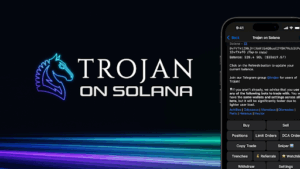
That monopoly just ended based on what we currently know from the recent achievements of Trojan on Solana, a trading bot that operates through Telegram messages and has democratized access to sophisticated DeFi trading strategies on Solana. By integrating into Telegram’s cloud-messaging platform, ‘Trojan on Solana’ has quietly orchestrated one of the most significant democratization events that we have arguably experienced thus far.
When you build it, users will come, and mainstream adoption is becoming a reality. Telegram’s secure, cloud-based messaging platform plays a key role by integrating easy-to-use DeFi tools like ‘Trojan on Solana’ directly within the app, connecting millions of users—no matter their experience—to fast, reliable trading on blockchains like Solana.
The platform’s competitive moat centers on three key differentiators: cross-chain Ethereum-Solana bridge capabilities that competitors lack, advanced MEV protection safeguarding retail traders from institutional exploitation, and zero-delay execution enabling effective participation in fast-moving markets.
According to a recent press release reviewed by Blockchain Magazine, with 2 million users collectively generating $25 billion in trading volume, the platform has proven that Wall Street’s most guarded advantages can be packaged into simple text commands accessible to anyone with a smartphone.
Numbers That Tell a Realistic Story
The raw metrics are staggering, but they reveal something more profound than growth. When ‘Trojan on Solana’ launched in January 2024, sophisticated DeFi trading required technical expertise that excluded most retail investors. Users needed to understand blockchain mechanics, navigate complex interfaces, and compete against institutional-grade systems with million-dollar advantages.
Twelve months later, 2 million everyday users are executing the same strategies that hedge funds deploy—sniping new token launches, executing cross-chain arbitrage, and protecting against front-running attacks—all through messages as simple as “buy 1 ETH of [insert your token of choice].”
The platform’s $25 billion in trading volume isn’t just impressive in isolation. It represents a fundamental shift in market dynamics. These aren’t institutional whales moving massive positions; they’re college students, small business owners, and retirees collectively generating more trading activity than many traditional exchanges handle in months.
Are Trading Bots a New Threat to Traditional Finance?
The timing of Trojan on Solana’s ascent couldn’t be more striking. Wall Street’s leading stock traders just achieved their most profitable quarter on record in Q1 2025, as the six largest U.S. banks generated about $39 billion in second-quarter profit, outstripping analysts’ expectations and collectively jumping more than 20% from core earnings a year ago.
Goldman Sachs, for example, joined the ranks alongside JPMorgan Chase and Morgan Stanley in reporting equities trading revenue that exceeded expectations, capitalizing on heightened market volatility driven significantly by Trump administrationTrump administration policies.
Earlier this month, CNBC reported that the “real surprise” came from investment banking–mergers advice, IPOs and debt and equity issuance. JP Morgan CEO Jeremy Barnum told CNBC that to “some extent, the pickup in investment banking fees reflects individuals accepting uncertainty and deciding to carry on with transactions,” further noting that the corporate community has somewhat come to the realization that the only way forward is to survive the current reality.
Yet while Wall Street celebrates record profits, Trojan’s 2 million users are accessing the same sophisticated tools that generate these returns—without paying the same fees, spreads, and intermediary costs that fuel traditional banking profits. The implications extend far beyond cryptocurrency markets. When retail users can access institutional-grade tools through a globally embraced cloud-messaging app, the value proposition of expensive financial intermediaries becomes questionable.
To put it in another perspective, Trojan on Solana’s recent success demonstrates that the technological moats which have historically protected traditional financial institutions are more fragile than assumed. Let’s consider the competitive advantages that investment banks have relied upon for decades:
- Speed and execution: Trojan on Solana delivers zero-delay price feeds and institutional-speed execution through simple commands.
- Market protection: Advanced MEV (Maximum Extractable Value) protection shields retail users from the same predatory practices that institutional traders use against them in traditional markets.
- Cross-market access: The platform’s Ethereum-Solana bridge functionality provides trading opportunities across different ecosystems—something that typically requires multiple broker relationships and complex settlement processes.
- Capital efficiency: Users maintain complete custody of their funds while accessing sophisticated strategies, eliminating the counterparty risk and fees associated with traditional intermediaries.
The Solana Ecosystem Effect
Credit: trojan
Trojan on Solana’s impact ripples far beyond individual user success, contributing to a broader transformation as traditional DeFi shows signs of institutional maturation–where Q1 2025, according to CoinDesk, “[told] a clear story about DeFi’s evolution.” In March, CoinDesk reported DeFi yields having “declined sharply” across all major lending platforms:
“As yields have fallen from nearly 15% to under 5%, capital has remained sticky,” CoinDesk noted, indicating its belief that this “contradictory behavior” reflected an increasing institutional comfort with DeFi protocols being more formally recognized as “legitimate financial infrastructure rather than speculative vehicles.”
While traditional DeFi has struggled, Solana’s ecosystem has bucked this trend dramatically, with ‘Trojan’ contributing significantly to Solana’s explosive growth, which occurred as the broader DeFi market faced headwinds, and as DeFi tokens soared alongside Bitcoin’s record highs, outperforming traditional cryptocurrencies like Litecoin and Bitcoin Cash.
CoinDesk reported earlier this month that the total value locked in Bitcoin-native protocols increased 20-fold from $307 million to $6.3 million between January 2024 and mid-2025. But Trojan on Solana’s ongoing contributions to the broader Solana ecosystem, coupled with its recent milestones aren’t coincidental.
“By enabling 2 million users to participate in sophisticated trading strategies, Trojan on Solana created liquidity flows and market dynamics that didn’t previously exist,” said a company representative to Blockchain Magazine.
Each user’s individual trading activity combines into ecosystem-wide effects that benefit all participants, which reinforces why Solana’s success has been particularly remarkable, driven by retail participation rather than institutional capital. While Wall Street banks like Morgan Stanley saw equity trading revenues soar 45% in Q1 2025 and JPMorgan set records for equities trading revenue, Solana’s growth came from millions of individual users accessing similar capabilities through a trading bot infrastructure like Trojan.
With up to 62,000 daily active users and 155 million lifetime trades, Trojan on Solana ranks among the 21 highest revenue-generating blockchain applications as of press time, with approximately $51 million in revenue generated in Q1 2025 alone–further demonstrating that democratizing access doesn’t mean sacrificing profitability.
Earlier this year, Bloomberg reported that this performance comes as the broader DeFi market shows signs of institutional acceptance, with BlackRock’s spot Ethereum ETF in early January reaching $10 billion in assets amid 14 straight days of inflows.
Trojan on Solana’s success further suggests that expanding the pool of sophisticated traders creates more sustainable value than the industry’s previous approach of restricting access to institutional players–or the privileged few.
Trading Bots Might Solve the Decentralization Paradox
Perhaps most remarkably, Trojan on Solana achieved this scale while maintaining the principles that define decentralized finance. Users retain complete custody of their funds, all trades execute directly on decentralized exchanges, and complete transparency allows on-chain verification of every operation.
This solves a fundamental paradox that has plagued DeFi since its inception: how to deliver the speed and sophistication needed to compete with traditional finance while preserving decentralization and user sovereignty. Traditional finance has long argued that efficiency requires centralization—that sophisticated trading demands the kind of institutional infrastructure that necessarily concentrates power and control. Trojan on Solana’s growing case appears to prove this assumption wrong.
Driving (Financial) Social Good: Real Money, Real People
The broader implications are profound, to say the least. Market volatility, for example, from the Trump administration’s rapidly “evolving” policies has boosted traditional trading revenues, yet that same volatility demonstrates retail traders’ need for sophisticated tools to navigate uncertain markets. If 2 million retail users can collectively generate $25 billion in sophisticated trading volume while maintaining complete control over their funds, what does this mean for the future role of banks, brokers, and other financial intermediaries?
The transformation isn’t theoretical. It’s happening now, measurably, with real money and real people. Every successful trade executed through a simple Telegram message represents a transaction that didn’t require traditional financial infrastructure.
The trading bot’s success suggests we’re witnessing the early stages of a fundamental restructuring of how financial markets operate–or how they can/should operate. While the global DeFi market is projected to reach $351.75 billion by 2031 with a 48.9% CAGR, platforms like Trojan demonstrate that growth will come from accessibility rather than exclusivity. Not through regulatory changes or institutional adoption, but through purposeful technology development and design architecture that makes sophisticated tools accessible to everyone.
The ‘Monopoly’ Breaks, Upholding DeFi’s Promise
For decades, access to advanced trading strategies served as a moat protecting institutional profits on Wall Street. Retail investors were relegated to basic buy-and-hold strategies or expensive mutual funds that charged high fees for professional management.
Trojan on Solana demonstrates that this artificial scarcity was just that—artificial. The tools existed; they were simply gatekept behind unnecessary complexity and institutional barriers. The value proposition here isn’t merely about a successful trading bot, but rather about validating an entirely new model for how financial markets can operate: open, accessible, and beneficial to everyone.
When those barriers fall, extraordinary things can happen–individual empowerment scales to ecosystem transformation, retail users become sophisticated market participants, and decentralized systems compete directly with centralized institutions.
Looking behind these impressive numbers, Trojan on Solana seems to have prioritized and validated DeFi’s fundamental promise: that decentralized financial tools can be both sophisticated enough to compete with traditional markets and accessible enough for mainstream adoption. The monopoly that Wall Street has historically maintained over sophisticated trading isn’t protected by fundamental technological limitations. It was protected by access restrictions that technology can now eliminate.
Why This Achievement is More Than Just ‘Growth’
The design architecture of the trading bot has so far demonstrated that Wall Street’s century-old monopoly on sophisticated trading can be broken—not through regulation or institutional disruption, but by simply giving regular people the tools they were always capable of using. That’s not to dismiss current and future regulation, as the global economy is desperately in need of foundational guidance, but this goes to show that the vision of “mass adoption” depends on a multitude of complex factors that are clearly driven by the average consumer’s demand for equal access to educational resources and emerging infrastructures. So, what does Trojan on Solana’s infrastructure reveal thus far?
- DeFi tools that are sophisticated yet accessible
- Decentralized yet efficient
- Inclusive yet competitive
- Transparent yet user-friendly
What’s clear is that each user has gained access to powerful financial tools they couldn’t use before, creating new liquidity flows, trading opportunities and economic activity that didn’t exist previously–for the benefit of all Solana DeFi participants. When you multiply that individual empowerment across millions, the positive impact on the whole ecosystem is extraordinary. This milestone represents a critical mass that makes the entire financial ecosystem more valuable.
The question isn’t whether this transformation will continue. With millions of users now experienced in sophisticated DeFi strategies and institutional-grade tools accessible through smartphone messages, the monopoly is already broken.
Rather, the question that we should be asking is how quickly the rest of the financial world will adapt to this new reality.
Stay informed with daily updates from Blockchain Magazine on Google News. Click here to follow us and mark as favorite: [Blockchain Magazine on Google News].
Stay informed with daily updates from Blockchain Magazine on Google News. Click here to follow us and mark as favorite: [Blockchain Magazine on Google News].
Disclaimer
Blockchain Magazine publishes content submitted by third-party agencies, partners, and clients. Any such posts are categorized and tagged accordingly:
- Sponsored Content: Posts labeled as "Sponsored" are paid placements submitted by third-party agencies or clients. Blockchain Magazine does not endorse or express any views regarding the information contained in these posts. The opinions expressed belong solely to the respective authors and do not reflect the official policy or position of Blockchain Magazine.
- Press Releases: Posts labeled as "Press Release" are paid PR submissions provided by our partners and clients. These are published as received and should be considered as promotional content.
The information provided in such posts is strictly for informational purposes only and should not be interpreted as financial, investment, or professional advice. Blockchain Magazine does not recommend, endorse, or promote any specific products, services, or companies mentioned. Readers are strongly encouraged to conduct independent research and consult with a qualified professional before making any financial or investment decisions.
Additionally, all featured images accompanying such posts are intended as creative depictions of the subject matter. There is no intent to offend or misrepresent any individual, institution, or entity. If any content or imagery is found to be objectionable, please reach out to us at [email protected], and we will promptly review the concern.
About the Author: Andrew Rossow, Esq.

editor's pick




Get Blockchain Insights In Inbox
Stay ahead of the curve with expert analysis and market updates.