

Why Is Crypto Crashing Today? Trade Tensions and Liquidations Drive Prices Down
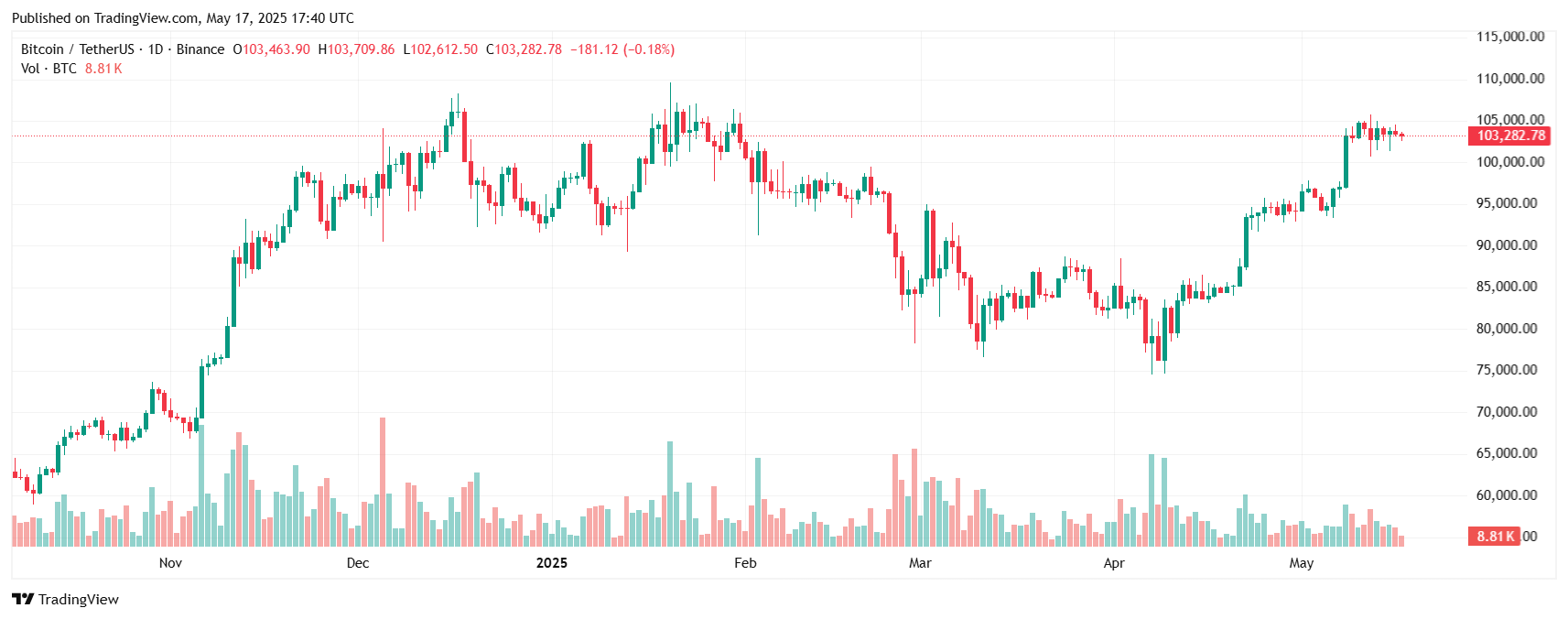
The cryptocurrency market is grappling with a short downturn on May 17, 2025, with Bitcoin (BTC) dropping below $104,000, marking its lowest level since last 7 days (also depicted in chart below).
The total crypto market capitalization has fallen by approximately 2.65%, to $3.27 trillion in the past 24 hours, according to coinmarketcap.
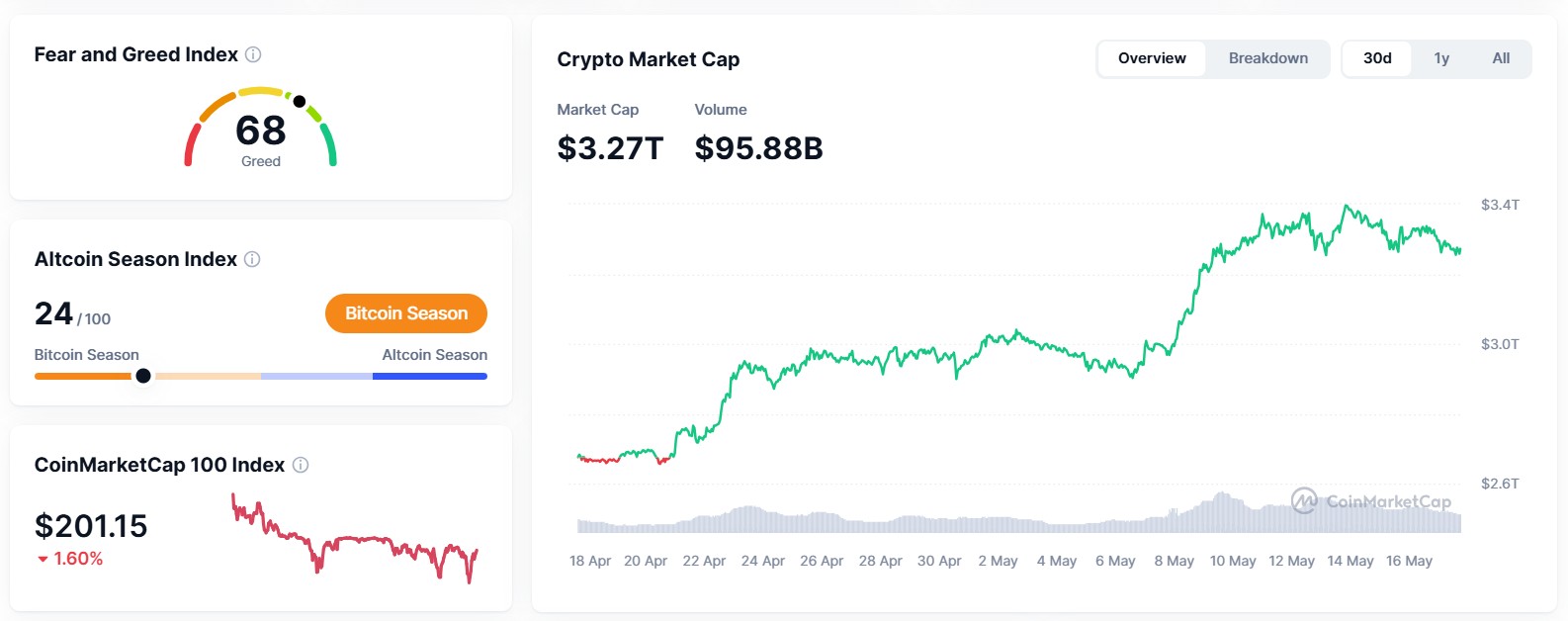
This crash is driven by a confluence of factors, including escalating trade tensions sparked by U.S. tariff policies, substantial liquidations in the futures market, and broader macroeconomic concerns. This article provides a detailed analysis of the reasons behind today’s crypto market crash, drawing on the latest data and expert insights.
Escalating Trade Tensions
A primary catalyst for the current crypto market crash is the trade policies introduced by the Trump administration. The impact on the crypto market has been significant, as cryptocurrencies are often correlated with other high-risk investments. Susannah Streeter, head of money and markets at Hargreaves Lansdown, noted that “high risk-off sentiment” is canceling out optimism about a more favorable environment for cryptocurrencies. This sentiment was echoed by billionaire investor Bill Ackman, who warned of a potential “economic nuclear winter” in the U.S., further dampening investor confidence.
Technical Liquidations Fuel Volatility
Another reason for the crypto market’s decline has been exacerbated by technical factors, particularly the liquidation of high-leverage positions in the futures market. Data from coinmarketcap indicates that $245.37 million in positions were liquidated in the 24 hours with $173.83 million in long positions and $71.55 million in short positions. Bitcoin accounted for $51.54 million of these liquidations, followed by Ethereum at $49.81 million. More recently, on May 14, 2025, a significant cluster of high-leverage long positions was liquidated around the $100,587 level, triggering stop-losses and margin calls.
This liquidation event caused Bitcoin to plummet from a high of $105,819 to a low of $103,718 on May 14, 2025, before stabilizing slightly. The volatility between the $103,718 low and $105,819 high swept liquidity, affecting overexposed traders and amplifying the downward pressure on prices.
Macroeconomic Pressures
Beyond trade tensions and liquidations, macroeconomic factors are also contributing to the crypto market’s woes. Concerns about potential recessions and inflationary pressures have led to increased market volatility. These concerns are particularly acute given the broader economic environment, with rising U.S. deficits and a volatile bond market expected to impact risk assets in 2025, according to economist Mark Zandi of Moody’s.
The crypto market’s correlation with traditional financial markets has also played a role. The tech sector, which often moves in tandem with cryptocurrencies, has been under pressure due to new restrictions on Nvidia’s chip exports to China, causing a downturn in Wall Street indices like the Nasdaq 100. Additionally, gold’s outperformance, rising 26.50% year-to-date to $3,317 per ounce compared to Bitcoin’s 11.50% decline, signals a shift in investor preference toward safer assets.
Institutional Confidence Amid the Crash
Despite the bearish market conditions, there are signs of resilience from institutional investors. On May 14, 2025, Bitcoin exchange-traded funds (ETFs) saw inflows of $319 million, with BlackRock’s IBIT contributing $232.9 million and Fidelity’s FBTC adding $36.1 million. These inflows suggest that institutional players view the current dip as a buying opportunity, reflecting long-term confidence in Bitcoin’s value proposition.
However, this optimism is tempered by recent regulatory filings showing that some high-profile asset managers reduced their stakes in spot Bitcoin ETFs during the first quarter of 2025, amid a 12% drop in Bitcoin’s price. This mixed sentiment underscores the complexity of the current market environment.
Potential Risks and Considerations
The crypto market’s volatility underscores the inherent risks of investing in cryptocurrencies. The reliance on high-leverage trading strategies, as seen in the recent liquidations, can amplify price swings, making the market susceptible to rapid declines. Moreover, the market’s correlation with global economic events, such as trade wars and macroeconomic shifts, means that external factors can have outsized impacts.
Investors should also be cautious of speculative narratives. While some analysts, like Scott Melker, predict Bitcoin could reach $250,000 by the end of 2025 due to growing institutional interest, others warn of further downside risks if trade tensions persist or if bond yields rise, as predicted by Mark Zandi.
Future Outlook
The crypto market’s recovery will hinge on several factors, including the resolution of trade tensions, stabilization of global financial markets, and continued institutional adoption. Analysts are monitoring key support levels for Bitcoin, with $91,028 identified as a critical threshold where $15.95 billion in long positions could be at risk if breached. Conversely, a move above $115,724 could liquidate $5.77 billion in short positions, potentially sparking a rally.
In the longer term, the crypto market’s trajectory will depend on its ability to decouple from traditional risk assets, as suggested by crypto entrepreneur Trevor Koverko. Until then, cryptocurrencies will likely remain sensitive to macroeconomic and geopolitical developments.
The crypto market crash on May 17, 2025, is a stark reminder of the sector’s volatility and its interconnectedness with global economic events. Escalating trade tensions, driven by U.S. tariff policies, have created a risk-off environment, while technical liquidations have amplified price declines. Despite these challenges, institutional inflows into Bitcoin ETFs signal long-term optimism, suggesting that the current dip may present opportunities for strategic investors. As the market navigates this turbulent period, staying informed and exercising caution will be crucial for participants.
Stay informed with daily updates from Blockchain Magazine on Google News. Click here to follow us and mark as favorite: [Blockchain Magazine on Google News].
Disclaimer
Blockchain Magazine publishes content submitted by third-party agencies, partners, and clients. Any such posts are categorized and tagged accordingly:
- Sponsored Content: Posts labeled as "Sponsored" are paid placements submitted by third-party agencies or clients. Blockchain Magazine does not endorse or express any views regarding the information contained in these posts. The opinions expressed belong solely to the respective authors and do not reflect the official policy or position of Blockchain Magazine.
- Press Releases: Posts labeled as "Press Release" are paid PR submissions provided by our partners and clients. These are published as received and should be considered as promotional content.
The information provided in such posts is strictly for informational purposes only and should not be interpreted as financial, investment, or professional advice. Blockchain Magazine does not recommend, endorse, or promote any specific products, services, or companies mentioned. Readers are strongly encouraged to conduct independent research and consult with a qualified professional before making any financial or investment decisions.
Additionally, all featured images accompanying such posts are intended as creative depictions of the subject matter. There is no intent to offend or misrepresent any individual, institution, or entity. If any content or imagery is found to be objectionable, please reach out to us at [email protected], and we will promptly review the concern.
About the Author: Lily Thompson



Get Blockchain Insights In Inbox
Stay ahead of the curve with expert analysis and market updates.