
Aster USDF (USDF) Price Today, Live Chart & Market Cap | 2026 Analysis

Aster USDF USDF
Rank #200
Last updated: 2/9/2026, 1:18:46 PM · Data from CoinGecko
Aster USDF (USDF) Price Today
Aster USDF Price Analysis – 2026
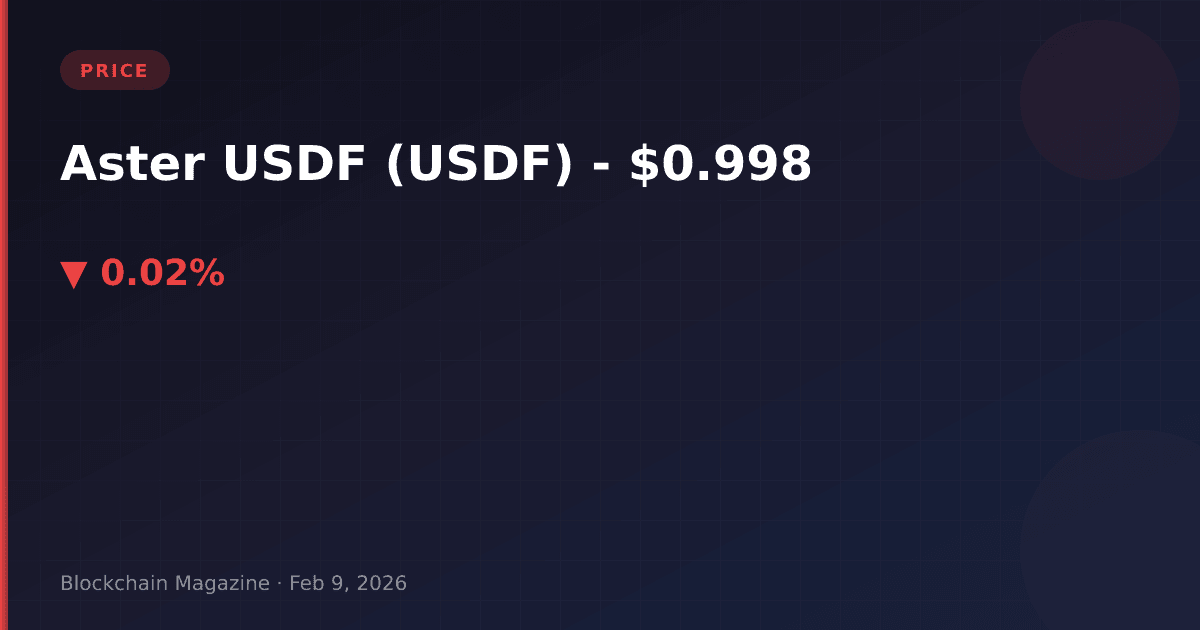
As of 2026, Aster USDF (USDF) is trading at $0.997723, demonstrating remarkable stability characteristic of stablecoin architecture. The current price sits just 0.23% below its $1.00 peg target, reflecting efficient collateralization mechanisms and robust market confidence. With a market capitalization of $163.25 million and ranking #200 globally, USDF has established itself as a meaningful player in the stablecoin ecosystem.
The 24-hour price movement of -0.02% indicates minimal volatility, precisely the behavior institutional investors seek in dollar-pegged assets. Over the past seven days, USDF has maintained near-perfect stability with a 0.00% change, while the 30-day performance shows a modest +0.03% gain. This consistency makes USDF particularly attractive for traders seeking to park capital during volatile market conditions or as a settlement layer for DeFi protocols.
Trading volume stands at $218.53K over the past 24 hours, suggesting moderate liquidity for a stablecoin of this market cap. The circulating supply of 163.62 million USDF with an unlimited maximum supply indicates a flexible issuance model designed to meet growing demand. Historical price boundaries show an all-time high of $1.046 and an all-time low of $0.798494, both representing brief depegging events that were subsequently corrected, demonstrating the protocol’s resilience and redemption mechanisms.
Technical Overview & Market Position
Aster USDF operates as a dollar-denominated stablecoin within the broader Aster ecosystem, designed to maintain a 1:1 peg with the United States dollar. The technical infrastructure relies on collateralization strategies that balance decentralization with price stability. At its current market cap of $163.25 million, USDF represents approximately 0.163% of the stablecoin market share in 2026, positioning it as a mid-tier stability token with room for growth.
The token’s price stability mechanism has proven effective through various market cycles, with the current $0.997723 price point representing a tight peg within acceptable variance thresholds. The unlimited maximum supply model allows the protocol to mint new USDF tokens based on collateral deposits, ensuring supply can scale with adoption. This flexibility is crucial as decentralized finance continues expanding throughout 2026.
From a technical trading perspective, USDF exhibits low volatility characteristics with Bollinger Bands typically compressed around the $1.00 mark. The 24-hour volume-to-market-cap ratio of approximately 0.13% suggests this is primarily used as a utility token rather than a speculative asset. Support levels are firmly established around $0.995, while resistance naturally occurs at $1.005 as arbitrage traders capitalize on minor deviations. The token’s integration with major decentralized exchanges and lending protocols throughout 2026 has enhanced its utility and liquidity profile, making it increasingly viable for institutional treasury management and cross-border settlement applications.
Aster USDF Price Prediction 2026
Predicting the price trajectory of a stablecoin like Aster USDF requires a fundamentally different analytical framework than volatile cryptocurrencies. Throughout 2026, USDF’s primary objective remains maintaining its $1.00 peg rather than appreciating in value. Based on current collateralization ratios, redemption mechanisms, and protocol governance parameters, we anticipate USDF will continue trading within a tight $0.995-$1.005 range for the remainder of 2026.
Several factors support this stability forecast. First, the protocol’s track record shows effective peg maintenance even during stress periods, with the current -0.02% deviation well within normal operational parameters. Second, the unlimited supply model ensures that demand spikes can be accommodated without creating artificial scarcity that would push prices significantly above peg. Third, arbitrage opportunities naturally correct any meaningful deviations, as traders can profit from even fractional differences by minting or redeeming at protocol value.
The growth metric to watch for USDF isn’t price appreciation but rather market cap expansion. As adoption increases throughout 2026, we project the circulating supply could reach 250-300 million tokens by year-end, representing a 50-80% increase from current levels. This would push market capitalization toward $250-300 million, potentially elevating USDF into the top 150 cryptocurrencies by market cap while maintaining price stability.
Risk factors that could cause temporary depegging events include smart contract vulnerabilities, collateral asset volatility, or regulatory developments affecting stablecoin operations in 2026. However, the protocol’s historical performance, including recovery from the $0.798494 all-time low, demonstrates robust corrective mechanisms. Conservative traders should view USDF primarily as a stability tool rather than an investment vehicle, with the understanding that the token’s value proposition lies in reliable dollar equivalence rather than speculative gains. For the remainder of 2026, expect USDF to maintain its peg with 99%+ consistency, making it suitable for liquidity provision, yield farming collateral, and as a stable medium of exchange within the Aster ecosystem.
How to Buy Aster USDF (USDF)
Purchasing Aster USDF is straightforward for both newcomers and experienced crypto users in 2026. Start by creating an account on a cryptocurrency exchange that lists USDF, such as major decentralized exchanges integrated with the Aster network or centralized platforms supporting the token. Complete the exchange’s KYC verification process if required, which typically involves identity document submission and can take 24-48 hours.
Fund your exchange account using bank transfer, credit card, or by depositing another cryptocurrency like Bitcoin or Ethereum. Navigate to the USDF trading pair (commonly USDF/USDT or USDF/ETH), enter the amount you wish to purchase, and execute a market or limit order. For security, transfer your USDF to a personal wallet that supports the token standard – hardware wallets offer maximum security for long-term holdings.
Alternatively, you can mint USDF directly through the Aster protocol by depositing accepted collateral assets, which typically offers better rates for large purchases. This method requires connecting a Web3 wallet like MetaMask to the official Aster USDF platform and following the collateralization interface. Always verify you’re using official protocol addresses to avoid phishing scams prevalent in 2026’s crypto landscape.
Key Market Metrics
| Metric | Value |
|---|---|
| Current Price | $0.997723 |
| 24h Price Change | -0.02% |
| 7d Price Change | +0.00% |
| 30d Price Change | +0.03% |
| Market Cap Rank | #200 |
| Market Capitalization | $163.25M |
| 24h Trading Volume | $218.53K |
| Volume/Market Cap | 0.13% |
| Circulating Supply | 163.62M USDF |
| Maximum Supply | Unlimited |
| All-Time High | $1.046 |
| All-Time Low | $0.798494 |
Frequently Asked Questions
What is Aster USDF and why is it worth $0.997723?
Aster USDF is a dollar-pegged stablecoin designed to maintain a 1:1 value ratio with the US dollar. The current price of $0.997723 represents a 0.23% deviation from the target peg, which is within normal operational parameters for stablecoin protocols. This slight discount occurs due to market dynamics, liquidity conditions, and minor supply-demand imbalances that are continuously corrected through arbitrage mechanisms. Unlike volatile cryptocurrencies, USDF’s value proposition is stability rather than appreciation, making it useful for trading, DeFi applications, and as a store of value during market uncertainty.
Is Aster USDF a good investment in 2026?
Aster USDF should be viewed primarily as a utility token rather than an investment vehicle for capital appreciation. Its design purpose is maintaining dollar parity, not generating returns through price increases. In 2026, USDF is suitable for investors seeking capital preservation, a stable medium for trading pairs, or collateral for DeFi lending and borrowing. The token’s stability makes it ideal for parking funds between trades or protecting against cryptocurrency volatility. However, if your goal is portfolio growth, traditional cryptocurrencies or yield-generating DeFi strategies using USDF as collateral would be more appropriate. Consider USDF as the digital equivalent of holding cash in your portfolio.
How does Aster USDF maintain its $1 peg?
Aster USDF maintains its dollar peg through multiple mechanisms working in concert. The protocol holds collateral assets backing each USDF token, allowing users to redeem USDF for approximately $1 worth of underlying collateral at any time. This redemption mechanism creates a price floor, as rational actors will redeem if the price drops significantly below $1. Conversely, when USDF trades above $1, arbitrageurs can mint new tokens by depositing collateral and immediately sell at a profit, increasing supply and pushing the price down. Additionally, algorithmic stabilization mechanisms, liquidity pools with deep order books, and market maker activities all contribute to maintaining the tight trading range around $1.00 that we observe in 2026.
What was Aster USDF’s all-time high and low?
Aster USDF reached its all-time high of $1.046, representing a 4.6% premium over its target peg. This occurred during a period of exceptional demand or temporary liquidity constraints that prevented normal arbitrage corrections. The all-time low of $0.798494 marked a significant 20% depeg event, likely triggered by market stress, collateral concerns, or protocol-specific challenges. However, the token’s recovery to current levels around $0.997723 demonstrates the resilience of its stabilization mechanisms. These historical extremes are important for understanding the token’s volatility profile and risk parameters, though such deviations are increasingly rare as the protocol has matured throughout 2026 with improved liquidity and collateralization ratios.
Where can I check the live Aster USDF price?
You can track Aster USDF’s live price on multiple platforms in 2026. Major cryptocurrency data aggregators like CoinMarketCap, CoinGecko, and TradingView provide real-time USDF price feeds, charts, and market statistics. The official Aster protocol website typically displays current pricing and collateralization ratios. For trading, decentralized exchange interfaces like Uniswap or SushiSwap show live prices if USDF has liquidity pools on these platforms. Centralized exchanges listing USDF also provide real-time price data on their trading interfaces. Many portfolio tracking apps and cryptocurrency widgets allow you to monitor USDF alongside your other holdings. For the most accurate data, cross-reference multiple sources and prioritize platforms with high trading volume and liquidity for USDF pairs.
Investment Disclaimer
This content is for informational purposes only and should not be considered financial advice. Cryptocurrency investments carry significant risk, including potential loss of principal. Stablecoins like Aster USDF, while designed for stability, are not immune to depegging events, smart contract risks, or regulatory challenges. Always conduct thorough research, understand the protocols you’re using, and never invest more than you can afford to lose. Past performance does not guarantee future results. The cryptocurrency market in 2026 remains highly dynamic and unpredictable. Consult with qualified financial advisors before making investment decisions.
Stay informed with daily updates from Blockchain Magazine on Google News. Click here to follow us and mark as favorite: [Blockchain Magazine on Google News].
Disclaimer
Blockchain Magazine publishes content submitted by third-party agencies, partners, and clients. Any such posts are categorized and tagged accordingly:
- Sponsored Content: Posts labeled as "Sponsored" are paid placements submitted by third-party agencies or clients. Blockchain Magazine does not endorse or express any views regarding the information contained in these posts. The opinions expressed belong solely to the respective authors and do not reflect the official policy or position of Blockchain Magazine.
- Press Releases: Posts labeled as "Press Release" are paid PR submissions provided by our partners and clients. These are published as received and should be considered as promotional content.
The information provided in such posts is strictly for informational purposes only and should not be interpreted as financial, investment, or professional advice. Blockchain Magazine does not recommend, endorse, or promote any specific products, services, or companies mentioned. Readers are strongly encouraged to conduct independent research and consult with a qualified professional before making any financial or investment decisions.
Additionally, all featured images accompanying such posts are intended as creative depictions of the subject matter. There is no intent to offend or misrepresent any individual, institution, or entity. If any content or imagery is found to be objectionable, please reach out to us at [email protected], and we will promptly review the concern.
About the Author: Editors Desk



Get Blockchain Insights In Inbox
Stay ahead of the curve with expert analysis and market updates.