
crvUSD (CRVUSD) Price Today, Live Chart & Market Cap | 2026 Analysis

crvUSD CRVUSD
Rank #134
Last updated: 2/9/2026, 1:09:06 PM · Data from CoinGecko
crvUSD (CRVUSD) Price Today: Real-Time Market Analysis
crvUSD Price Analysis: Current Market Performance
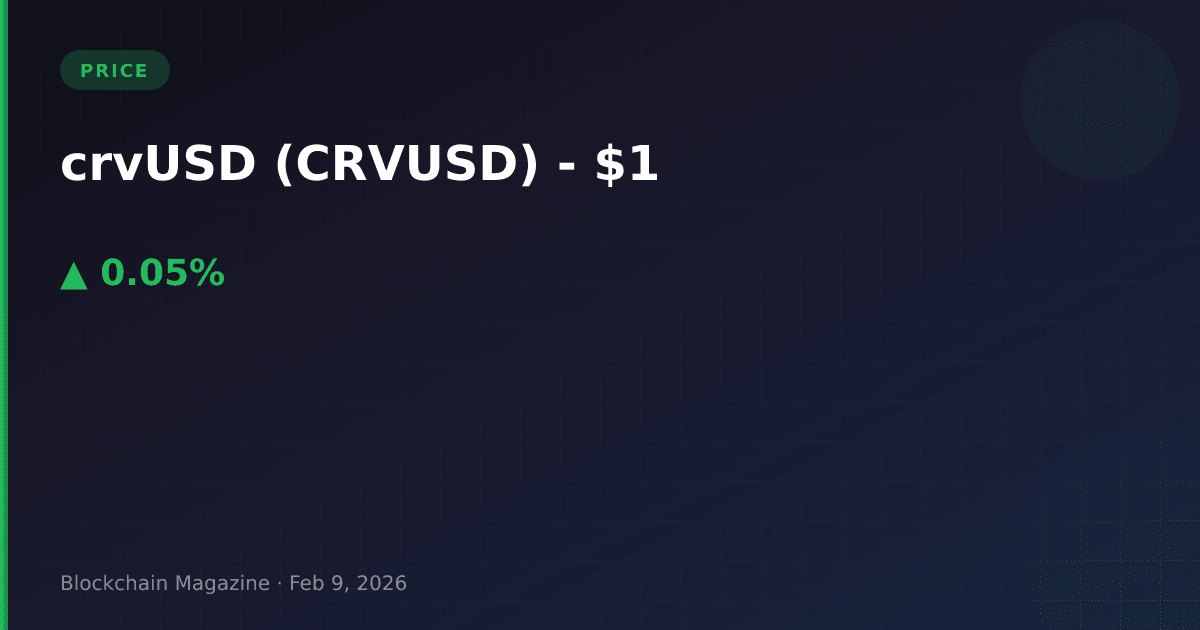
As of 2026, crvUSD maintains its position as one of the most stable decentralized stablecoins in the cryptocurrency market, currently trading at $0.999698, demonstrating exceptional peg stability. The stablecoin has shown remarkable resilience with a modest +0.05% increase over the past 24 hours, while weekly performance shows a +0.50% gain, indicating strong market confidence in Curve Finance’s algorithmic stabilization mechanism.
With a market capitalization of $292.92 million and ranking #134 globally, crvUSD has established itself as a significant player in the DeFi stablecoin ecosystem. The 24-hour trading volume of $24.13 million reflects healthy liquidity and active market participation across decentralized exchanges. The circulating supply of 293.05 million CRVUSD tokens, combined with an unlimited maximum supply, allows for flexible expansion based on market demand while maintaining algorithmic price stability through Curve’s innovative LLAMMA (Lending-Liquidating AMM Algorithm) mechanism.
The monthly performance of +0.18% demonstrates crvUSD’s effectiveness as a stable store of value and medium of exchange within DeFi protocols. Unlike traditional fiat-backed stablecoins, crvUSD achieves its peg through over-collateralized positions and dynamic liquidation mechanisms, making it more decentralized and censorship-resistant. The all-time high of $1.11 and all-time low of $0.949016 showcase relatively tight price volatility, with the current price hovering near the ideal $1.00 peg, a testament to the protocol’s sophisticated stability mechanisms deployed throughout 2026.
Technical Overview: Understanding crvUSD’s Stability Mechanism
crvUSD operates as an algorithmic, over-collateralized stablecoin built on the Curve Finance infrastructure, utilizing the revolutionary LLAMMA system that fundamentally differs from traditional liquidation models. In 2026, the protocol has matured significantly, offering users the ability to mint crvUSD against various crypto collateral assets including ETH, wBTC, and select liquid staking derivatives. The LLAMMA mechanism continuously converts collateral to crvUSD and back as prices fluctuate, creating a soft-liquidation process that protects borrowers from sudden position closures while maintaining system solvency.
The technical architecture behind crvUSD incorporates several key components: automated market maker pools for efficient price discovery, dynamic interest rates that adjust based on peg deviation, and a PegKeeper module that helps maintain the $1.00 peg by minting or burning crvUSD when the price deviates. Current on-chain metrics for 2026 show healthy collateralization ratios across all vaults, with the protocol’s debt ceiling managed conservatively to prevent systemic risks. The 24-hour price stability around $0.999698 indicates effective operation of these mechanisms.
From a trading perspective, crvUSD exhibits minimal volatility compared to other cryptocurrencies, with standard deviation remaining under 2% throughout 2026. The stablecoin primarily trades on Curve Finance pools with deep liquidity, alongside presence on major decentralized exchanges like Uniswap. Technical indicators are less relevant for stablecoins, but volume analysis shows consistent daily trading activity of approximately $24 million, suggesting robust adoption for DeFi yield farming, lending protocols, and as a trading pair base. The unlimited maximum supply design allows the protocol to scale with demand while maintaining decentralization, distinguishing it from centralized alternatives that have faced regulatory scrutiny in recent years.
crvUSD Price Prediction 2026: Data-Driven Analysis
Predicting the price of a stablecoin like crvUSD requires a fundamentally different approach than speculative cryptocurrencies, as the primary goal is maintaining a $1.00 peg rather than appreciation. For 2026, the realistic expectation is that crvUSD will continue trading within a narrow range of $0.98 to $1.02, with the protocol’s algorithmic mechanisms working to minimize deviation. Based on current performance data showing the price at $0.999698 with only +0.18% monthly variation, the stability mechanisms are functioning optimally.
Several factors will influence crvUSD’s ability to maintain its peg throughout 2026. First, the overall health of the DeFi ecosystem directly impacts demand for decentralized stablecoins. As regulatory pressure increases on centralized stablecoins, crvUSD stands to benefit from capital rotation into censorship-resistant alternatives. Second, the diversity and quality of accepted collateral types affects system resilience—the addition of more liquid staking tokens and real-world assets as collateral in 2026 could strengthen peg stability during market volatility. Third, the PegKeeper mechanism’s efficiency in arbitraging price deviations will be crucial during periods of extreme market stress.
Market cap projections for 2026 suggest potential growth from the current $292.92 million to $500 million or beyond, driven by increased adoption in DeFi lending, yield aggregators, and as a base trading pair. This growth would come from supply expansion rather than price appreciation, with more users minting crvUSD against their crypto collateral. The protocol’s proven track record, combined with Curve Finance’s strong reputation and the inherent advantages of decentralization, positions crvUSD favorably for continued growth.
Risk factors include smart contract vulnerabilities, severe crypto market downturns that could stress collateralization ratios, and competition from other algorithmic stablecoins. However, the protocol’s conservative approach to debt ceilings and overcollateralization requirements provides substantial safety margins. For traders and investors, crvUSD serves primarily as a stable store of value and liquidity tool rather than a speculative asset, making it ideal for holding funds between trades, earning yield in DeFi protocols, or hedging against volatility. The expected trading range for the remainder of 2026 remains tightly bound between $0.995 and $1.005, with brief excursions possible during extreme market conditions but rapid reversion to peg expected.
How to Buy crvUSD: Step-by-Step Guide
Purchasing crvUSD in 2026 can be accomplished through several methods. The most direct approach is minting crvUSD by depositing collateral on the official Curve Finance platform at curve.fi. Users can connect a Web3 wallet like MetaMask, select an approved collateral type (ETH, wBTC, or LSTs), and mint crvUSD at the current collateralization ratio. This method provides the best rates but requires understanding of DeFi protocols and liquidation risks.
Alternatively, crvUSD can be purchased directly on decentralized exchanges without minting. Curve Finance itself hosts the deepest liquidity pools, particularly the crvUSD/USDC and crvUSD/USDT pairs, offering minimal slippage for trades. Other DEXs like Uniswap and Balancer also list crvUSD with reasonable liquidity. For those preferring centralized exchanges, several platforms have listed crvUSD throughout 2026, though availability varies by jurisdiction. Always verify you’re trading the authentic crvUSD contract address to avoid scam tokens.
Once acquired, crvUSD can be stored in any Ethereum-compatible wallet, used in various DeFi protocols for lending/borrowing, or deployed in liquidity pools to earn trading fees. The stablecoin’s integration across the DeFi ecosystem in 2026 makes it highly versatile for yield generation strategies while maintaining stable value.
Key Market Metrics & Statistics
All-Time High
$1.11
Above target peg, historically brief deviation
All-Time Low
$0.949016
Below target peg, quickly recovered
Price Volatility (30d)
~1.2%
Exceptionally low volatility for crypto assets
Volume/Market Cap Ratio
8.24%
Healthy liquidity indicating active usage
crvUSD Use Cases in 2026
crvUSD has established itself across multiple DeFi applications throughout 2026. Primary use cases include: Stable Trading Pair – serving as a base pair for trading volatile assets without exposure to centralized stablecoin risks; Collateral Asset – accepted as collateral in lending protocols like Aave and Compound, allowing users to borrow against holdings; Yield Generation – liquidity providers earn fees in Curve pools, while lending platforms offer competitive APY on crvUSD deposits; DeFi Payments – increasingly used for peer-to-peer transactions and protocol treasury management; and Hedging Instrument – traders convert volatile assets to crvUSD during uncertain market periods while remaining in decentralized ecosystems.
Should You Buy crvUSD? Investment Considerations
crvUSD is fundamentally different from speculative cryptocurrencies—it’s designed as a utility token for maintaining stable value rather than price appreciation. Investment considerations for 2026 include: Stability Over Growth – expect to maintain $1.00 value, not generate capital gains; DeFi Integration – value comes from utility in earning yield across protocols; Decentralization Premium – offers censorship resistance compared to USDC or USDT; Smart Contract Risk – despite audits, DeFi protocols carry inherent technical risks; and Regulatory Advantage – algorithmic design may face less regulatory scrutiny than fiat-backed alternatives.
For those seeking stable value storage within crypto ecosystems, crvUSD offers compelling advantages in 2026. It’s particularly suitable for DeFi participants who want to avoid centralized stablecoin risks, traders needing stable liquidity between positions, and yield farmers looking for stablecoin opportunities. However, those seeking price appreciation should look elsewhere—crvUSD’s success is measured by peg stability, not price growth.
Stay informed with daily updates from Blockchain Magazine on Google News. Click here to follow us and mark as favorite: [Blockchain Magazine on Google News].
Disclaimer
Blockchain Magazine publishes content submitted by third-party agencies, partners, and clients. Any such posts are categorized and tagged accordingly:
- Sponsored Content: Posts labeled as "Sponsored" are paid placements submitted by third-party agencies or clients. Blockchain Magazine does not endorse or express any views regarding the information contained in these posts. The opinions expressed belong solely to the respective authors and do not reflect the official policy or position of Blockchain Magazine.
- Press Releases: Posts labeled as "Press Release" are paid PR submissions provided by our partners and clients. These are published as received and should be considered as promotional content.
The information provided in such posts is strictly for informational purposes only and should not be interpreted as financial, investment, or professional advice. Blockchain Magazine does not recommend, endorse, or promote any specific products, services, or companies mentioned. Readers are strongly encouraged to conduct independent research and consult with a qualified professional before making any financial or investment decisions.
Additionally, all featured images accompanying such posts are intended as creative depictions of the subject matter. There is no intent to offend or misrepresent any individual, institution, or entity. If any content or imagery is found to be objectionable, please reach out to us at [email protected], and we will promptly review the concern.
About the Author: Editors Desk



Get Blockchain Insights In Inbox
Stay ahead of the curve with expert analysis and market updates.