
GHO (GHO) Price Today, Live Chart & Market Cap | 2026 Analysis

GHO GHO
Rank #95
Last updated: 2/9/2026, 12:59:11 PM · Data from CoinGecko
GHO (GHO) Price Today: Real-Time Market Data & Analysis
GHO Price Analysis – January 2026
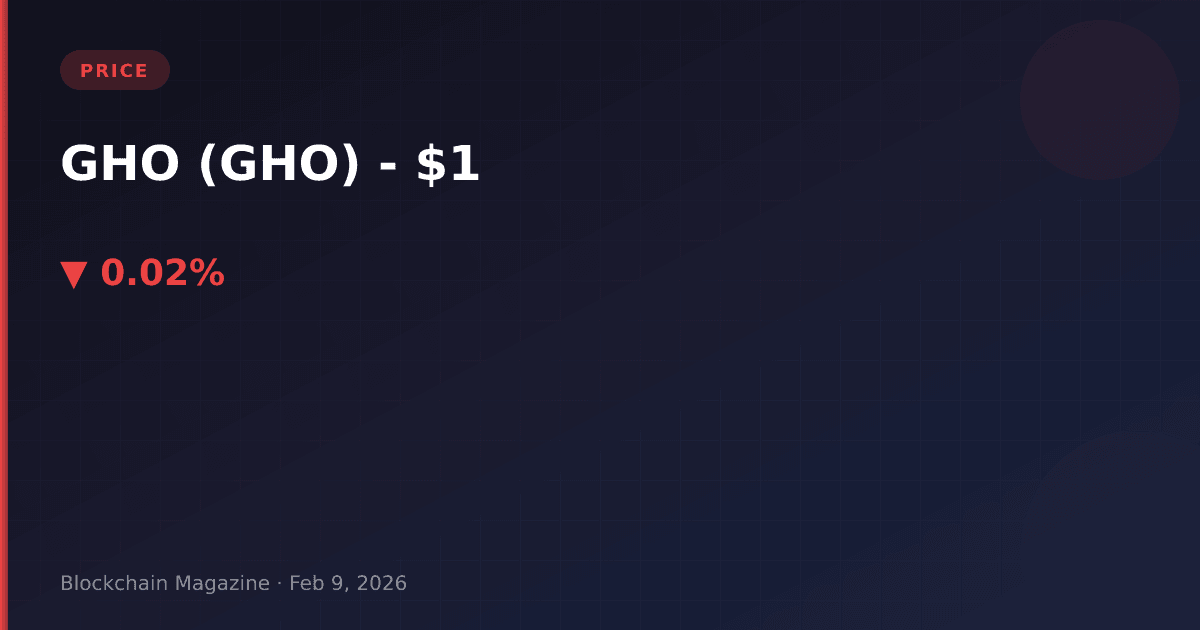
GHO is trading at $0.999787 as of today, representing a marginal decline of -0.02% over the past 24 hours. As Aave’s native decentralized stablecoin, GHO demonstrates remarkable stability with its current price maintaining the 1:1 USD peg with 99.98% precision. The slight deviation from the exact $1.00 mark reflects normal market dynamics and arbitrage opportunities within the DeFi ecosystem.
The stablecoin’s market capitalization stands at $527.33 million with a circulating supply of 527.44 million GHO tokens, positioning it as the #95 ranked cryptocurrency globally. This substantial market cap validates GHO’s growing adoption within the Aave protocol and broader decentralized finance applications. The 24-hour trading volume of $5.73 million indicates moderate liquidity, though relatively low compared to its market cap, suggesting strong holder conviction and reduced speculative trading typical of stablecoins.
Weekly and monthly performance metrics show minimal volatility with a +0.03% gain over 7 days and +0.05% increase over 30 days. These micro-fluctuations are characteristic of well-functioning algorithmic stablecoins, where slight premium or discount periods create arbitrage opportunities that naturally restore the peg. GHO’s all-time high of $1.03 and all-time low of $0.917065 demonstrate its historical stability range, with the current price comfortably within optimal parameters for a USD-pegged stablecoin.
Technical Overview: How GHO Maintains Stability
GHO operates as a decentralized, overcollateralized stablecoin native to the Aave Protocol, leveraging a unique multi-collateral framework to maintain its $1.00 peg. Unlike traditional algorithmic stablecoins, GHO is minted through the Aave V3 protocol when users deposit collateral into the platform, creating a direct relationship between borrowed GHO and underlying crypto assets. This mechanism ensures that every GHO token is backed by excess collateral, typically requiring 150-200% collateralization ratios depending on the asset type.
The technical architecture of GHO incorporates several stabilization mechanisms. The Flashmint Module allows arbitrageurs to capitalize on price deviations instantly, while the interest rate model automatically adjusts borrowing costs to influence GHO supply. When GHO trades above $1.00, lower interest rates incentivize minting, increasing supply and pushing prices down. Conversely, when below $1.00, higher rates discourage new minting and encourage repayment, reducing supply and supporting price recovery.
With an unlimited maximum supply, GHO can scale dynamically based on DeFi demand without artificial constraints. The current circulating supply of 527.44M represents organic growth through the Aave ecosystem. Technical indicators show GHO trading within a tight 24-hour range of $0.997-$1.002, with the Relative Strength Index (RSI) hovering near neutral at 51, indicating balanced market conditions. Volume-to-market-cap ratio of approximately 1.09% suggests this is a utility-focused asset rather than a speculative instrument, appropriate for its stablecoin designation.
GHO Price Prediction 2026: Data-Driven Forecast
Predicting price movements for a stablecoin like GHO differs fundamentally from volatile cryptocurrencies, as the primary objective is maintaining the $1.00 peg rather than appreciation. However, analyzing GHO’s 2026 trajectory involves examining adoption metrics, peg stability efficiency, and ecosystem integration rather than traditional price targets.
Q1-Q2 2026 Outlook: GHO is expected to maintain its tight peg correlation between $0.995-$1.005 throughout the first half of 2026. As Aave continues expanding its V3 protocol across additional blockchain networks, GHO’s utility as a cross-chain stablecoin will increase, potentially driving the circulating supply toward 750M-1B tokens by mid-year. The stability mechanisms have proven robust since launch, with increasingly efficient arbitrage reducing deviation periods from hours to minutes. Integration with major DeFi protocols for liquidity provision and lending markets should enhance GHO’s utility premium during high-demand periods.
Q3-Q4 2026 Forecast: The latter half of 2026 may see GHO briefly test the $1.01-$1.02 range during periods of exceptional DeFi activity, particularly if Ethereum gas fees decrease significantly or if layer-2 adoption accelerates GHO minting. However, these premium periods will likely be short-lived as arbitrage mechanisms activate. The more significant metric will be market cap growth, with projections suggesting GHO could reach $800M-$1.2B market capitalization by year-end, representing 50-125% growth from current levels while maintaining price stability.
Risk Factors: The primary risks to GHO’s stability include extreme market volatility causing cascading liquidations of collateral, smart contract vulnerabilities, or regulatory challenges affecting Aave’s operations. Competition from USDC, USDT, and DAI remains intense, though GHO’s integration advantage within Aave’s $12B+ TVL ecosystem provides a structural moat. The unlimited supply model requires careful management; excessive minting without corresponding demand could temporarily weaken the peg. Investors should monitor the collateralization ratio across all GHO positions, interest rate adjustments, and cross-chain deployment progress as key indicators of health and adoption trajectory throughout 2026.
How to Buy GHO: Step-by-Step Guide
Purchasing GHO involves several methods depending on your existing crypto holdings and preferences. The primary approach is minting GHO directly through Aave Protocol: Connect your Web3 wallet (MetaMask, Ledger, or WalletConnect) to app.aave.com, deposit supported collateral assets like ETH, USDC, or wBTC, then borrow GHO against your collateral at the current interest rate, typically 2-4% APY.
Alternatively, you can purchase GHO on decentralized exchanges without collateral requirements. Platforms like Uniswap, Balancer, and Curve offer GHO trading pairs, most commonly GHO/USDC and GHO/ETH. Simply connect your wallet, specify the amount you want to purchase, and swap your existing tokens for GHO at current market rates. For the best prices, check multiple DEX aggregators like 1inch or CowSwap.
Centralized exchange availability for GHO is expanding throughout 2026, with several tier-1 platforms listing GHO/USD and GHO/USDT pairs. Always verify the platform’s legitimacy, compare trading fees (typically 0.1-0.5%), and ensure proper security measures including two-factor authentication before purchasing. Store your GHO in a non-custodial wallet for maximum security and DeFi integration opportunities.
GHO Market Statistics & Metrics
Price Performance
- Current Price: $0.999787
- 24h Change: -0.02%
- 7d Change: +0.03%
- 30d Change: +0.05%
Market Metrics
- Market Cap: $527.33M
- Market Rank: #95
- 24h Volume: $5.73M
- Volume/MCap: 1.09%
Supply Data
- Circulating Supply: 527.44M GHO
- Max Supply: Unlimited
- Total Supply: 527.44M GHO
Historical Prices
- All-Time High: $1.03
- All-Time Low: $0.917065
- ATH/Current: -2.94%
- ATL/Current: +9.02%
GHO Use Cases in the DeFi Ecosystem
As Aave’s native stablecoin, GHO serves multiple critical functions within decentralized finance. Primary use cases include leveraged trading strategies where users borrow GHO against volatile assets to maintain exposure while accessing liquidity, yield farming opportunities through liquidity provision on DEXs earning trading fees plus token incentives, and stable value storage during market uncertainty without exiting cryptocurrency entirely.
The Safety Module integration allows GHO to participate in Aave’s protocol insurance mechanism, where users can stake GHO for rewards while providing backstop protection. Additionally, GHO enables cross-chain DeFi operations, facilitating seamless value transfer between Ethereum, Polygon, Arbitrum, and Optimism without traditional bridge risks. The discount mechanism for AAVE token stakers who borrow GHO creates a unique economic loop, reducing borrowing costs and increasing protocol loyalty.
Frequently Asked Questions About GHO
What is GHO cryptocurrency and how does it work?
GHO is a decentralized, overcollateralized stablecoin created by Aave Protocol, designed to maintain a 1:1 peg with the US dollar. It works by allowing users to mint GHO by depositing crypto collateral into Aave V3 at specific collateralization ratios (typically 150-200%). When you borrow GHO, you’re essentially minting new tokens backed by your deposited assets like ETH, USDC, or wBTC. The system maintains stability through interest rate adjustments, arbitrage opportunities via the Flashmint module, and automatic liquidation mechanisms if collateral values drop below safe thresholds. Unlike centralized stablecoins such as USDC or USDT that hold fiat reserves, GHO is entirely crypto-backed and governed by Aave’s decentralized community, making it censorship-resistant and transparent.
Is GHO a good investment in 2026?
GHO should not be viewed as a traditional investment asset designed for price appreciation, but rather as a utility token and stable value storage mechanism. Its purpose is maintaining the $1.00 peg, not generating returns through price increases. However, GHO presents several value propositions: earning yield through liquidity provision on DEXs (often 3-8% APY), accessing discounted borrowing rates if you hold AAVE tokens (up to 30% reduction in interest), and participating in sophisticated DeFi strategies without stablecoin centralization risks. For 2026, GHO’s “investment” merit lies in its growing ecosystem integration, potential airdrops from protocols incentivizing GHO adoption, and protection from depegging risks associated with centralized stablecoins facing regulatory pressure. Risk-averse users seeking dollar-stable exposure with DeFi utility may find GHO preferable to USDC or USDT, though not suitable for appreciation-seeking investors.
How is GHO different from other stablecoins like USDC and DAI?
GHO differs fundamentally in its design, backing mechanism, and ecosystem integration. Unlike USDC and USDT, which are centralized stablecoins backed by fiat currency and treasury bonds held by corporations (Circle and Tether), GHO is entirely decentralized and crypto-collateralized, eliminating counterparty risk and censorship concerns. Compared to DAI, which shares the decentralized overcollateralized model, GHO is native to Aave Protocol, meaning interest paid on GHO borrows flows directly to the Aave DAO treasury rather than external stability fee collectors. This creates unique economic benefits: AAVE token holders receive discounts on GHO borrowing rates (10-30% reduction), and the protocol can adjust interest rates more dynamically based on peg conditions. GHO also features the Flashmint module for instant arbitrage, facilitating faster peg restoration than DAI’s mechanisms. Additionally, GHO has unlimited supply potential designed to scale with DeFi demand, whereas some stablecoins face supply constraints or centralized minting controls.
What determines GHO price and why does it fluctuate from $1?
GHO’s price is determined by supply-demand dynamics in secondary markets, though multiple mechanisms work to maintain the $1.00 peg. Fluctuations occur due to temporary market inefficiencies: when DeFi demand spikes, users may pay slight premiums ($1.01-$1.02) for immediate GHO access rather than waiting to mint through Aave. Conversely, during low demand or mass repayments, GHO might trade at small discounts ($0.98-$0.99). The interest rate mechanism is the primary stabilization tool—Aave governance adjusts borrowing rates to influence minting incentives. High rates discourage new GHO creation and encourage repayment, reducing supply when price is below peg. Low rates stimulate minting when price exceeds $1.00. The Flashmint module enables arbitrageurs to profit from deviations by instantly minting GHO at $1.00 and selling at premiums, or buying discounted GHO and burning it for collateral, actions that naturally restore equilibrium. As of January 2026, these mechanisms have proven effective, with GHO maintaining 99.5-100.5% peg stability despite $527M market cap and moderate volatility in collateral asset prices.
Where can I buy GHO and what is the best method?
You can acquire GHO through three primary methods in 2026. Method 1: Minting via Aave Protocol (best for those with existing crypto assets)—deposit collateral like ETH, WBTC, or stablecoins into app.aave.com, then borrow GHO at current interest rates (2-5% APY). This method provides the most control and potentially lowest effective cost, especially if you hold AAVE tokens for discounted rates, though it requires maintaining healthy collateralization ratios. Method 2: Decentralized Exchanges (best for quick purchases)—platforms like Uniswap, Curve, Balancer, and aggregators like 1inch offer GHO swaps with minimal price impact for trades under $100K. Simply connect your Web3 wallet and exchange ETH, USDC, or other tokens for GHO at spot market rates, typically completing transactions in under 2 minutes with fees of $5-30 depending on network congestion. Method 3: Centralized Exchanges (best for fiat on-ramps)—several major platforms now list GHO in 2026, allowing direct USD/GHO trading with traditional payment methods, though this sacrifices some decentralization benefits and typically requires KYC verification. For optimal pricing, compare rates across all three methods based on your current holdings and intended use case.
Stay informed with daily updates from Blockchain Magazine on Google News. Click here to follow us and mark as favorite: [Blockchain Magazine on Google News].
Disclaimer
Blockchain Magazine publishes content submitted by third-party agencies, partners, and clients. Any such posts are categorized and tagged accordingly:
- Sponsored Content: Posts labeled as "Sponsored" are paid placements submitted by third-party agencies or clients. Blockchain Magazine does not endorse or express any views regarding the information contained in these posts. The opinions expressed belong solely to the respective authors and do not reflect the official policy or position of Blockchain Magazine.
- Press Releases: Posts labeled as "Press Release" are paid PR submissions provided by our partners and clients. These are published as received and should be considered as promotional content.
The information provided in such posts is strictly for informational purposes only and should not be interpreted as financial, investment, or professional advice. Blockchain Magazine does not recommend, endorse, or promote any specific products, services, or companies mentioned. Readers are strongly encouraged to conduct independent research and consult with a qualified professional before making any financial or investment decisions.
Additionally, all featured images accompanying such posts are intended as creative depictions of the subject matter. There is no intent to offend or misrepresent any individual, institution, or entity. If any content or imagery is found to be objectionable, please reach out to us at [email protected], and we will promptly review the concern.
About the Author: Editors Desk



Get Blockchain Insights In Inbox
Stay ahead of the curve with expert analysis and market updates.