
Tether (USDT) Price Today, Chart & Market Cap | Real-Time USD Updates 2026

Tether USDT
Rank #3
Last updated: 2/9/2026, 12:42:20 PM · Data from CoinGecko
Tether (USDT) Price Today: Real-Time Market Data & Analysis
Tether Price Analysis: Current Market Performance
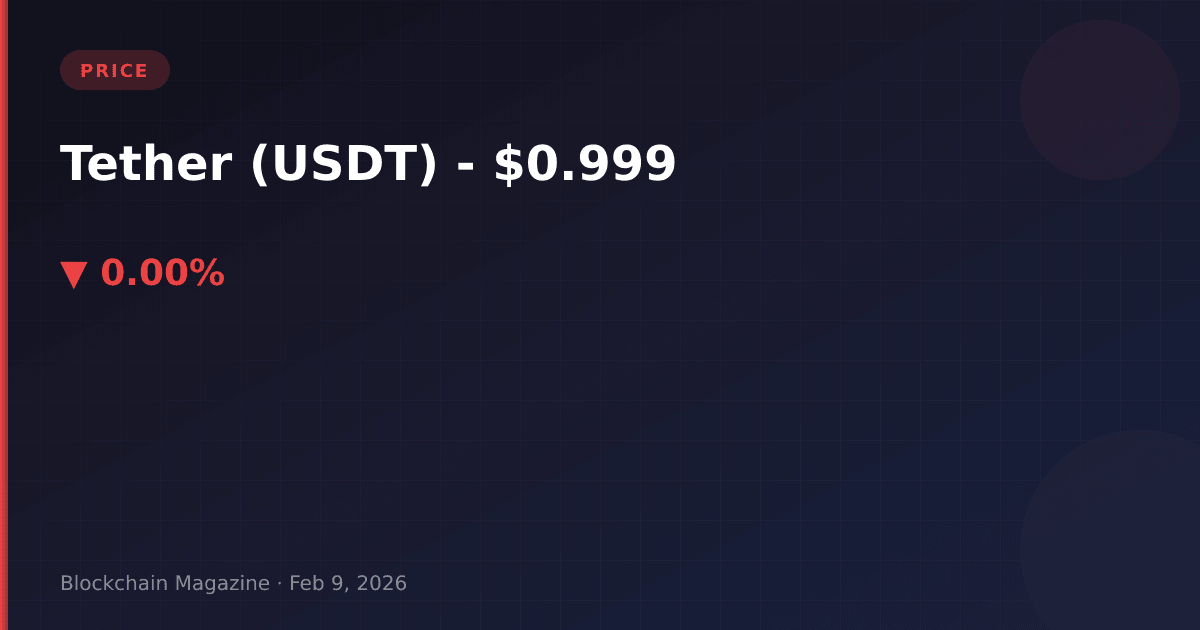
As of 2026, Tether (USDT) maintains its position as the world’s largest stablecoin and third-ranked cryptocurrency by market capitalization, with a current valuation of $184.44 billion. Trading at $0.999245, USDT demonstrates the tight peg maintenance that has characterized its operational excellence throughout the year. The minimal 24-hour price movement of -0.00% reflects the stablecoin’s fundamental purpose: providing a reliable bridge between fiat currencies and cryptocurrency markets.
The impressive 24-hour trading volume of $74.00 billion underscores Tether’s critical role in the cryptocurrency ecosystem as the primary liquidity provider across hundreds of exchanges worldwide. With a circulating supply of 184.57 billion tokens and an unlimited maximum supply structure, USDT’s supply dynamics are directly tied to market demand and redemption mechanisms. The 7-day change of +0.03% and 30-day change of +0.04% indicate exceptional price stability, with fluctuations remaining well within the acceptable variance range for USD-pegged stablecoins. This consistency makes USDT the preferred choice for traders seeking to preserve capital during volatile market conditions, execute arbitrage strategies, and facilitate seamless cross-exchange transfers without exposure to cryptocurrency price volatility.
Technical Overview: Understanding Tether’s Market Infrastructure
Tether’s technical architecture in 2026 represents a multi-blockchain ecosystem, with USDT tokens issued across multiple networks including Ethereum (ERC-20), Tron (TRC-20), Binance Smart Chain (BEP-20), Solana, and various Layer-2 solutions. This multi-chain approach has solidified USDT’s position as the most accessible stablecoin, available on virtually every major blockchain platform. The token’s price stability mechanism relies on maintaining reserves that back each USDT token with equivalent value in fiat currencies, cash equivalents, and other assets, with Tether Limited publishing regular attestation reports to verify reserve adequacy.
From a market structure perspective, USDT’s all-time high of $1.32 (recorded during periods of extreme market stress) and all-time low of $0.572521 represent historical anomalies that occurred during low-liquidity events rather than fundamental peg failures. In 2026, robust liquidity mechanisms and improved regulatory compliance have strengthened confidence in Tether’s peg stability. The technical indicators for USDT focus less on traditional cryptocurrency metrics like RSI or moving averages, and more on peg deviation percentage, reserve composition, and redemption efficiency. Market participants monitor the spread between USDT and true $1.00 USD, with the current $0.000755 deviation representing normal market friction. The stablecoin’s role as the primary trading pair for most cryptocurrencies means its stability directly impacts overall market functionality, making USDT’s technical health a systemic priority for the entire crypto ecosystem.
Tether Price Prediction 2026: Stability Outlook & Market Scenarios
Predicting Tether’s price in 2026 differs fundamentally from forecasting volatile cryptocurrencies, as USDT’s design purpose is to maintain a stable $1.00 peg rather than appreciate in value. However, understanding the factors that could influence USDT’s stability and market position throughout 2026 remains crucial for investors and traders. The primary prediction for USDT centers on continued peg maintenance within a tight range of $0.995 to $1.005, with brief excursions outside this band during periods of extreme market volatility or liquidity stress.
Several factors support Tether’s stability outlook for 2026: enhanced regulatory clarity following increased engagement with financial authorities, improved reserve transparency through more frequent and detailed attestations, expanded use cases in cross-border payments and remittances, and continued dominance as the preferred stablecoin for institutional traders. The growing market capitalization, now at $184.44 billion, reflects sustained demand for dollar-denominated digital assets, particularly as cryptocurrency adoption accelerates in emerging markets where access to stable currencies is limited. Competition from other stablecoins including USDC, DAI, and central bank digital currencies (CBDCs) could influence USDT’s market share, but is unlikely to affect its core peg stability.
Risk scenarios that could impact USDT in 2026 include regulatory actions requiring significant operational changes, large-scale redemption events testing reserve adequacy, or technical vulnerabilities in underlying blockchain infrastructure. However, Tether’s track record of maintaining its peg through multiple market cycles, including the tumultuous periods of 2022-2024, provides confidence in its resilience. For investors, the value proposition of USDT isn’t price appreciation but rather capital preservation, transaction efficiency, and reliable access to dollar-denominated value within cryptocurrency ecosystems. As institutional adoption of digital assets continues growing throughout 2026, Tether’s role as foundational infrastructure positions it for sustained relevance, with daily trading volumes potentially exceeding $100 billion during peak market activity periods. The focus for 2026 remains on maintaining trust, transparency, and technical reliability rather than price growth.
How to Buy Tether (USDT): Complete Guide for 2026
Purchasing Tether in 2026 is straightforward due to its availability on virtually every cryptocurrency exchange. Begin by selecting a reputable exchange such as Binance, Coinbase, Kraken, or OKX, and complete the registration process including identity verification (KYC). Fund your account using bank transfer, credit card, or existing cryptocurrency holdings. Navigate to the USDT trading section and select your preferred purchase method: direct fiat-to-USDT conversion or trading another cryptocurrency for USDT.
For new investors, purchasing USDT directly with USD, EUR, or other fiat currencies offers the simplest approach, typically with minimal fees and instant settlement. Experienced traders often acquire USDT by trading volatile cryptocurrencies during profit-taking moments, converting gains into the stable USDT to protect capital while remaining within the crypto ecosystem. After purchase, consider transferring USDT to a personal wallet for enhanced security, choosing between software wallets (MetaMask, Trust Wallet), hardware wallets (Ledger, Trezor), or keeping funds on exchange for active trading. When selecting a blockchain network for transfers, TRC-20 (Tron) typically offers the lowest fees, while ERC-20 (Ethereum) provides maximum compatibility but higher transaction costs. Always verify the receiving address and network compatibility before initiating transfers to prevent permanent loss of funds.
Tether Market Statistics 2026
| Metric | Value |
|---|---|
| Current Price | $0.999245 |
| Market Capitalization | $184.44B |
| Market Rank | #3 |
| 24-Hour Trading Volume | $74.00B |
| Volume/Market Cap Ratio | 0.401 |
| Circulating Supply | 184.57B USDT |
| Maximum Supply | Unlimited |
| All-Time High | $1.32 |
| All-Time Low | $0.572521 |
| 24h Price Change | -0.00% |
| 7d Price Change | +0.03% |
| 30d Price Change | +0.04% |
Tether Use Cases & Ecosystem Role in 2026
Tether’s utility in 2026 extends far beyond simple price stability, functioning as essential infrastructure for the global cryptocurrency economy. Primary use cases include: serving as the dominant trading pair for cryptocurrency exchanges worldwide, enabling traders to quickly move between positions without converting to fiat currencies; facilitating cross-border payments and remittances with near-instant settlement and minimal fees compared to traditional banking systems; providing a store of value for individuals in countries experiencing currency devaluation or limited banking access; supporting DeFi protocols as collateral for lending, liquidity provision, and yield generation; and enabling businesses to accept cryptocurrency payments while minimizing exposure to price volatility.
The institutional adoption of USDT has accelerated in 2026, with treasury management platforms incorporating stablecoins for corporate cash management, payment processors integrating USDT for merchant settlements, and investment firms using it as a settlement layer for tokenized securities. The regulatory landscape has evolved to accommodate stablecoins as a recognized financial instrument, with Tether implementing enhanced compliance measures including transaction monitoring, sanctions screening, and regular audits. This maturation has positioned USDT as a bridge between traditional finance and decentralized systems, with daily transaction volumes rivaling major payment networks.
Stay informed with daily updates from Blockchain Magazine on Google News. Click here to follow us and mark as favorite: [Blockchain Magazine on Google News].
Disclaimer
Blockchain Magazine publishes content submitted by third-party agencies, partners, and clients. Any such posts are categorized and tagged accordingly:
- Sponsored Content: Posts labeled as "Sponsored" are paid placements submitted by third-party agencies or clients. Blockchain Magazine does not endorse or express any views regarding the information contained in these posts. The opinions expressed belong solely to the respective authors and do not reflect the official policy or position of Blockchain Magazine.
- Press Releases: Posts labeled as "Press Release" are paid PR submissions provided by our partners and clients. These are published as received and should be considered as promotional content.
The information provided in such posts is strictly for informational purposes only and should not be interpreted as financial, investment, or professional advice. Blockchain Magazine does not recommend, endorse, or promote any specific products, services, or companies mentioned. Readers are strongly encouraged to conduct independent research and consult with a qualified professional before making any financial or investment decisions.
Additionally, all featured images accompanying such posts are intended as creative depictions of the subject matter. There is no intent to offend or misrepresent any individual, institution, or entity. If any content or imagery is found to be objectionable, please reach out to us at [email protected], and we will promptly review the concern.
About the Author: Editors Desk



Get Blockchain Insights In Inbox
Stay ahead of the curve with expert analysis and market updates.