Cosmos Hub (ATOM) Price Today, Live Chart & Market Cap | ATOM to USD

Cosmos Hub ATOM
Rank #70
Last updated: 2/8/2026, 10:40:11 PM · Data from CoinGecko
Cosmos Hub (ATOM) Price Today
Cosmos Hub Price Analysis
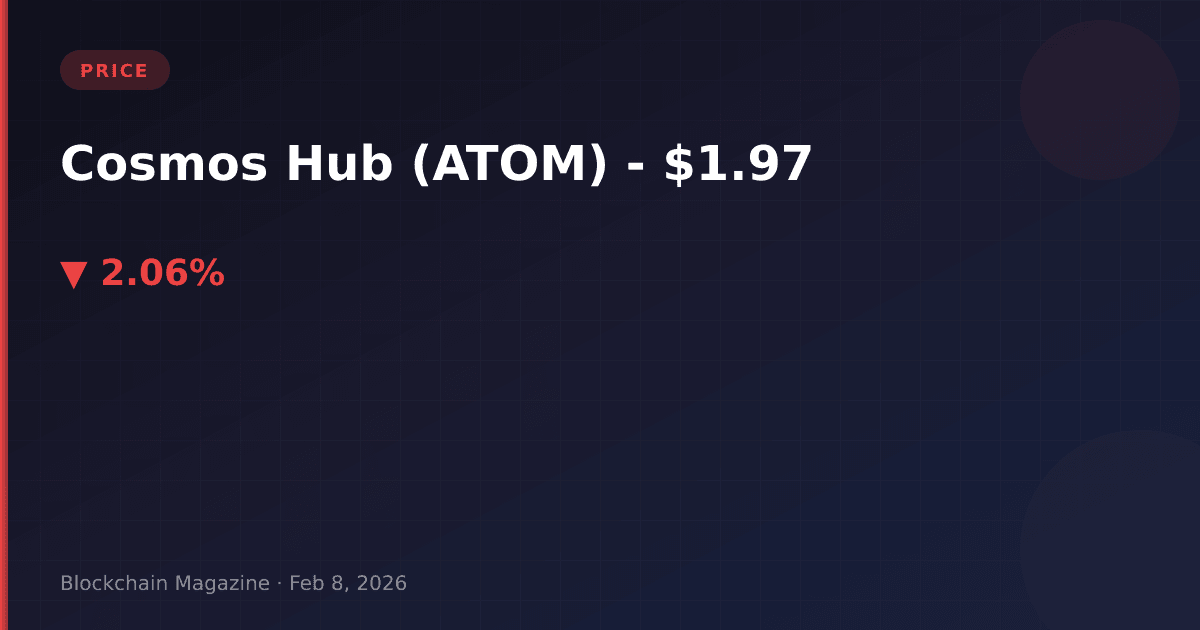
Cosmos Hub (ATOM) is currently trading at $1.97, positioning itself within a critical support zone after experiencing significant volatility over the past month. The current price represents a substantial 95.57% decline from its all-time high of $44.45, while trading approximately 69.83% above its all-time low of $1.16. With a market capitalization of $968.43 million, ATOM maintains its position as the 70th largest cryptocurrency by market cap.
The 24-hour trading volume of $33.44 million indicates moderate market activity, with the volume-to-market cap ratio sitting at approximately 3.45%. This suggests healthy liquidity for traders and investors looking to enter or exit positions. The recent price action shows short-term bearish momentum with a -2.06% decline in the past 24 hours, though the 7-day performance reveals a positive +3.18% gain, indicating potential recovery momentum. However, the 30-day decline of -22.66% reflects broader market challenges and selling pressure that has impacted the Cosmos ecosystem. ATOM’s unlimited maximum supply model, characteristic of proof-of-stake networks with inflationary tokenomics, means continuous token issuance through staking rewards, which investors should factor into long-term valuation models.
Technical Overview and Market Metrics
From a technical perspective, Cosmos Hub operates as the central blockchain of the Cosmos network, utilizing the Inter-Blockchain Communication (IBC) protocol to enable seamless cross-chain transactions. The current circulating supply of 492.29 million ATOM tokens represents the actively traded portion of the network’s tokens, with new tokens continuously entering circulation through staking rewards at an annual inflation rate that adjusts based on the percentage of staked tokens. This mechanism incentivizes network security while introducing predictable selling pressure.
The current price action suggests ATOM is testing significant support levels near the $1.90-$2.00 range, which has historically acted as both support and resistance. The Relative Strength Index (RSI) territory suggests the asset may be approaching oversold conditions following the 30-day decline, potentially setting up for a technical bounce. Trading volumes have remained consistent, with the $33.44 million in 24-hour volume representing stable institutional and retail interest despite bearish price action.
Market structure analysis reveals that ATOM’s correlation with Bitcoin and broader crypto markets remains strong, with systemic market movements significantly impacting price action. The token’s utility within the Cosmos ecosystem—including governance rights, staking rewards averaging 15-20% APY, and IBC transaction fees—provides fundamental value support. However, competition from alternative layer-0 and interoperability solutions continues to pressure market share and valuation multiples.
Cosmos Hub (ATOM) Price Prediction 2024-2025
Analyzing Cosmos Hub’s price trajectory requires examining both technical indicators and fundamental ecosystem developments. The current price of $1.97 represents a critical juncture, with several scenarios possible based on market conditions and network growth metrics. In the near term (3-6 months), if broader crypto market sentiment improves and Bitcoin establishes a sustained uptrend, ATOM could target the $2.50-$3.20 resistance zone, representing 27-62% upside potential. This scenario depends on increased IBC transaction volumes and successful implementation of upcoming protocol upgrades, including liquid staking modules and interchain security enhancements.
For 2024, a conservative price target places ATOM in the $2.80-$4.50 range, assuming moderate market recovery and continued ecosystem expansion. This projection factors in the current circulating supply expansion rate and assumes the Cosmos Hub captures approximately 8-12% of the interoperability market share. Key catalysts include major DeFi protocols migrating to Cosmos SDK chains, increased adoption of IBC by institutional players, and successful rollout of the Interchain Security (ICS) model, which allows other chains to rent security from the Cosmos Hub validator set.
Looking toward 2025, more bullish scenarios could see ATOM reaching $6.00-$9.00 if the network achieves significant milestones including onboarding 10+ consumer chains through Interchain Security, processing 1 million+ daily IBC transactions, and establishing partnerships with major financial institutions for blockchain infrastructure. However, bearish scenarios must consider persistent selling pressure from staking rewards, competition from Polkadot, Avalanche, and emerging modular blockchain solutions, plus regulatory uncertainty affecting proof-of-stake networks. The unlimited supply model means token value appreciation depends heavily on demand growth outpacing inflation. Investors should monitor key metrics including total value locked (TVL) in Cosmos ecosystem applications, IBC transaction volume growth rates, and the percentage of ATOM staked, which currently hovers around 65% of circulating supply. Risk factors include potential validator centralization, security vulnerabilities in connected chains, and market share erosion to competing interoperability protocols.
How to Buy Cosmos Hub (ATOM)
Purchasing ATOM is straightforward through major cryptocurrency exchanges. First, create an account on reputable platforms like Coinbase, Binance, Kraken, or Crypto.com, completing KYC verification as required. Deposit funds via bank transfer, debit card, or cryptocurrency transfer. Navigate to the ATOM trading pair (ATOM/USD or ATOM/USDT), enter your desired purchase amount, and execute a market or limit order based on your strategy.
For long-term holders, consider transferring ATOM to a non-custodial wallet like Keplr or Cosmostation to participate in staking and governance while maintaining full control of your assets. These wallets enable direct interaction with the Cosmos Hub blockchain, allowing you to stake tokens with validators earning 15-20% annual rewards. Always enable two-factor authentication, store recovery phrases securely offline, and start with smaller amounts while learning the ecosystem. Hardware wallets like Ledger also support ATOM for maximum security.
Investment Considerations and Risk Factors
Investing in Cosmos Hub requires understanding both the technological value proposition and market dynamics. ATOM’s primary value derives from its role as the central hub in the Cosmos ecosystem, providing security, governance, and liquidity for interconnected blockchains. The staking mechanism offers attractive yields but introduces opportunity costs and lock-up periods typically ranging from 21 days for unbonding. The unlimited supply model contrasts with Bitcoin’s scarcity narrative, meaning ATOM value appreciation depends entirely on utility demand exceeding inflation rates.
Key risk factors include smart contract vulnerabilities in connected chains potentially affecting hub security, validator centralization concerns as staking requirements create barriers to entry, and competition from alternative interoperability solutions offering different technical trade-offs. The Cosmos ecosystem’s success depends on developer adoption of the Cosmos SDK and meaningful IBC volume growth, metrics that investors should monitor quarterly. Regulatory developments affecting proof-of-stake networks, particularly regarding staking rewards classification, could impact tokenomics and investor returns. Portfolio allocation should reflect these risks, with most advisors suggesting limiting individual crypto positions to 1-5% of investable assets.
Frequently Asked Questions
What is Cosmos Hub (ATOM) and why does it have value?
Cosmos Hub is the central blockchain of the Cosmos network, an ecosystem of interoperable blockchains connected through the Inter-Blockchain Communication (IBC) protocol. ATOM, the native token, serves three primary functions that create its value: (1) Network Security – ATOM is staked by validators and delegators to secure the Cosmos Hub through proof-of-stake consensus, with stakers earning 15-20% annual rewards; (2) Governance – ATOM holders vote on protocol upgrades, parameter changes, and treasury allocation decisions that shape the network’s future; (3) Transaction Fees – ATOM pays for transactions and IBC transfers across the Cosmos ecosystem. The token’s value proposition centers on the Cosmos Hub becoming the primary security and liquidity provider for hundreds of interconnected blockchains, with Interchain Security allowing other chains to rent the Hub’s validator set. As more applications and chains join the ecosystem, demand for ATOM theoretically increases for staking and governance participation.
Is Cosmos Hub (ATOM) a good investment in 2024?
Whether ATOM represents a good investment depends on individual risk tolerance, investment timeline, and portfolio strategy. Positive factors include: a proven technology with IBC processing millions of transactions, strong developer community building on Cosmos SDK, attractive staking yields of 15-20% that compound holdings, current price 95% below all-time highs presenting potential upside, and upcoming catalysts like Interchain Security adoption. However, significant risks exist: unlimited token supply creates constant selling pressure, intense competition from Polkadot, Avalanche, and modular blockchain solutions, 30-day decline of -22.66% showing bearish momentum, and the network’s value depending entirely on ecosystem adoption rates. ATOM works best as part of a diversified cryptocurrency portfolio for investors who understand blockchain interoperability’s long-term importance and can withstand high volatility. The current price near $1.97 may offer value for those with 2-5 year time horizons, but short-term performance remains uncertain. Consider dollar-cost averaging rather than lump-sum investment, and only invest amounts you can afford to lose completely.
What was Cosmos Hub’s all-time high and can it reach that price again?
Cosmos Hub reached its all-time high of $44.45 in September 2021 during the broader cryptocurrency bull market. At current prices of $1.97, ATOM would need to appreciate 2,156% to revisit those levels. While technically possible, several factors make a return to ATH challenging: the circulating supply has increased significantly since 2021 due to inflationary staking rewards, requiring proportionally more capital inflow to reach equivalent prices; market capitalization at ATH prices would exceed $21 billion based on current supply, placing ATOM among the top 15 cryptocurrencies where competition is intense; and the 2021 bull market featured unique conditions including unprecedented liquidity, retail FOMO, and less competition that may not repeat identically. More realistic scenarios involve ATOM reaching 30-50% of its ATH ($13-$22) in the next major bull cycle if the Cosmos ecosystem demonstrates substantial growth in users, transactions, and interconnected chains. This would still represent 559-1,017% upside from current levels. Investors should focus on network fundamentals—IBC volume, number of connected chains, TVL in Cosmos DeFi—rather than arbitrary price targets based on historical peaks reached under different market conditions.
How does Cosmos Hub staking work and what are the rewards?
Cosmos Hub staking allows ATOM holders to participate in network security while earning rewards. The process involves delegating tokens to one of 175 active validators who maintain network infrastructure and propose/validate blocks. Staking rewards currently range from 15-20% APY, sourced from two mechanisms: inflationary token issuance that creates new ATOM (currently around 14% annually, dynamically adjusted based on staking ratio targets), and transaction fees collected from network activity. To stake, users can use wallets like Keplr, Cosmostation, or Ledger Live, selecting validators based on commission rates (typically 5-10%), uptime performance, and voting participation. Once delegated, rewards begin accruing immediately and compound automatically if you periodically claim and restake them. Important considerations include the 21-day unbonding period when unstaking—during this time, tokens earn no rewards and cannot be traded, exposing holders to price volatility risk. Staked tokens can be slashed (partially confiscated) if validators engage in malicious behavior like double-signing, though this risk is minimal with reputable validators. Tax implications vary by jurisdiction, with many countries treating staking rewards as income at the time of receipt. Despite risks, staking provides superior returns compared to simply holding ATOM, and participation strengthens network security while granting governance voting rights.
What makes Cosmos different from other blockchain platforms?
Cosmos distinguishes itself through its focus on blockchain interoperability and application-specific chains rather than competing directly with smart contract platforms like Ethereum. Key differentiators include: (1) The Inter-Blockchain Communication (IBC) protocol enables trustless communication between independent blockchains, allowing asset transfers and data sharing without centralized bridges—over 50 chains currently use IBC, processing millions of monthly transactions; (2) Cosmos SDK provides modular framework letting developers build custom blockchains optimized for specific applications rather than deploying to congested general-purpose chains, giving them control over governance, economics, and performance; (3) Tendermint consensus offers instant finality and high throughput (thousands of transactions per second per chain) compared to probabilistic finality in Bitcoin/Ethereum proof-of-work; (4) The hub-and-zone model creates a network topology where the Cosmos Hub serves as central connection point, but zones (connected chains) maintain sovereignty and can implement different consensus mechanisms, programming languages, and governance models; (5) Interchain Security (recently launched) allows smaller chains to rent security from Cosmos Hub validators, solving the bootstrapping problem new networks face. Unlike Ethereum’s unified world computer approach or Polkadot’s shared security model requiring parachain slots, Cosmos prioritizes sovereignty and loose coupling. This makes Cosmos ideal for applications needing customization—blockchain games, DeFi protocols, enterprise solutions—but creates challenges in capturing value at the hub level, an ongoing discussion in governance.
Current Market Context and Trading Considerations
The current market environment for Cosmos Hub reflects broader cryptocurrency sector dynamics combined with ecosystem-specific factors. At $1.97, ATOM trades within a consolidation range that has established over recent months, with significant support near the psychological $1.50-$1.80 zone and resistance around $2.40-$2.80. The 24-hour trading volume of $33.44 million represents approximately 3.45% of market cap, indicating moderate liquidity that accommodates position building without significant slippage for most retail and small institutional investors.
Market sentiment indicators suggest cautious positioning among ATOM holders, with the recent -22.66% monthly decline reflecting both profit-taking after earlier gains and broader risk-off behavior in cryptocurrency markets. On-chain metrics reveal that approximately 65% of circulating ATOM remains staked, demonstrating long-term conviction among holders despite price volatility. This high staking ratio reduces available liquid supply, potentially amplifying price movements in both directions when demand shifts occur.
Trading strategies should account for ATOM’s volatility profile, which typically exceeds Bitcoin’s but remains lower than smaller-cap altcoins. For active traders, the $1.85-$2.15 range has provided multiple profitable swing trading opportunities over recent weeks. Long-term investors might consider dollar-cost averaging during periods of negative sentiment while monitoring key adoption metrics including IBC transaction volume growth, new chain integrations, and Interchain Security consumer chain launches. Stop-loss placement below the $1.60 level could protect against breakdown scenarios, while profit targets around $2.60-$2.80 align with technical resistance zones. Always maintain proper position sizing with cryptocurrency investments representing only a small portion of diversified portfolios.
Stay informed with daily updates from Blockchain Magazine on Google News. Click here to follow us and mark as favorite: [Blockchain Magazine on Google News].
Disclaimer
Blockchain Magazine publishes content submitted by third-party agencies, partners, and clients. Any such posts are categorized and tagged accordingly:
- Sponsored Content: Posts labeled as "Sponsored" are paid placements submitted by third-party agencies or clients. Blockchain Magazine does not endorse or express any views regarding the information contained in these posts. The opinions expressed belong solely to the respective authors and do not reflect the official policy or position of Blockchain Magazine.
- Press Releases: Posts labeled as "Press Release" are paid PR submissions provided by our partners and clients. These are published as received and should be considered as promotional content.
The information provided in such posts is strictly for informational purposes only and should not be interpreted as financial, investment, or professional advice. Blockchain Magazine does not recommend, endorse, or promote any specific products, services, or companies mentioned. Readers are strongly encouraged to conduct independent research and consult with a qualified professional before making any financial or investment decisions.
Additionally, all featured images accompanying such posts are intended as creative depictions of the subject matter. There is no intent to offend or misrepresent any individual, institution, or entity. If any content or imagery is found to be objectionable, please reach out to us at [email protected], and we will promptly review the concern.
About the Author: Editors Desk



Get Blockchain Insights In Inbox
Stay ahead of the curve with expert analysis and market updates.