
USDD Price Today: Real-Time USDD to USD Chart & Market Cap | USDD Stablecoin Analysis

USDD USDD
Rank #66
Last updated: 2/8/2026, 10:33:32 PM · Data from CoinGecko
USDD Price Today: USDD to USD Live Chart & Market Data
USDD Price Analysis: Current Market Performance
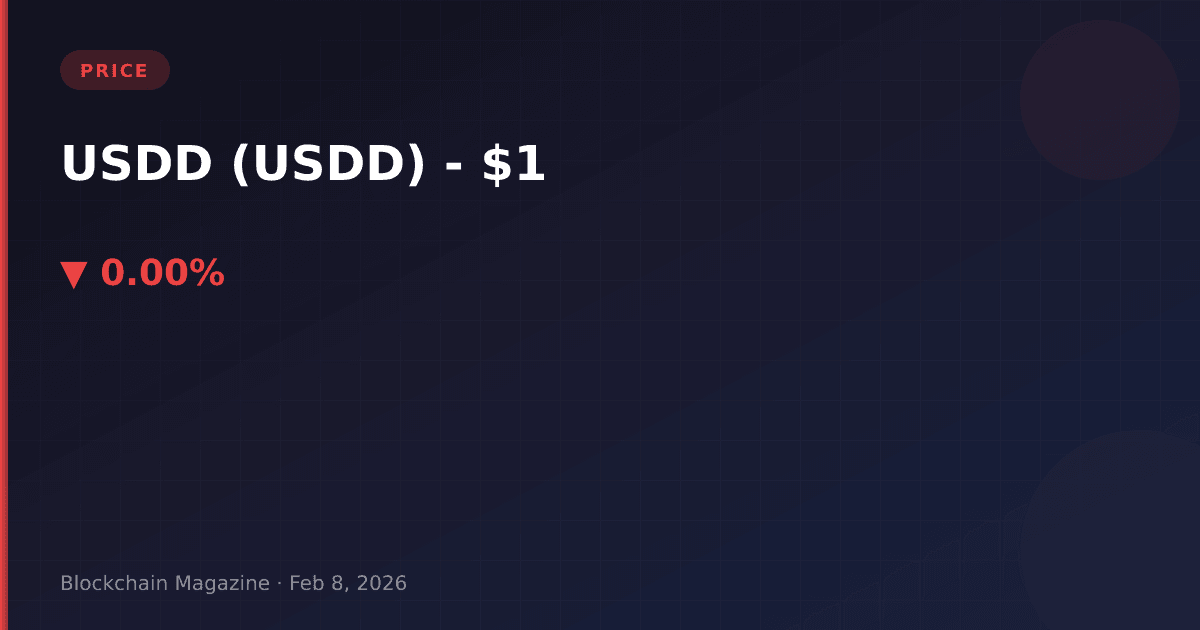
USDD (USDD) is currently trading at $0.999503, demonstrating the characteristic stability expected from an algorithmic stablecoin designed to maintain a 1:1 peg with the US Dollar. The current price represents a negligible deviation of just 0.0497% from its target peg, showcasing the protocol’s effectiveness in maintaining dollar parity. With a market capitalization of $1.00 billion, USDD ranks #66 among all cryptocurrencies, positioning it as a significant player in the decentralized stablecoin ecosystem.
The 24-hour trading activity shows minimal price movement at -0.00%, reflecting the stablecoin’s core value proposition of price stability. Over the past week, USDD has registered a modest +0.03% increase, while the 30-day performance shows a slight -0.04% decline—both movements remaining well within acceptable stability thresholds. The current 24-hour trading volume of $1.53 million indicates moderate liquidity, though notably lower than top-tier stablecoins. With a circulating supply of 1.00 billion USDD and an unlimited maximum supply, the protocol maintains flexibility for expansion as adoption grows. USDD’s all-time high of $1.052 and all-time low of $0.928067 reveal past volatility events that tested the peg mechanism, though current stability metrics suggest improved algorithmic adjustments.
Technical Overview: Understanding USDD Stablecoin Mechanics
USDD is a decentralized algorithmic stablecoin launched by the TRON DAO Reserve, designed to provide a stable, decentralized alternative to centralized stablecoins like USDT and USDC. The protocol employs a sophisticated collateralization mechanism backed by a reserve of multiple cryptocurrencies including USDT, USDC, BTC, and TRX, with the TRON DAO Reserve maintaining an over-collateralization ratio to ensure stability. Unlike purely algorithmic stablecoins that failed during market stress, USDD combines algorithmic mechanisms with substantial backing reserves to maintain its dollar peg.
The technical architecture utilizes smart contracts on the TRON blockchain, enabling fast transactions with minimal fees—a significant advantage for users conducting frequent transfers or DeFi operations. The stability mechanism operates through arbitrage opportunities: when USDD trades above $1.00, users are incentivized to mint new USDD and sell it for profit; when it trades below $1.00, users can burn USDD to redeem collateral at face value. This creates natural market forces pushing the price toward equilibrium. The current price of $0.999503 indicates the mechanism is functioning within normal parameters, with arbitrageurs maintaining tight peg adherence. The protocol’s governance is overseen by multiple authorized institutions that manage collateral and ensure reserve adequacy, providing transparency through regular attestations. With integration across major DeFi platforms and centralized exchanges, USDD serves as a bridge for traders seeking stability without relying on traditional banking infrastructure.
USDD Price Prediction: Data-Driven Outlook & Stability Analysis
Predicting the price of USDD differs fundamentally from forecasting volatile cryptocurrencies, as stablecoins are explicitly designed to maintain a consistent $1.00 value. However, analyzing stability confidence and potential deviation risks provides valuable insights for traders and investors. The current price of $0.999503 sits just 0.05% below the target peg, indicating excellent short-term stability. Historical data shows USDD has successfully maintained its peg within a tight ±2% range for extended periods, significantly outperforming algorithmic predecessors that experienced catastrophic de-pegging events.
Looking at short-term prospects (1-3 months), USDD is expected to continue trading within the $0.995-$1.005 range, barring exceptional market disruptions. The key factors supporting this outlook include: the TRON DAO Reserve’s reported over-collateralization ratio exceeding 200%, ongoing liquidity provisions across major exchanges, and gradual adoption in Asian DeFi ecosystems where TRON maintains strong infrastructure presence. The moderate 24-hour volume of $1.53 million suggests room for liquidity expansion, which could further tighten the peg through increased arbitrage activity.
For medium-term analysis (6-12 months), USDD’s stability will depend on several critical factors: maintaining transparent reserve audits, avoiding regulatory scrutiny that has impacted other stablecoins, and expanding utility beyond the TRON ecosystem. The unlimited supply model provides flexibility but also raises questions about potential dilution if growth outpaces collateral acquisition. Competitive pressure from established stablecoins like USDC (which holds $25+ billion market cap) may limit USDD’s market share expansion. Risk factors include potential regulatory changes targeting algorithmic stablecoins, smart contract vulnerabilities, or significant TRON ecosystem disruptions. Conversely, successful integration with cross-chain bridges and partnerships with payment processors could drive adoption and strengthen peg confidence. Investors should monitor the TRON DAO Reserve’s monthly transparency reports and track the collateralization ratio as primary indicators of long-term stability viability.
How to Buy USDD: Step-by-Step Purchase Guide
Purchasing USDD is straightforward through both centralized and decentralized platforms. To buy USDD on centralized exchanges, create an account on platforms like Poloniex, HTX (formerly Huobi), or Gate.io that list USDD trading pairs. Complete KYC verification, deposit funds (fiat or crypto), navigate to the USDD/USDT or USDD/USD trading pair, and execute your purchase. Centralized exchanges offer higher liquidity and simpler user interfaces for beginners.
For decentralized purchases, USDD is available on SunSwap (TRON’s native DEX), JustLend, and cross-chain DEX aggregators. Connect a compatible wallet (TronLink for TRON network), ensure you have TRX for transaction fees, swap supported tokens directly for USDD, and confirm the transaction. DEX purchases offer greater privacy and custody control. After purchase, store USDD in a secure wallet—hardware wallets like Ledger support TRON-based tokens for maximum security. Always verify contract addresses (TPYmHEhy5n8TCEfYGqW2rPxsghSfzghPDn on TRON) to avoid fake tokens, and start with small test transactions when using new platforms.
Investment Considerations: Is USDD Right for Your Portfolio?
USDD serves specific portfolio functions distinct from traditional cryptocurrencies. As a stability instrument, it’s ideal for traders seeking to park funds between trades without converting to fiat, DeFi users requiring stable collateral for lending/borrowing, or individuals in regions with currency instability seeking dollar exposure. The primary advantage is maintaining purchasing power without volatility risk—your $1,000 in USDD should theoretically remain $1,000 in value.
However, risk assessment is crucial. Unlike USDC or USDT backed by traditional financial reserves, USDD’s algorithmic nature and crypto-collateralization introduces smart contract risk, governance risk, and potential de-pegging scenarios during extreme market stress. The 2022 crypto market demonstrated how algorithmic stablecoins can fail catastrophically (e.g., Terra’s UST). While USDD has maintained its peg more successfully, the historical price range of $0.928067-$1.052 reveals it has experienced significant deviation. Investors should limit USDD exposure to amounts they can afford to lose and avoid using it as a long-term store of value without regular monitoring. The unlimited supply model also creates potential inflation concerns if governance becomes compromised.
USDD is best suited for active traders needing temporary stability within the TRON ecosystem, DeFi participants utilizing TRON-based protocols, or users specifically seeking decentralized stablecoin alternatives. It’s less appropriate for conservative investors, those seeking SEC-regulated stablecoins, or portfolios requiring maximum capital preservation. The relatively modest $1.00 billion market cap compared to USDT ($95+ billion) also suggests lower network effects and potentially higher volatility during market stress. Always diversify stablecoin holdings across multiple issuers and mechanism types to mitigate systemic risk.
USDD Market Context: Competitive Position & Ecosystem Role
Within the stablecoin landscape, USDD occupies a unique niche as the primary decentralized stablecoin of the TRON ecosystem, competing against both centralized giants and algorithmic alternatives. Its market ranking at #66 places it well behind leaders like USDT (#3), USDC (#6), and DAI (#19), but ahead of numerous smaller stablecoin projects. This mid-tier positioning reflects both the achievements of maintaining a billion-dollar market cap and the challenges of competing against established alternatives with deeper liquidity and broader acceptance.
The TRON ecosystem advantage provides USDD with built-in utility across DeFi protocols like JustLend, SunSwap, and various yield farming platforms where TRON’s low transaction costs make stablecoin operations economically viable even for small transactions. This contrasts with Ethereum-based stablecoins that face high gas fees. However, TRON’s more limited developer ecosystem and fewer institutional partnerships restrict USDD’s expansion compared to multi-chain stablecoins. The competitive dynamics in 2024 increasingly favor regulatory-compliant, fully-backed stablecoins, placing algorithmic models under scrutiny. USDD’s hybrid approach—combining algorithmic mechanisms with substantial collateral backing—attempts to bridge this gap, though market confidence remains lower than purely asset-backed alternatives. For users, this translates to viable utility within TRON-native applications but limited acceptance for major payments or cross-ecosystem transfers compared to USDT or USDC.
Frequently Asked Questions About USDD Price
What is the current price of USDD?
The current USDD price is $0.999503 USD, representing a -0.00% change over the last 24 hours. USDD is designed as a stablecoin maintaining a 1:1 peg with the US Dollar, and the current price shows just a 0.0497% deviation from the target $1.00 value. You can monitor real-time USDD price updates across major cryptocurrency exchanges including Poloniex, HTX, and Gate.io. The live USDD to USD conversion rate fluctuates minimally within a tight range as the algorithmic mechanism and arbitrage traders work to maintain price stability. For the most accurate pricing, check multiple exchanges as slight variations may exist across different platforms.
Is USDD a safe stablecoin investment?
USDD carries different risk profiles compared to both traditional cryptocurrencies and centralized stablecoins. As an algorithmic stablecoin backed by cryptocurrency collateral, it has successfully maintained its peg since launch with the current price at $0.999503, demonstrating functional stability mechanisms. The TRON DAO Reserve reports over-collateralization exceeding 200% with reserves including BTC, USDT, USDC, and TRX. However, risks include smart contract vulnerabilities, potential de-pegging during extreme market stress (historical range: $0.928067-$1.052), regulatory uncertainty around algorithmic stablecoins, and reliance on TRON ecosystem health. USDD is safer than uncollateralized algorithmic stablecoins but carries more risk than fully-regulated, bank-backed stablecoins like USDC. It’s appropriate for experienced crypto users who understand these risks, need TRON ecosystem functionality, and don’t rely on it as their sole stable asset. Always diversify stablecoin holdings and only invest amounts you can afford to lose.
What is USDD price prediction for 2024-2025?
As a stablecoin, USDD’s price prediction differs from volatile cryptocurrencies—the target is consistently $1.00 USD rather than exponential growth. For 2024-2025, USDD is expected to maintain its peg within the $0.98-$1.02 range under normal market conditions, with the current price of $0.999503 indicating effective stability mechanisms. Key factors influencing future stability include: maintaining transparent collateral reserves (currently over 200% collateralization), regulatory developments affecting algorithmic stablecoins, TRON ecosystem growth or contraction, and competition from established stablecoins. Bullish scenarios involve expanded DeFi integration, cross-chain bridges increasing utility, and successful regulatory navigation, which would strengthen peg confidence without changing the target price. Bearish risks include regulatory crackdowns on algorithmic models, TRON ecosystem disruptions, or collateral reserve concerns that could cause temporary de-pegging events similar to the historical low of $0.928067. Investors shouldn’t expect price appreciation but rather focus on stability consistency and yield opportunities through DeFi lending. Monitor the TRON DAO Reserve’s monthly reports and collateralization ratios as primary indicators of 2024-2025 stability prospects.
How does USDD maintain its $1 peg?
USDD maintains its dollar peg through a hybrid mechanism combining algorithmic incentives with substantial collateral backing. The system works on multiple levels: First, the TRON DAO Reserve maintains over-collateralization (currently exceeding 200%) with reserves of Bitcoin, USDT, USDC, TRX, and other cryptocurrencies, providing fundamental backing for every USDD in circulation. Second, arbitrage mechanisms create profit opportunities when USDD deviates from $1.00—if trading above $1.00, authorized institutions can mint new USDD at face value and sell at market price; if trading below $1.00, they can purchase discounted USDD and redeem it for $1.00 worth of collateral. These arbitrage opportunities naturally drive price toward equilibrium. Third, market makers and liquidity providers on exchanges like Poloniex and SunSwap actively maintain tight bid-ask spreads around $1.00. Fourth, smart contracts on the TRON blockchain automatically facilitate minting and burning operations. The current price of $0.999503 demonstrates this mechanism functioning effectively, with only 0.05% deviation. This multi-layered approach provides more resilience than purely algorithmic models while maintaining decentralization advantages over fully centralized stablecoins.
Where can I buy USDD and what are the best exchanges?
You can buy USDD on multiple centralized and decentralized exchanges with varying liquidity and features. Top centralized options include Poloniex (high USDD liquidity with USDT pairs), HTX/Huobi (multiple trading pairs including USDD/USDT), Gate.io (spot trading with competitive fees), and Bitget (derivatives and spot markets). These platforms offer user-friendly interfaces, higher liquidity, and fiat on-ramps but require KYC verification. For decentralized purchases, SunSwap (TRON’s native DEX) provides the most direct access with TRX pairing, while JustLend offers USDD integration for lending/borrowing. Cross-chain DEX aggregators like 1inch can route USDD trades across multiple liquidity pools. When choosing an exchange, consider trading volume (currently $1.53M daily across all platforms), fee structures (TRON transactions are typically under $1), geographic restrictions, and whether you need advanced trading features. For beginners, centralized exchanges offer simplest onboarding; for privacy-focused users, DEX options provide non-custodial trading. Always verify the official USDD contract address (TPYmHEhy5n8TCEfYGqW2rPxsghSfzghPDn on TRON network) to avoid counterfeit tokens, and consider starting with small test transactions before large purchases.
Stay informed with daily updates from Blockchain Magazine on Google News. Click here to follow us and mark as favorite: [Blockchain Magazine on Google News].
Disclaimer
Blockchain Magazine publishes content submitted by third-party agencies, partners, and clients. Any such posts are categorized and tagged accordingly:
- Sponsored Content: Posts labeled as "Sponsored" are paid placements submitted by third-party agencies or clients. Blockchain Magazine does not endorse or express any views regarding the information contained in these posts. The opinions expressed belong solely to the respective authors and do not reflect the official policy or position of Blockchain Magazine.
- Press Releases: Posts labeled as "Press Release" are paid PR submissions provided by our partners and clients. These are published as received and should be considered as promotional content.
The information provided in such posts is strictly for informational purposes only and should not be interpreted as financial, investment, or professional advice. Blockchain Magazine does not recommend, endorse, or promote any specific products, services, or companies mentioned. Readers are strongly encouraged to conduct independent research and consult with a qualified professional before making any financial or investment decisions.
Additionally, all featured images accompanying such posts are intended as creative depictions of the subject matter. There is no intent to offend or misrepresent any individual, institution, or entity. If any content or imagery is found to be objectionable, please reach out to us at [email protected], and we will promptly review the concern.
About the Author: Editors Desk



Get Blockchain Insights In Inbox
Stay ahead of the curve with expert analysis and market updates.