OKB Price Today | OKB to USD Live Chart, Market Cap & Analysis 2026

OKB OKB
Rank #46
Last updated: 2/8/2026, 10:01:17 PM · Data from CoinGecko
OKB Price (OKB)
OKB Price Analysis Today
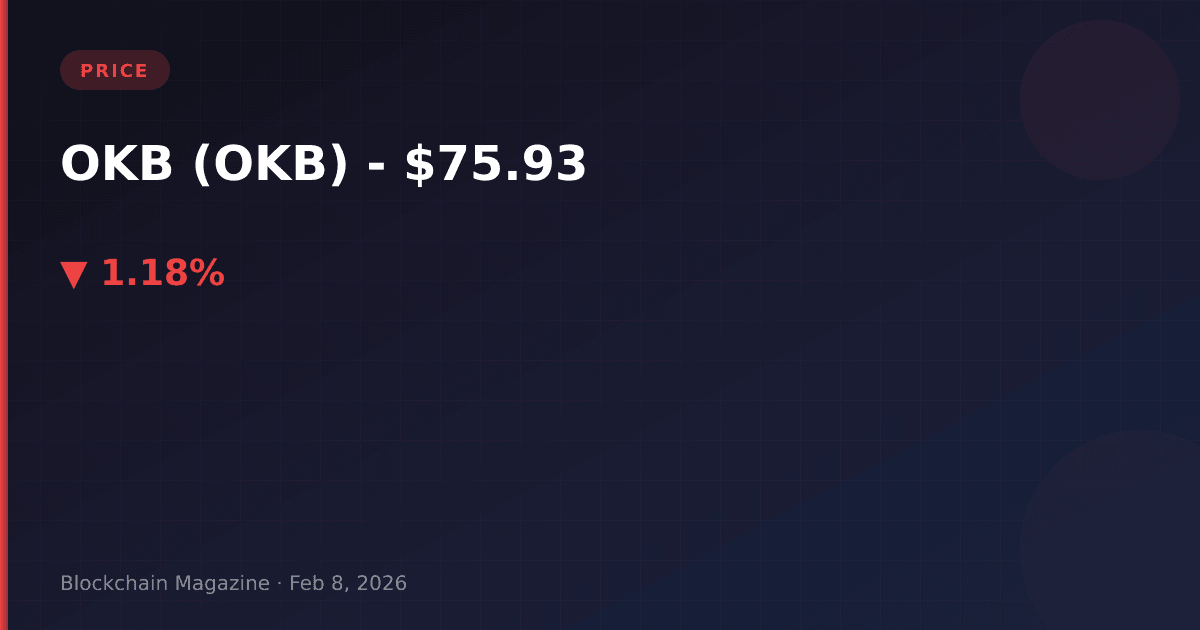
OKB is currently trading at $75.93, experiencing a modest decline of 1.18% over the past 24 hours. As the native utility token of the OKX cryptocurrency exchange, OKB has demonstrated significant volatility in recent weeks, with a 7-day decline of 14.01% and a more substantial 30-day drop of 30.84%. This downward pressure reflects broader market corrections and potential profit-taking following previous rallies.
With a market capitalization of $1.59 billion, OKB maintains its position as the 46th largest cryptocurrency by market cap. The token’s 24-hour trading volume stands at $17.83 million, indicating moderate market activity. OKB’s fully diluted supply of 21 million tokens mirrors Bitcoin’s scarcity model, with all tokens already in circulation. The token trades significantly below its all-time high of $255.50, presenting a 70.28% decline from peak levels, while maintaining substantial appreciation from its all-time low of $0.580608. Current price action suggests consolidation as traders assess support levels and future catalysts for the OKX ecosystem.
Technical Overview & Market Metrics
From a technical perspective, OKB is navigating a challenging market environment characterized by declining momentum across multiple timeframes. The consistent negative performance across 7-day (-14.01%) and 30-day (-30.84%) periods indicates sustained bearish pressure and suggests traders should monitor key support levels closely. The current price of $75.93 represents a critical juncture where buyers may step in to defend psychological support near the $75 threshold.
The token’s market depth reveals a market cap to volume ratio of approximately 89:1, suggesting relatively lower liquidity compared to top-tier cryptocurrencies. This can amplify price volatility during significant market moves. With a fixed maximum supply of 21 million tokens already fully circulating, OKB benefits from clear tokenomics without inflationary pressure from new token emissions. The token’s utility within the OKX ecosystem—including trading fee discounts, staking rewards, and platform governance—provides fundamental support for long-term value accrual. Technical indicators suggest OKB is approaching oversold conditions on longer timeframes, though confirmation of trend reversal would require sustained buying pressure and reclamation of key moving averages. Traders should watch for volume spikes and positive divergence on momentum indicators as potential signals of accumulation.
OKB Price Prediction & Future Outlook
Analyzing OKB’s price trajectory requires considering both technical patterns and fundamental ecosystem developments. In the short term (1-3 months), OKB faces headwinds from the recent 30.84% monthly decline, with immediate resistance forming near the $85-$90 range. A sustained recovery would need to reclaim these levels while maintaining support above $70. If broader cryptocurrency markets stabilize and Bitcoin maintains bullish momentum, OKB could potentially recover to the $95-$110 range by Q2 2024, representing a 25-45% upside from current levels.
Medium-term projections (6-12 months) depend heavily on OKX exchange performance, user adoption metrics, and regulatory developments affecting centralized exchanges. Should OKX continue expanding its global market share and introduce innovative DeFi products, OKB could target the $130-$160 range, testing previous resistance zones. The token’s deflationary tokenomics through quarterly buyback and burn programs provide structural price support, having already removed significant supply from circulation. Historical patterns suggest OKB tends to outperform during crypto bull markets when exchange volumes surge.
Long-term forecasts (2-3 years) present more optimistic scenarios if cryptocurrency adoption accelerates. Analysts suggest OKB could reach $200-$250 during the next major bull cycle, approaching or testing previous all-time highs. This would require sustained growth in OKX’s trading volumes, successful expansion into emerging markets, and continued development of the OKX Chain ecosystem. However, investors should note significant risks including regulatory scrutiny of centralized exchanges, competition from decentralized platforms, and overall market sentiment. The token’s performance remains highly correlated with Bitcoin and general crypto market conditions. Conservative investors might target accumulation zones between $65-$75, while setting realistic profit targets based on historical resistance levels and maintaining appropriate risk management strategies.
How to Buy OKB
Purchasing OKB is straightforward through multiple platforms. The primary venue is the OKX exchange itself, where users can create an account, complete KYC verification, and deposit funds via bank transfer, credit card, or cryptocurrency. Once funded, navigate to the OKB trading pair (OKB/USDT or OKB/USD), enter your desired amount, and execute a market or limit order.
Alternative platforms include major exchanges like KuCoin, Gate.io, and Bitget, offering OKB trading pairs with competitive liquidity. Decentralized exchange users can acquire OKB through Uniswap or PancakeSwap where wrapped versions may be available. After purchase, consider transferring OKB to a secure wallet—OKX Web3 Wallet supports native OKB storage, while hardware wallets like Ledger and Trezor provide enhanced security for long-term holdings. Always enable two-factor authentication and verify withdrawal addresses carefully to protect your investment.
Investment Considerations for OKB
Investing in OKB presents unique opportunities and risks tied directly to the OKX exchange ecosystem. As an exchange token, OKB’s value proposition centers on utility benefits including reduced trading fees (up to 40% discount), staking rewards, exclusive token sale access, and participation in platform governance decisions. The token’s deflationary model through quarterly burns has historically removed over 40% of the original supply, creating scarcity dynamics that support long-term value.
Risk factors include regulatory uncertainty surrounding centralized exchanges, competition from rivals like Binance (BNB) and Coinbase, and the token’s high correlation with overall crypto market sentiment. OKB’s recent 30% monthly decline highlights volatility concerns, making it suitable primarily for risk-tolerant investors. The concentration of trading volume on OKX itself creates liquidity risks during market stress. Diversification remains essential—OKB should constitute only a portion of a broader crypto portfolio. Positive catalysts include OKX’s expansion into new jurisdictions, integration of OKX Chain into DeFi protocols, and increasing institutional adoption of the platform.
OKB Token Utility & Ecosystem
OKB serves as the cornerstone of the OKX ecosystem, functioning across multiple chains including Ethereum, OKC (OKX Chain), and various Layer 2 networks. The token provides holders with tangible benefits that increase with holding volume, structured across multiple VIP tiers. Trading fee discounts scale from 5% to 40% based on OKB holdings and 30-day trading volumes, directly reducing transaction costs for active traders.
Beyond fee reductions, OKB unlocks access to exclusive features including priority customer support, higher API rate limits, and early participation in OKX Jumpstart token sales. The staking mechanism allows holders to earn passive income, with flexible and fixed-term options yielding competitive APYs. OKB also plays a governance role through the OKX DAO, where holders can propose and vote on ecosystem developments. The OKX Chain leverages OKB for gas fees and validator staking, creating additional utility in the DeFi space. Recent developments include integration with OKX NFT marketplace, where OKB provides fee discounts and exclusive drop access, plus expanding use cases in the OKX Web3 wallet for transaction fee payments across multiple blockchains.
Historical Performance & Market Cycles
OKB’s price history reflects dramatic volatility characteristic of exchange tokens. Launched in 2018 at approximately $1, the token experienced significant growth during the 2020-2021 bull market, reaching its all-time high of $255.50 in May 2021. This represented a 25,000%+ return from initial levels, driven by explosive growth in cryptocurrency trading volumes and increased adoption of the OKX platform across Asian and global markets.
The subsequent bear market saw OKB decline approximately 80% from peak levels, finding support in the $10-$20 range during 2022’s crypto winter. Recovery began in early 2023, with the token appreciating to the $40-$60 range as market conditions improved. The recent rally to current levels around $75 demonstrated renewed investor interest, though the subsequent 30% monthly decline indicates profit-taking and market correction. OKB has historically outperformed during high-volume trading periods and underperformed during extended bear markets. The token’s quarterly burn mechanism has provided consistent deflationary pressure, with OKX having repurchased and burned billions of dollars worth of OKB since inception. Correlation analysis shows OKB maintains a 0.75+ correlation coefficient with Bitcoin, moving largely in tandem with broader crypto trends while occasionally exhibiting independent moves based on OKX-specific news.
OKB vs. Competing Exchange Tokens
In the competitive landscape of exchange tokens, OKB competes primarily with Binance Coin (BNB), Crypto.com Coin (CRO), and other platform tokens. BNB remains the market leader with significantly higher market capitalization and broader ecosystem adoption including BSC blockchain dominance. However, OKB differentiates through OKX’s strong derivatives trading platform, which generates substantial volumes particularly in Asian markets.
Compared to BNB’s $75-85 billion market cap, OKB’s $1.59 billion valuation suggests potential upside if OKX continues gaining market share. OKB’s tokenomics mirror Bitcoin’s 21 million supply cap, providing clearer scarcity metrics than BNB’s more complex supply schedule. CRO offers similar utility benefits but focuses more on payments and rewards, while OKB emphasizes trading utility. FTT’s collapse in 2022 highlighted risks inherent to exchange tokens, though OKB weathered that crisis relatively well. OKB’s advantages include aggressive burn schedules, comprehensive DeFi integration through OKX Chain, and growing institutional adoption. Disadvantages include lower global brand recognition compared to Binance and regulatory uncertainties in key markets. For investors, OKB presents a mid-cap alternative with potentially higher upside but increased risk compared to industry leader BNB.
Trading Strategies for OKB
Successful OKB trading requires understanding the token’s unique characteristics and market dynamics. Day traders can capitalize on intraday volatility, particularly during Asian trading hours when OKX volumes peak. The token typically exhibits increased volatility around quarterly burn announcements, creating short-term trading opportunities. Technical traders should monitor key support levels at $70, $65, and $60, with resistance forming at $85, $95, and $110.
Swing traders might employ a strategy of accumulating during broader market corrections, targeting 15-30% moves as market sentiment improves. OKB tends to lag Bitcoin’s initial moves but can experience catch-up rallies as capital rotates into altcoins. Long-term holders benefit from staking rewards and trading fee discounts, effectively earning yield while waiting for price appreciation. Dollar-cost averaging (DCA) strategies work well for OKB given its volatility, allowing investors to build positions during drawdowns. Risk management remains critical—consider position sizing at 3-5% of total portfolio for moderate risk tolerance. Setting stop-losses at 15-20% below entry points protects against major downturns, while taking partial profits at predetermined resistance levels locks in gains. Advanced traders might employ options strategies where available, using covered calls to generate income or protective puts during uncertain market conditions.
Frequently Asked Questions About OKB
What is OKB and why does it have value?
OKB is the native utility token of the OKX cryptocurrency exchange, one of the world’s largest digital asset trading platforms. Launched in 2018, OKB derives value from multiple sources: it provides trading fee discounts up to 40%, grants access to exclusive token sales, enables staking rewards, and serves as the gas token for OKX Chain. The token follows a deflationary model with quarterly burns funded by OKX exchange profits, having already reduced circulating supply significantly. With a fixed maximum supply of 21 million tokens (mirroring Bitcoin), OKB benefits from scarcity economics. Value appreciation correlates with OKX platform growth, trading volume increases, and overall cryptocurrency market adoption.
Is OKB a good investment in 2024?
OKB presents a mixed investment profile in 2024. Potential advantages include its deflationary tokenomics, strong utility within a growing exchange ecosystem, and recovery potential from recent declines. Trading at $75.93, the token sits 70% below its all-time high, potentially offering value for long-term believers in cryptocurrency adoption. However, significant risks exist: recent 30% monthly decline indicates bearish momentum, regulatory uncertainties affect all centralized exchanges, and competition from Binance and other platforms remains intense. OKB suits risk-tolerant investors who believe in OKX’s continued market share growth and cryptocurrency’s broader adoption. Conservative investors should limit exposure to 3-5% of portfolio, while considering staking rewards as additional return. Market timing matters—accumulating during fear periods historically outperforms buying during euphoria.
How high can OKB price go?
OKB’s price potential depends on multiple variables including overall crypto market conditions, OKX platform growth, and regulatory developments. Short-term (3-6 months), recovery to $95-$110 is feasible if market sentiment improves, representing 25-45% upside. Medium-term (1-2 years), a return to $150-$180 could occur during sustained bull market conditions with strong exchange fundamentals. Long-term optimistic scenarios suggest $200-$255 (previous ATH) is achievable in a major crypto bull cycle with continued supply burns and ecosystem expansion. However, these projections assume favorable conditions—regulatory crackdowns, competition, or declining exchange volumes could limit upside. Conservative price targets should account for risks: $85-$100 represents realistic near-term resistance. Historical analysis shows OKB can deliver 3-5x returns during bull markets but may decline 60-80% during bear cycles. Investment decisions should balance potential rewards against substantial volatility risks.
Where can I buy OKB cryptocurrency?
OKB is available on multiple platforms, with the OKX exchange being the primary and most liquid venue. To buy on OKX: create an account at okx.com, complete KYC verification, deposit funds (bank transfer, card, or crypto), and trade fiat or stablecoins for OKB. Alternative centralized exchanges offering OKB include KuCoin, Gate.io, HTX (Huobi), Bitget, and MEXC, each with varying liquidity and trading pairs. For decentralized options, OKB is available on Ethereum-based DEXs like Uniswap (wrapped version) and on OKX Chain’s native DEXs. Trading pairs include OKB/USDT, OKB/USD, OKB/BTC, and OKB/ETH. After purchase, transfer tokens to secure storage—OKX Web3 Wallet for convenience, or hardware wallets (Ledger, Trezor) for maximum security. Always verify contract addresses when using DEXs to avoid scams.
What makes OKB different from other exchange tokens?
OKB distinguishes itself through several unique characteristics. Its 21 million fixed supply mirrors Bitcoin’s scarcity model, unlike BNB or CRO which have different supply mechanisms. OKB’s quarterly burn program, funded by OKX trading revenue, has already removed significant supply permanently, creating stronger deflationary pressure than many competitors. The token’s multi-chain presence (Ethereum, OKX Chain, Layer 2s) provides broader utility than exchange-locked tokens. OKX’s strength in derivatives trading, particularly perpetual futures with high leverage, drives substantial platform volumes that benefit OKB holders through fee discounts. OKB also powers OKX Chain, a blockchain ecosystem supporting DeFi applications, NFTs, and Web3 projects—extending utility beyond simple exchange functions. The governance aspect allows holders to influence platform development. Compared to FTT’s centralization risks (exposed in 2022), OKB benefits from OKX’s stronger regulatory positioning and more conservative management approach, though all exchange tokens carry platform-specific risks.
Latest OKB News & Developments
Staying informed about OKB developments is crucial for investment decisions. Recent announcements include OKX’s expansion into new regulated markets, integration of advanced trading features like copy trading and algorithmic strategies, and partnerships with institutional custody providers. The quarterly OKB burn mechanism continues reducing supply, with recent burns removing millions of dollars worth of tokens based on exchange profitability.
OKX Chain developments include new DeFi protocol launches, NFT marketplace enhancements, and cross-chain bridge improvements facilitating asset transfers. Regulatory news significantly impacts OKB—positive licensing developments in jurisdictions like Dubai, Malta, or Singapore boost sentiment, while restrictions in markets like the United States create headwinds. Technical upgrades to the OKX platform, including improved matching engines and reduced latency, enhance user experience and potentially drive volume growth. Competition developments—particularly Binance regulatory challenges or new exchange launches—also affect OKB’s relative positioning. Investors should monitor OKX’s official blog, crypto news outlets, and social media channels for real-time updates that may create trading opportunities or signal risk factors.
Risk Disclaimer
Investment in OKB carries substantial risk and may not be suitable for all investors. Cryptocurrency prices are highly volatile and can experience dramatic fluctuations in short periods. OKB’s 30% monthly decline demonstrates significant downside potential. Exchange tokens face unique risks including platform security breaches, regulatory actions against exchanges, competition, and correlation with platform success. Past performance does not guarantee future results—OKB’s historical returns do not ensure similar future appreciation.
Regulatory uncertainty remains elevated globally, with potential for restrictive legislation affecting centralized exchanges. Concentration risk exists as OKB’s value depends heavily on OKX’s continued operation and market position. Liquidity risks may emerge during market stress, particularly on smaller exchanges. This content is for informational purposes only and does not constitute financial advice. Conduct thorough research, consider your risk tolerance and financial situation, and consult qualified financial advisors before investing. Never invest more than you can afford to lose completely. Cryptocurrency investments should represent only a portion of a diversified portfolio.
Stay informed with daily updates from Blockchain Magazine on Google News. Click here to follow us and mark as favorite: [Blockchain Magazine on Google News].
Disclaimer
Blockchain Magazine publishes content submitted by third-party agencies, partners, and clients. Any such posts are categorized and tagged accordingly:
- Sponsored Content: Posts labeled as "Sponsored" are paid placements submitted by third-party agencies or clients. Blockchain Magazine does not endorse or express any views regarding the information contained in these posts. The opinions expressed belong solely to the respective authors and do not reflect the official policy or position of Blockchain Magazine.
- Press Releases: Posts labeled as "Press Release" are paid PR submissions provided by our partners and clients. These are published as received and should be considered as promotional content.
The information provided in such posts is strictly for informational purposes only and should not be interpreted as financial, investment, or professional advice. Blockchain Magazine does not recommend, endorse, or promote any specific products, services, or companies mentioned. Readers are strongly encouraged to conduct independent research and consult with a qualified professional before making any financial or investment decisions.
Additionally, all featured images accompanying such posts are intended as creative depictions of the subject matter. There is no intent to offend or misrepresent any individual, institution, or entity. If any content or imagery is found to be objectionable, please reach out to us at [email protected], and we will promptly review the concern.
About the Author: Editors Desk



Get Blockchain Insights In Inbox
Stay ahead of the curve with expert analysis and market updates.