
Falcon USD (USDF) Price Today, Live Chart & Market Cap | #43 Crypto

Falcon USD USDF
Rank #43
Last updated: 2/8/2026, 9:56:04 PM · Data from CoinGecko
Falcon USD (USDF) Price
Falcon USD Price Analysis
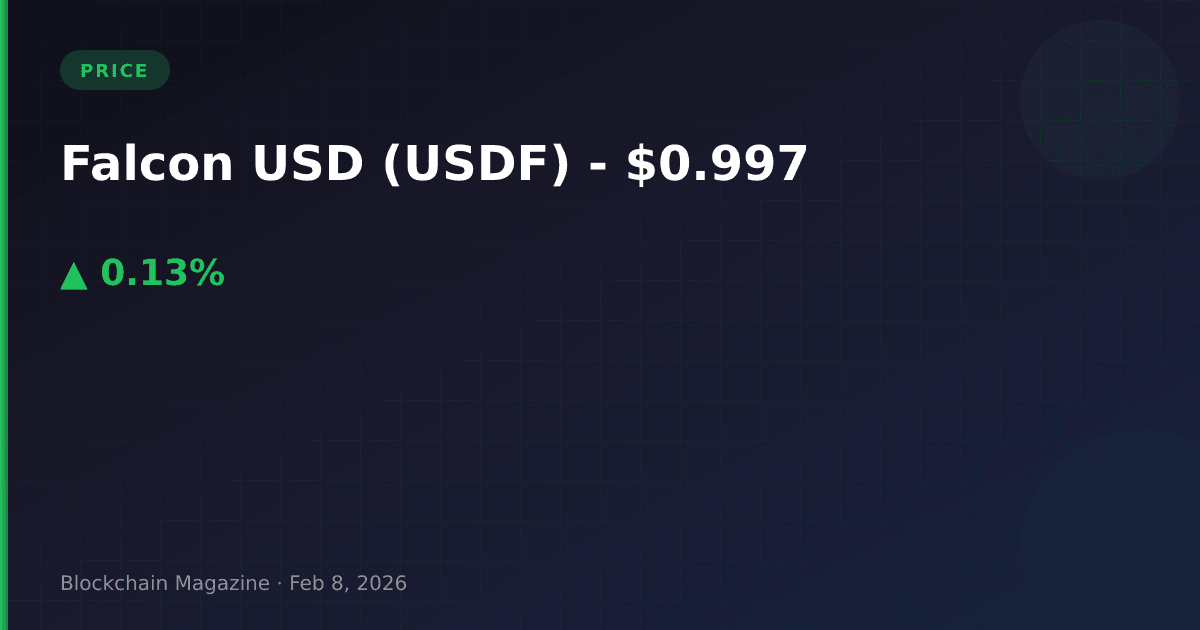
Falcon USD (USDF) is currently trading at $0.997036, demonstrating the characteristic stability expected from a stablecoin pegged to the US Dollar. With a market capitalization of $1.76 billion, USDF ranks #43 among all cryptocurrencies, positioning it as a significant player in the stablecoin ecosystem. The token has shown slight positive momentum with a +0.13% increase in the last 24 hours and a +0.34% gain over the past week.
The current price sits approximately 0.30% below its $1.00 peg, which falls within the normal fluctuation range for algorithmic and collateralized stablecoins. The 24-hour trading volume of $870,070 indicates moderate liquidity, though this represents a relatively low volume-to-market-cap ratio of 0.049%, suggesting that USDF may experience less active trading compared to larger stablecoins like USDT or USDC. The all-time high of $1.075 and all-time low of $0.943422 demonstrate a historical volatility range of approximately 13.9%, which is wider than ideal for a stablecoin but reflects market stress periods or initial stabilization phases. With a circulating supply of 1.77 billion tokens and unlimited maximum supply, USDF employs a flexible monetary policy that can expand or contract based on market demand.
Technical Overview and Market Metrics
From a technical perspective, Falcon USD exhibits stability metrics that align with its function as a USD-pegged stablecoin. The current deviation of -0.30% from the $1.00 peg is minimal and represents normal market behavior. The 30-day performance of +0.13% indicates successful peg maintenance over the medium term, though the all-time high of $1.075 suggests the token has experienced temporary depegging events with a maximum upward deviation of 7.5%. This could indicate periods of high demand or liquidity constraints during market volatility.
The market structure shows a mature stablecoin with established infrastructure. The $1.76 billion market capitalization places USDF in the mid-tier category of stablecoins, significantly smaller than industry leaders like Tether (USDT) and USD Coin (USDC), but still maintaining considerable adoption. The volume-to-market-cap ratio of 0.049% is notably low, suggesting that USDF holders primarily use the token for value storage or specific ecosystem applications rather than active trading. This low velocity could indicate strong holder confidence or limited exchange listings.
The technical support level appears firmly established around the all-time low of $0.943422, representing a 5.66% maximum downward deviation from peg. For a stablecoin, maintaining tighter bounds would inspire greater confidence, though these historical ranges may reflect early-stage growing pains or extreme market conditions during crypto-wide stress events. The unlimited maximum supply structure allows the protocol to mint new tokens as demand increases, a critical feature for maintaining the peg during expansion phases while requiring robust collateralization or algorithmic mechanisms to ensure stability.
Falcon USD (USDF) Price Prediction 2024-2025
Predicting the price trajectory of a stablecoin differs fundamentally from forecasting volatile cryptocurrencies, as the primary objective is maintaining parity with the US Dollar rather than appreciation. For Falcon USD (USDF), the realistic price expectation for both 2024 and 2025 centers around the $0.98-$1.02 range, with the goal of minimizing deviation from the $1.00 target. Several factors will influence USDF’s ability to maintain its peg and grow its market presence.
Short-term outlook (3-6 months): USDF should trade within a tight range of $0.995-$1.005 assuming normal market conditions. The current +0.13% momentum suggests adequate collateralization or algorithmic mechanisms are functioning properly. However, the low 24-hour volume of $870,070 relative to its market cap indicates limited liquidity depth, which could cause temporary deviations during large redemptions or minting events. Increased exchange listings and DeFi protocol integrations would improve stability by enhancing liquidity. The key risk factor remains transparency around reserve composition and audit frequency—factors that have historically caused stablecoin depegging events industry-wide.
Medium-term outlook (6-12 months): For the remainder of 2024 and into 2025, USDF’s growth trajectory depends on expanding its utility within the blockchain ecosystem. With regulatory clarity improving around stablecoins, particularly with frameworks emerging in the US and EU, compliant stablecoins may gain significant market share. If USDF maintains transparent reserves, regular attestations, and expands its use cases in payment systems, DeFi lending protocols, and cross-border transactions, the circulating supply could grow from the current 1.77 billion to potentially 3-5 billion tokens, increasing market cap proportionally while maintaining the $1.00 peg.
Long-term considerations (2025 and beyond): The stablecoin market is projected to reach $400 billion by 2025, presenting growth opportunities for well-managed projects. USDF’s unlimited supply model positions it to capture market share if backed by credible reserves or over-collateralization. The competitive landscape favors stablecoins with strong regulatory compliance, banking partnerships, and clear redemption mechanisms. Price stability will remain the primary success metric, with the target remaining firmly at $1.00. Investors should monitor the project’s transparency initiatives, audit reports, and adoption metrics rather than anticipating price appreciation. The realistic scenario involves USDF maintaining its peg within ±2% during normal conditions and ±5% during market stress events, with success measured by ecosystem growth rather than token price increase.
How to Buy Falcon USD (USDF)
Purchasing Falcon USD is straightforward through cryptocurrency exchanges that list the token. Step 1: Create an account on a supporting exchange platform that offers USDF trading pairs. Complete the required KYC (Know Your Customer) verification process by submitting identification documents. Step 2: Deposit funds into your exchange account using bank transfer, credit card, or by transferring other cryptocurrencies like Bitcoin or Ethereum. Step 3: Navigate to the USDF trading pair (commonly USDF/USDT or USDF/USD) and place a market or limit order based on your preferred entry price. Step 4: Once purchased, consider transferring your USDF to a secure wallet—either a hardware wallet for maximum security or a software wallet that supports the token’s blockchain standard. For larger holdings, self-custody is recommended to maintain control over your assets. Always verify contract addresses when adding USDF to your wallet to avoid scam tokens, and start with a small test transaction before transferring larger amounts.
Market Dynamics and Trading Considerations
The $870,070 daily trading volume for Falcon USD reveals important liquidity characteristics. While the $1.76 billion market cap indicates substantial total value locked in the stablecoin, the low volume suggests that USDF may be primarily used within specific ecosystems rather than as a widely-traded instrument across multiple platforms. This concentration can be both a strength and weakness—providing stability through committed holders but potentially limiting liquidity during large transactions.
For traders and investors, USDF serves primarily as a stable store of value and trading pair base rather than a speculative asset. The token’s utility lies in its ability to provide USD exposure without leaving the blockchain ecosystem, facilitating rapid entry and exit from volatile crypto positions. The slight positive returns over 24-hour (+0.13%), 7-day (+0.34%), and 30-day (+0.13%) periods demonstrate successful peg maintenance, though these small positive deviations might indicate slightly higher demand than supply in recent weeks.
Institutional and retail users should evaluate USDF based on reserve transparency, regulatory compliance, and integration within their preferred DeFi protocols. The unlimited supply model provides flexibility but requires trust in the issuing entity’s minting and burning mechanisms. Compared to algorithmic stablecoins that have faced historical challenges, reserve-backed models generally provide greater stability, though users should verify USDF’s specific collateralization approach through official documentation and third-party audits.
Investment Considerations and Risk Factors
While stablecoins like Falcon USD are designed for stability rather than appreciation, several risk factors warrant consideration. Depeg risk remains the primary concern, as evidenced by the historical range between $0.943422 and $1.075. A 5.66% downward and 7.5% upward deviation suggests USDF has experienced notable volatility events, potentially during market stress periods or liquidity crises. Future depegging events could occur if reserves prove insufficient, if redemption mechanisms fail, or during broader market panics.
Regulatory risk affects all stablecoins as governments worldwide develop frameworks for digital assets pegged to fiat currencies. Compliance with evolving regulations regarding reserve requirements, audits, and licensing could impact USDF’s operations. Projects that proactively embrace transparency and regulatory cooperation typically fare better long-term. Liquidity risk is apparent in USDF’s low trading volume relative to market cap. Large redemptions or purchases could cause temporary price dislocations, particularly if the token isn’t deeply integrated across major exchanges. Users requiring rapid conversion to fiat or other cryptocurrencies should verify adequate liquidity on their preferred platforms before committing significant capital.
Smart contract risk and counterparty risk also apply. If USDF operates on smart contract infrastructure, code vulnerabilities could be exploited. Additionally, if a centralized entity controls reserves or minting, that entity represents a single point of failure. Diversification across multiple stablecoins (USDT, USDC, DAI, USDF) can mitigate concentration risk while maintaining stable value exposure within a crypto portfolio.
Use Cases and Ecosystem Integration
Falcon USD serves multiple functions within the cryptocurrency ecosystem. As a trading pair and market stability tool, USDF allows traders to exit volatile positions quickly without converting to fiat currency, preserving capital on-chain for rapid redeployment. This function is particularly valuable during market downturns when maintaining liquidity is crucial. The stablecoin’s presence in trading pairs enables more efficient price discovery and reduces friction in crypto-to-crypto transactions.
For DeFi applications, stablecoins like USDF provide the foundation for lending protocols, liquidity pools, and yield farming strategies. Users can deposit USDF into lending platforms to earn interest, or provide liquidity to decentralized exchanges paired with volatile assets, earning trading fees while maintaining partial stable exposure. The unlimited supply model supports ecosystem growth, allowing the stablecoin supply to expand as adoption increases across DeFi protocols.
In payments and remittances, stablecoins offer advantages over traditional methods by enabling near-instantaneous, low-cost international transfers. If USDF develops partnerships with payment processors or remittance services, it could facilitate cross-border transactions without the delays and fees associated with conventional banking systems. The current market cap of $1.76 billion suggests sufficient liquidity to support meaningful payment volume, though broader adoption would require enhanced accessibility through user-friendly wallets and merchant integration tools.
Competitive Position in the Stablecoin Market
Within the stablecoin landscape, Falcon USD occupies a mid-tier position at rank #43, significantly behind market leaders but maintaining a respectable presence. Tether (USDT) dominates with over $90 billion market cap, followed by USD Coin (USDC) at approximately $30 billion, and other major players like DAI, BUSD, and TrueUSD. USDF’s $1.76 billion market cap represents approximately 0.5-1% of the total stablecoin market, indicating niche adoption rather than mainstream status.
USDF’s competitive advantages may include specialized ecosystem integration, potentially lower fees, or unique features not broadly advertised. The unlimited supply model provides flexibility to scale with demand, avoiding the supply constraints that could limit growth. However, this same model requires exceptional transparency and reserve management to maintain user confidence. Compared to algorithmic stablecoins that adjust supply through market mechanisms alone, reserve-backed models like USDF (assuming this model applies) generally provide greater stability through tangible asset backing.
The primary competitive challenges include establishing sufficient liquidity to compete with entrenched players, building trust through transparent audits and regulatory compliance, and securing listings on major exchanges and integration with prominent DeFi protocols. Network effects strongly favor existing stablecoins—users gravitate toward the most liquid and widely accepted options. USDF’s growth strategy must focus on specific use cases or ecosystems where it offers distinct advantages, rather than competing directly across all dimensions with USDT and USDC. Potential differentiation could come through superior regulatory compliance, innovative features, lower transaction costs, or deep integration within particular blockchain ecosystems or geographic markets.
Frequently Asked Questions
What is the current price of Falcon USD (USDF)?
Falcon USD (USDF) is currently trading at $0.997036 USD, representing a slight 0.30% discount from its $1.00 peg. The token has shown positive momentum with a +0.13% increase in the last 24 hours and +0.34% over the past week. As a stablecoin designed to maintain parity with the US Dollar, USDF’s price typically fluctuates within a narrow range around $1.00. The current price reflects normal market conditions and minor supply-demand imbalances that are common among stablecoins. Real-time USDF price updates can be tracked on major cryptocurrency data platforms and exchanges where the token is listed.
Is Falcon USD (USDF) a good investment?
Falcon USD (USDF) serves a fundamentally different purpose than speculative cryptocurrencies—it’s designed to maintain stable value rather than appreciate. As an investment, USDF is appropriate for users seeking to preserve capital in US Dollar equivalent while remaining within the cryptocurrency ecosystem. The token’s $1.76 billion market cap and #43 ranking indicate established adoption, though its relatively low 24-hour trading volume of $870,070 suggests limited liquidity compared to larger stablecoins. USDF is best utilized as a stable store of value, trading pair base, or DeFi collateral rather than as a growth investment. Investors should evaluate USDF based on its reserve transparency, regulatory compliance, and utility within their preferred platforms. For portfolio allocation, stablecoins typically serve to reduce volatility and provide dry powder for opportunistic purchases rather than generate significant returns. Consider diversifying across multiple reputable stablecoins to mitigate concentration risk.
What is the all-time high and all-time low price of USDF?
Falcon USD reached its all-time high of $1.075, representing a 7.5% premium above its $1.00 peg. This deviation likely occurred during periods of exceptionally high demand, liquidity constraints, or market inefficiencies that temporarily disrupted the stabilization mechanism. The token’s all-time low of $0.943422 represents a 5.66% discount from peg, potentially occurring during market stress events, large redemptions, or confidence crises. For a stablecoin, these extremes indicate a historical volatility range of approximately 13.9%, which is wider than ideal but may reflect early operational phases or exceptional market conditions. The current price of $0.997036 sits comfortably within the historical range and close to the target peg, suggesting improved stability mechanisms or more mature market conditions. Investors should monitor whether USDF tightens this range over time, as narrower bounds indicate more robust peg maintenance and greater reliability as a stable value instrument.
How can I buy Falcon USD (USDF)?
You can purchase Falcon USD through cryptocurrency exchanges that list USDF trading pairs. Start by creating an account on a supporting exchange and completing identity verification (KYC) requirements. Deposit funds via bank transfer, credit/debit card, or by transferring other cryptocurrencies like Bitcoin, Ethereum, or USDT. Navigate to the USDF trading section and select your preferred pair (such as USDF/USDT or USDF/USD). Place a market order for immediate execution at current prices or a limit order to specify your desired purchase price. After buying, consider transferring USDF to a secure wallet—hardware wallets offer maximum security for long-term storage, while software wallets provide convenience for active use. Always verify the correct contract address when adding USDF to your wallet to avoid scam tokens. For first-time purchases, start with a small amount to familiarize yourself with the process before committing larger sums. Check the exchange’s fee structure, as costs can vary significantly between platforms.
What is Falcon USD (USDF) price prediction for 2024 and 2025?
As a stablecoin, Falcon USD’s price target remains $1.00 USD for both 2024 and 2025, with expected fluctuations in the $0.98-$1.02 range during normal market conditions. Unlike volatile cryptocurrencies, USDF’s success is measured by peg maintenance rather than price appreciation. Short-term (3-6 months), expect USDF to trade within $0.995-$1.005 assuming proper collateralization and stable market conditions. Medium-term (6-12 months), the focus should be on ecosystem growth—increased exchange listings, DeFi integrations, and expanded use cases could grow circulating supply from 1.77 billion to potentially 3-5 billion tokens while maintaining the $1.00 peg. Long-term (2025 and beyond), success depends on regulatory compliance, transparent audits, and adoption in payments and DeFi. The stablecoin market is expected to reach $400 billion by 2025, providing growth opportunities for well-managed projects. Risk factors include potential depegging events during market stress (historical range $0.943-$1.075), regulatory changes, and competition from established stablecoins. Monitor USDF’s reserve transparency, audit frequency, and trading volume as indicators of stability rather than expecting price appreciation.
Stay informed with daily updates from Blockchain Magazine on Google News. Click here to follow us and mark as favorite: [Blockchain Magazine on Google News].
Disclaimer
Blockchain Magazine publishes content submitted by third-party agencies, partners, and clients. Any such posts are categorized and tagged accordingly:
- Sponsored Content: Posts labeled as "Sponsored" are paid placements submitted by third-party agencies or clients. Blockchain Magazine does not endorse or express any views regarding the information contained in these posts. The opinions expressed belong solely to the respective authors and do not reflect the official policy or position of Blockchain Magazine.
- Press Releases: Posts labeled as "Press Release" are paid PR submissions provided by our partners and clients. These are published as received and should be considered as promotional content.
The information provided in such posts is strictly for informational purposes only and should not be interpreted as financial, investment, or professional advice. Blockchain Magazine does not recommend, endorse, or promote any specific products, services, or companies mentioned. Readers are strongly encouraged to conduct independent research and consult with a qualified professional before making any financial or investment decisions.
Additionally, all featured images accompanying such posts are intended as creative depictions of the subject matter. There is no intent to offend or misrepresent any individual, institution, or entity. If any content or imagery is found to be objectionable, please reach out to us at [email protected], and we will promptly review the concern.
About the Author: Editors Desk



Get Blockchain Insights In Inbox
Stay ahead of the curve with expert analysis and market updates.