Uniswap (UNI) Price Today, Live Chart & Market Cap | UNI to USD Converter

Uniswap UNI
Rank #39
Last updated: 2/8/2026, 9:49:15 PM · Data from CoinGecko
Uniswap (UNI) Price Today
Uniswap Price Analysis
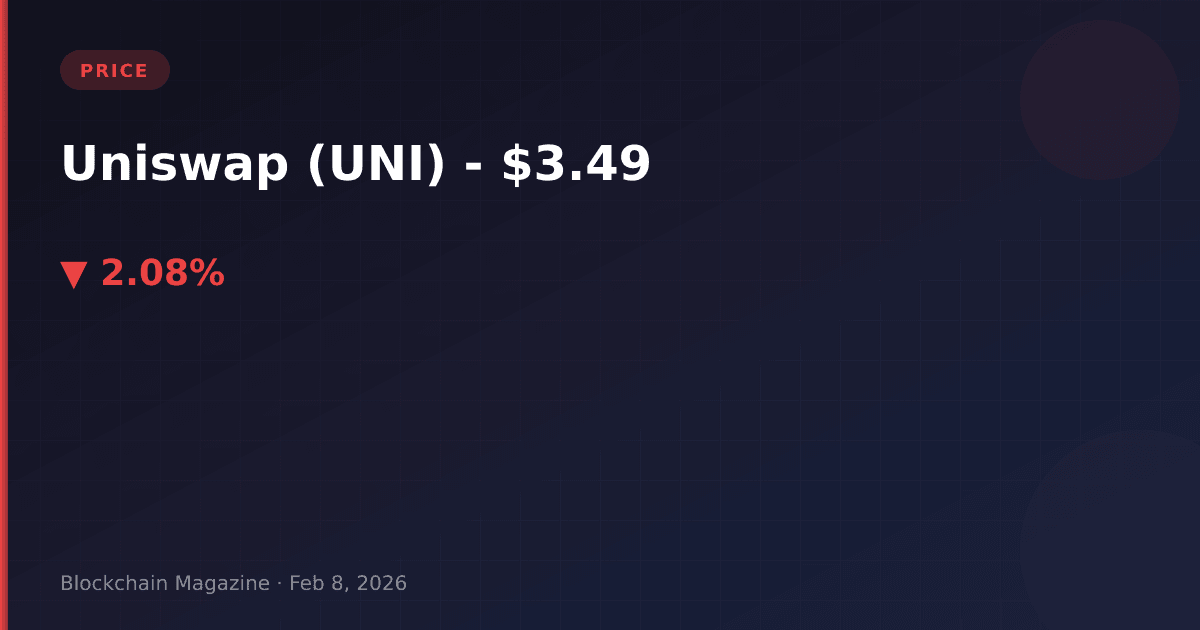
Uniswap (UNI) is currently trading at $3.49, representing a decline of 2.08% over the past 24 hours. The leading decentralized exchange (DEX) protocol token has experienced significant volatility, with a 7-day decrease of 9.50% and a more substantial 30-day decline of 35.98%. This downward momentum reflects broader market corrections affecting DeFi tokens and reduced trading activity in the decentralized finance sector.
Despite recent price weakness, UNI maintains its position as the #39 cryptocurrency by market capitalization at $2.21 billion. The 24-hour trading volume of $129.75 million indicates moderate liquidity, though this represents a decrease from peak trading periods. With 633.99 million UNI tokens in circulation out of a maximum supply of 1 billion, approximately 63.4% of tokens have been distributed. The token remains significantly below its all-time high of $44.92, trading approximately 92.2% down from that peak, while maintaining a substantial premium of 238.8% above its all-time low of $1.03. Current market conditions suggest UNI is navigating through a consolidation phase as the DeFi ecosystem adjusts to changing market dynamics and evolving regulatory landscapes.
Technical Overview and Market Metrics
From a technical perspective, Uniswap’s current price action shows several key indicators worth monitoring. The token’s position at $3.49 places it in a critical support zone that has historically provided buying interest during previous market cycles. The market capitalization of $2.21 billion reflects UNI’s status as one of the most established DeFi governance tokens, despite the recent bearish trend. Trading volume analysis reveals that the $129.75 million in 24-hour volume represents a volume-to-market-cap ratio of approximately 5.87%, indicating moderate trading activity compared to other top-50 cryptocurrencies.
The circulating supply dynamics present an important consideration for price analysis. With 633.99 million tokens currently circulating and a maximum supply capped at 1 billion UNI, approximately 366 million tokens remain to be released through Uniswap’s predetermined distribution schedule over the next several years. This scheduled token emission creates ongoing selling pressure that must be offset by increased demand for sustainable price appreciation. The token’s utility as a governance mechanism for the Uniswap protocol—the largest DEX by trading volume—provides fundamental value supporting its market position. However, the steep 35.98% decline over 30 days suggests traders are taking a cautious approach amid broader cryptocurrency market uncertainty and reduced DeFi yields compared to 2021-2022 levels.
Uniswap Price Prediction 2024-2025
Predicting Uniswap’s future price requires analyzing both protocol-specific fundamentals and broader market trends. In the near term, UNI faces technical resistance levels around $4.20-$4.50, which represent significant psychological barriers and previous support-turned-resistance zones. A sustainable move above these levels would require increased trading volume on the Uniswap platform itself and renewed interest in DeFi protocols. The 24-hour change of -2.08% and 7-day decline of -9.50% indicate short-term bearish momentum, suggesting potential consolidation or further downside testing before establishing a new base.
For 2024, conservative price projections based on historical volatility patterns and current market structure suggest UNI could trade in a range between $2.80 (representing a retest of stronger support) and $6.50 (marking a recovery to mid-2023 levels). A return to previous resistance zones would require several catalysts: increased Ethereum network activity driving higher DEX volumes, successful implementation of Uniswap v4 features, expansion of protocol fee mechanisms benefiting token holders, and overall cryptocurrency market recovery. The upcoming token unlock schedule will introduce approximately 50-70 million additional UNI tokens annually, creating predictable supply pressure that must be absorbed by growing demand.
Looking toward 2025, longer-term projections become increasingly speculative but can be grounded in adoption metrics. If Uniswap maintains its market-leading position capturing 60-70% of DEX trading volume, and if total DeFi trading volumes return to 2021 levels, UNI could potentially test the $8-$12 range. A truly bullish scenario—contingent on a new crypto bull market, mainstream DeFi adoption, and favorable regulatory clarity—could see UNI challenge its previous high near $15-$20. However, investors should note the significant distance to the all-time high of $44.92, which was reached during peak market euphoria with substantially different market conditions. Realistic expectations should account for token inflation, competitive DEX protocols, and the maturation of the DeFi sector beyond speculative peaks.
How to Buy Uniswap (UNI)
Purchasing UNI tokens is straightforward through major cryptocurrency exchanges. Centralized exchanges like Coinbase, Binance, Kraken, and Gemini offer UNI trading pairs against USD, USDT, and BTC with high liquidity and user-friendly interfaces. To buy on these platforms: (1) Create and verify your account with KYC documentation, (2) Deposit funds via bank transfer, debit card, or cryptocurrency, (3) Navigate to the UNI trading pair, (4) Execute a market or limit order, and (5) Consider transferring tokens to a personal wallet for security.
Alternatively, you can acquire UNI directly through decentralized exchanges, including Uniswap itself, which offers an ironic full-circle experience. Using MetaMask or another Web3 wallet with ETH for gas fees, connect to Uniswap’s interface and swap ETH or stablecoins for UNI tokens. This method provides immediate custody without centralized intermediaries but requires understanding of wallet security and transaction fees. DEX purchases may offer better privacy but typically involve higher costs due to Ethereum network fees during periods of congestion.
Understanding Uniswap’s Role in DeFi
Uniswap represents a paradigm shift in cryptocurrency trading infrastructure, pioneering the automated market maker (AMM) model that eliminates traditional order books. Launched in 2018 by Hayden Adams, the protocol enables permissionless token swaps through liquidity pools where users provide trading capital in exchange for fees. The UNI governance token, distributed in September 2020, grants holders voting rights over protocol parameters, fee structures, treasury allocation, and strategic direction.
The protocol has facilitated over $1.5 trillion in cumulative trading volume since inception, establishing itself as the most widely-used DEX in the cryptocurrency ecosystem. Uniswap v3, the current iteration, introduced concentrated liquidity allowing liquidity providers to specify price ranges for improved capital efficiency. The upcoming v4 promises “hooks”—customizable smart contract plugins that will enable unprecedented flexibility for liquidity pool creators. These technological innovations reinforce Uniswap’s competitive moat despite emerging rivals like Curve, Balancer, and PancakeSwap.
As a governance token, UNI’s value proposition extends beyond speculation to include protocol decision-making authority. Recent governance discussions have focused on implementing protocol fees that would direct a percentage of trading fees to UNI token holders, transitioning from a pure governance token to a value-accruing asset. This potential shift could fundamentally alter UNI’s investment thesis, creating sustainable cash flows similar to traditional equity dividends. However, such changes require governance approval and careful balancing of stakeholder interests between traders, liquidity providers, and token holders.
Investment Considerations and Risk Factors
Bullish factors: Uniswap’s dominant market position with 60-70% DEX market share, proven protocol security through years of operation without major exploits, continuous technological innovation with v4 development, potential fee switch activation creating token value accrual, strong brand recognition and developer ecosystem, and exposure to DeFi sector growth as blockchain adoption expands.
Bearish factors: Ongoing token unlocks diluting existing holder value, regulatory uncertainty surrounding DEX operations and DeFi protocols, intense competition from alternative DEXs with lower fees or better user experience, dependence on Ethereum ecosystem performance and gas fee levels, lack of current cash flow generation for token holders, and vulnerability to broader cryptocurrency market downturns that disproportionately affect DeFi tokens.
Risk assessment: UNI carries high volatility typical of mid-cap cryptocurrencies, with potential for 30-50% price swings within weeks based on market sentiment. The 35.98% decline over 30 days exemplifies this volatility. Smart contract risk remains minimal given Uniswap’s battle-tested code, but protocol governance risk exists if controversial proposals divide the community. Regulatory risk represents perhaps the greatest unknown, as increased government scrutiny of DeFi platforms could impact operations or token value. Investors should only allocate capital they can afford to lose and maintain diversified portfolios beyond single-protocol exposure.
UNI Price Milestones
| Metric | Value | Context |
|---|---|---|
| Current Price | $3.49 | Down 2.08% (24h) |
| All-Time High | $44.92 | 92.2% below ATH |
| All-Time Low | $1.03 | 238.8% above ATL |
| 30-Day High | ~$5.48 | Based on 35.98% decline |
| Market Cap Rank | #39 | Top 40 cryptocurrency |
| Supply Issued | 63.4% | 366M tokens remaining |
Stay informed with daily updates from Blockchain Magazine on Google News. Click here to follow us and mark as favorite: [Blockchain Magazine on Google News].
Disclaimer
Blockchain Magazine publishes content submitted by third-party agencies, partners, and clients. Any such posts are categorized and tagged accordingly:
- Sponsored Content: Posts labeled as "Sponsored" are paid placements submitted by third-party agencies or clients. Blockchain Magazine does not endorse or express any views regarding the information contained in these posts. The opinions expressed belong solely to the respective authors and do not reflect the official policy or position of Blockchain Magazine.
- Press Releases: Posts labeled as "Press Release" are paid PR submissions provided by our partners and clients. These are published as received and should be considered as promotional content.
The information provided in such posts is strictly for informational purposes only and should not be interpreted as financial, investment, or professional advice. Blockchain Magazine does not recommend, endorse, or promote any specific products, services, or companies mentioned. Readers are strongly encouraged to conduct independent research and consult with a qualified professional before making any financial or investment decisions.
Additionally, all featured images accompanying such posts are intended as creative depictions of the subject matter. There is no intent to offend or misrepresent any individual, institution, or entity. If any content or imagery is found to be objectionable, please reach out to us at [email protected], and we will promptly review the concern.
About the Author: Editors Desk



Get Blockchain Insights In Inbox
Stay ahead of the curve with expert analysis and market updates.