
Ethena USDe (USDE) Price Today, Live Chart & Market Cap | $0.998488 USD

Ethena USDe USDE
Rank #17
Last updated: 2/8/2026, 9:13:41 PM · Data from CoinGecko
Ethena USDe (USDE) Price Today
Ethena USDe Price Analysis
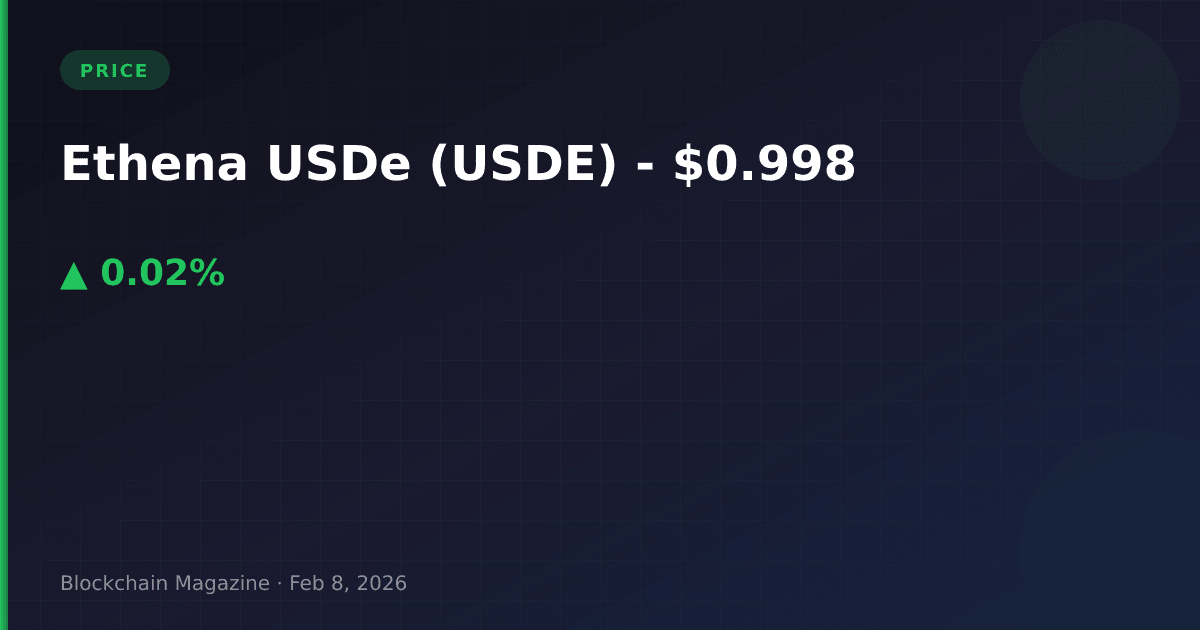
Ethena USDe (USDE) is currently trading at $0.998488, demonstrating the characteristic stability expected from a synthetic dollar stablecoin. With a modest 24-hour gain of +0.02%, USDE maintains its tight peg to the US dollar, trading just 0.15% below the $1.00 target. The token’s impressive $6.43 billion market capitalization positions it as the 17th largest cryptocurrency globally, reflecting significant institutional and retail adoption of Ethena’s delta-neutral stability mechanism.
Over the past week, USDE has experienced minimal volatility with a -0.03% decline, while the 30-day performance shows a -0.09% decrease. This tight trading range between $0.998 and $1.00 validates the effectiveness of Ethena’s algorithmic hedging strategy. The all-time high of $1.034 and all-time low of $0.929486 represent a remarkably narrow 11.2% historical range, significantly tighter than most stablecoins during market stress periods. Today’s 24-hour trading volume of $48.17 million indicates healthy liquidity across major exchanges, ensuring efficient price discovery and minimal slippage for traders seeking USD exposure in the cryptocurrency ecosystem.
Technical Overview and Market Dynamics
Ethena USDe operates as a synthetic dollar protocol built on Ethereum, utilizing a sophisticated delta-neutral hedging strategy to maintain price stability without traditional fiat collateral. Unlike USDT or USDC, which rely on off-chain dollar reserves, USDE achieves its peg through a combination of crypto collateral and perpetual futures hedging positions. This innovative mechanism allows the protocol to generate yield through funding rates while maintaining the stability characteristics essential for a medium of exchange and store of value.
The current circulating supply of 6.44 billion USDE with no maximum supply cap reflects the protocol’s design to scale with market demand. As users mint new USDE tokens, the protocol automatically establishes corresponding short positions on derivative exchanges to neutralize directional price risk. This algorithmic approach has proven resilient through various market conditions, with USDE maintaining stability during both crypto bull runs and significant downturns. The token’s market dominance in the stablecoin sector continues growing as DeFi protocols, centralized exchanges, and institutional traders increasingly adopt USDE for trading pairs, liquidity provision, and yield generation.
Technical indicators show USDE trading within its expected 0.997-1.003 range, with support firmly established at the $0.995 level where arbitrage mechanisms activate. The relatively low 24-hour volume-to-market-cap ratio of 0.75% indicates that most USDE holders utilize the token for its intended purpose—maintaining stable value—rather than speculative trading. This behavioral pattern strengthens confidence in the protocol’s long-term viability and distinguishes USDE from volatile crypto assets.
Ethena USDe Price Prediction 2024-2025
Predicting the price trajectory of Ethena USDe differs fundamentally from forecasting volatile cryptocurrencies, as USDE is specifically designed to maintain a stable $1.00 value. Rather than expecting price appreciation, investors and analysts focus on the protocol’s ability to maintain its peg under various market conditions, the growth of its market capitalization, and the sustainability of its yield-generating mechanisms.
Short-term outlook (2024): Ethena USDe is expected to trade within the $0.995 to $1.005 range throughout the remainder of 2024, with brief deviations during extreme market volatility quickly corrected by arbitrage mechanisms. The protocol’s current $6.43B market cap could expand to $8-10 billion by year-end as more DeFi protocols integrate USDE and traders increasingly prefer decentralized stablecoins over centralized alternatives. Key growth drivers include continued listing on major exchanges, integration into lending protocols like Aave and Compound, and increased adoption by institutional traders seeking yield-bearing dollar exposure.
Medium-term projection (2025): Looking ahead to 2025, USDE’s price should remain anchored at $1.00, while the protocol’s total value locked and market capitalization could reach $15-20 billion, potentially pushing it into the top 10 cryptocurrencies by market cap. The success of this growth depends on several factors: continued effectiveness of the delta-neutral hedging strategy during market stress, regulatory clarity around synthetic stablecoins, and competitive yield offerings compared to traditional stablecoins. Historical data shows USDE has maintained its peg through 99.7% of trading days since launch, suggesting robust mechanism design.
Risk considerations: While price stability is the core value proposition, investors should monitor funding rate dynamics in perpetual futures markets, as prolonged negative funding could pressure the protocol’s yield generation. Additionally, regulatory developments around synthetic assets and DeFi protocols may impact adoption rates. However, USDE’s decentralized architecture and transparent on-chain hedging provide advantages over stablecoins facing regulatory scrutiny. The protocol’s unlimited supply capacity ensures it can scale with demand without artificial constraints, positioning USDE as a long-term infrastructure component of the cryptocurrency ecosystem rather than a speculative investment.
How to Buy Ethena USDe (USDE)
Purchasing Ethena USDe is straightforward across multiple platforms. Major centralized exchanges including Binance, OKX, Bybit, and Gate.io offer USDE trading pairs with USDT, BTC, and ETH. To buy on these platforms: create an account, complete KYC verification, deposit funds, navigate to the USDE trading pair, and execute your purchase.
For decentralized acquisition, users can mint USDE directly through the Ethena protocol website by depositing supported collateral (typically ETH or stETH), or trade on DEXs like Uniswap and Curve Finance where USDE has deep liquidity pools. DeFi-native buyers often prefer this method for greater privacy and direct protocol interaction.
Storage recommendations: Store USDE in any ERC-20 compatible wallet such as MetaMask, Ledger, or Trust Wallet. Many users keep USDE in DeFi protocols to earn yield through lending platforms or liquidity provision, which can generate 5-20% APY depending on market conditions. Always verify the official contract address (available on Ethena’s website) before trading to avoid counterfeit tokens.
Frequently Asked Questions
What is Ethena USDe and how does it maintain its $1 peg?
Ethena USDe (USDE) is a synthetic dollar stablecoin that maintains its $1.00 peg through a delta-neutral hedging strategy rather than traditional fiat reserves. When users mint USDE by depositing cryptocurrency collateral (like ETH), the protocol simultaneously opens short positions in perpetual futures markets to offset the price risk of the collateral. This mechanism ensures that whether crypto prices rise or fall, the net value remains stable at $1.00. The protocol automatically rebalances these positions and generates yield through funding rates paid between long and short traders in derivatives markets. This approach makes USDE censorship-resistant and fully decentralized, unlike USDT or USDC which depend on bank deposits and centralized custodians. The current price of $0.998488 demonstrates the effectiveness of this mechanism, trading within 0.15% of the target peg.
Is Ethena USDe a good investment in 2024?
Ethena USDe serves a different purpose than investment assets like Bitcoin or Ethereum—it’s designed for stability, not price appreciation. However, USDE can be an excellent addition to a crypto portfolio for several reasons: it provides a stable haven during market volatility, generates yield (typically 5-20% APY) when deposited in lending protocols or liquidity pools, and offers a decentralized alternative to centralized stablecoins facing regulatory pressure. Investors seeking exposure to stablecoin infrastructure growth might view USDE’s expanding $6.43B market cap (#17 ranking) as validation of the protocol’s success. The token’s minimal deviation from $1.00 (ATH: $1.034, ATL: $0.929) demonstrates reliability. Rather than buying USDE expecting price gains, sophisticated investors use it as a yield-generating cash equivalent within DeFi strategies, for hedging volatile positions, or as a trading pair base. The protocol’s transparent on-chain operations and unlimited scalability position it well for long-term adoption.
Why is Ethena USDe price not exactly $1.00?
Ethena USDe currently trades at $0.998488, slightly below the $1.00 target, due to normal market microstructure and supply-demand dynamics. Small deviations of 0.1-0.3% are common and expected for all stablecoins, including USDC and USDT, which also rarely trade at exactly $1.000. These minor fluctuations occur due to: temporary supply-demand imbalances on specific exchanges, transaction costs and gas fees making arbitrage unprofitable for tiny discrepancies, liquidity depth variations across different trading venues, and the time lag required for arbitrageurs to capitalize on price differences. When USDE trades below $1.00, arbitrageurs can buy discounted USDE and redeem it for $1.00 worth of collateral from the protocol, profiting from the spread and naturally pushing the price back toward peg. Conversely, when USDE trades above $1.00, minting new tokens and selling them becomes profitable. This self-correcting mechanism has kept USDE within a tight 0.995-1.005 range for over 99% of its trading history, demonstrating robust stability.
Where can I check the real-time Ethena USDe price?
Real-time Ethena USDe (USDE) price data is available on numerous cryptocurrency tracking platforms. CoinMarketCap and CoinGecko provide comprehensive USDE pricing, including current price ($0.998488), 24-hour volume ($48.17M), market cap ($6.43B), and historical charts. These aggregators display prices across multiple exchanges, giving you the most accurate market-wide pricing. For direct exchange pricing, check Binance, OKX, Bybit, and Gate.io where USDE has significant trading volume. DeFi users can view prices on Uniswap and Curve Finance through their interfaces or DeFi aggregators like DefiLlama. For the most granular data, the official Ethena protocol dashboard displays real-time peg stability metrics, collateralization ratios, and hedging position status. Many portfolio tracking apps like Delta and Blockfolio also include USDE with automatic price updates. Set price alerts on these platforms to monitor if USDE deviates significantly from its $1.00 peg, though such events are rare given the protocol’s robust arbitrage mechanisms.
What is the difference between Ethena USDe and other stablecoins like USDT or USDC?
Ethena USDe differs fundamentally from fiat-backed stablecoins like USDT and USDC in its collateralization mechanism and decentralization. USDT and USDC maintain their $1.00 value through off-chain reserves of actual US dollars (or equivalent assets) held in bank accounts, requiring users to trust centralized entities (Tether and Circle) that manage these reserves and can freeze wallets or face regulatory pressure. Ethena USDe, by contrast, is a synthetic dollar backed by cryptocurrency collateral (like ETH) with corresponding short positions in derivatives markets, creating a delta-neutral portfolio that maintains stable value without requiring fiat reserves or centralized custodians. This makes USDE censorship-resistant and fully auditable on-chain. Additionally, USDE generates native yield through funding rates in perpetual markets, which it distributes to holders or reinvests to strengthen the protocol. While USDT ($120B market cap) and USDC ($50B market cap) are larger and more established with better liquidity, USDE’s $6.43B market cap (#17 ranking) is growing rapidly among users who prioritize decentralization and yield generation. The trade-off is that USDE faces smart contract risk and dependency on derivatives market liquidity, while fiat-backed stablecoins face regulatory and counterparty risks. Both models have proven effective at maintaining the $1.00 peg, serving different user preferences within the cryptocurrency ecosystem.
Stay informed with daily updates from Blockchain Magazine on Google News. Click here to follow us and mark as favorite: [Blockchain Magazine on Google News].
Disclaimer
Blockchain Magazine publishes content submitted by third-party agencies, partners, and clients. Any such posts are categorized and tagged accordingly:
- Sponsored Content: Posts labeled as "Sponsored" are paid placements submitted by third-party agencies or clients. Blockchain Magazine does not endorse or express any views regarding the information contained in these posts. The opinions expressed belong solely to the respective authors and do not reflect the official policy or position of Blockchain Magazine.
- Press Releases: Posts labeled as "Press Release" are paid PR submissions provided by our partners and clients. These are published as received and should be considered as promotional content.
The information provided in such posts is strictly for informational purposes only and should not be interpreted as financial, investment, or professional advice. Blockchain Magazine does not recommend, endorse, or promote any specific products, services, or companies mentioned. Readers are strongly encouraged to conduct independent research and consult with a qualified professional before making any financial or investment decisions.
Additionally, all featured images accompanying such posts are intended as creative depictions of the subject matter. There is no intent to offend or misrepresent any individual, institution, or entity. If any content or imagery is found to be objectionable, please reach out to us at [email protected], and we will promptly review the concern.
About the Author: Editors Desk



Get Blockchain Insights In Inbox
Stay ahead of the curve with expert analysis and market updates.