
GitHub Investigates Internal Repo Breach After Malicious VS Code Extension Attack
GitHub has confirmed it is investigating unauthorized access to its internal repositories after a security incident tied to a compromised VS Code extension.
In an initial update posted on X on May 20, the company said it had detected suspicious access to internal systems. GitHub stressed that there was no evidence at the time that customer data stored outside internal repositories had been affected. However, it added that it was actively monitoring for any follow-on activity.

Source: GitHub
Later the same day, GitHub shared a more detailed breakdown of what happened. According to the company, the incident began with a compromised employee device that had been infected through a poisoned Visual Studio Code extension. The extension was later removed, and the affected device was isolated as part of the response.

Source: GitHub
GitHub said the attacker appears to have exfiltrated internal repositories only. It also noted that claims circulating online about roughly 3,800 repositories being accessed are “directionally consistent” with its ongoing investigation.
As part of its response, GitHub confirmed that critical credentials were rotated quickly, with priority given to the most sensitive systems. The company also said it is continuing to review logs, validate security changes, and monitor for any further suspicious activity. A full report is expected once the investigation is complete.
Supply Chain Concerns Spread Across The Developer Community
The incident quickly gained attention across crypto and developer circles, where concerns about supply chain security began to grow.
Web3 entrepreneur Justin Wu reacted on X, warning that a breach of this scale could expose entire startup backends if internal systems and repositories were compromised. He pointed to source code, API keys, and internal tools as especially sensitive assets in such scenarios.
Meanwhile, Binance founder CZ also weighed in, urging developers to review and rotate any API keys that may be stored in code, including private repositories.
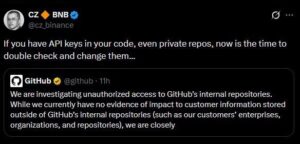
Source: CZ Binance
Cybersecurity commentary platform CoinBureau also reported that a threat group calling itself TeamPCP had claimed responsibility for the attack. The group allegedly stated it had accessed around 4,000 private repositories and was attempting to sell the data for more than $50,000 on underground forums. GitHub has not confirmed these claims but continues to investigate the scope of the breach.
The incident was further amplified by posts across X describing how the attack may have originated from a poisoned VS Code extension that briefly passed through the official marketplace. According to these reports, the malicious update was live for only a short time before being removed, but it may have already reached developers with auto-update enabled.
Some security commentators described the incident as a classic supply chain attack, where trusted developer tools become the entry point for wider system access. If confirmed, it would highlight how quickly a single compromised extension can scale across millions of machines.
What This Means For Developers?
GitHub has said no customer repositories or external organizations have been confirmed as impacted so far. Still, it has urged continued caution as the investigation continues.
As the situation develops, developers are being advised to rotate sensitive credentials, review connected API keys, and monitor any tools or extensions that may have access to internal systems.
The full scope of the incident remains unclear. However, the breach has already reignited concerns around developer tool security and how dependent modern software ecosystems are on shared infrastructure.
Stay informed with daily updates from Blockchain Magazine on Google News. Click here to follow us and mark as favorite: [Blockchain Magazine on Google News].
Disclaimer
Blockchain Magazine publishes content submitted by third-party agencies, partners, and clients. Any such posts are categorized and tagged accordingly:
- Sponsored Content: Posts labeled as "Sponsored" are paid placements submitted by third-party agencies or clients. Blockchain Magazine does not endorse or express any views regarding the information contained in these posts. The opinions expressed belong solely to the respective authors and do not reflect the official policy or position of Blockchain Magazine.
- Press Releases: Posts labeled as "Press Release" are paid PR submissions provided by our partners and clients. These are published as received and should be considered as promotional content.
The information provided in such posts is strictly for informational purposes only and should not be interpreted as financial, investment, or professional advice. Blockchain Magazine does not recommend, endorse, or promote any specific products, services, or companies mentioned. Readers are strongly encouraged to conduct independent research and consult with a qualified professional before making any financial or investment decisions.
Additionally, all featured images accompanying such posts are intended as creative depictions of the subject matter. There is no intent to offend or misrepresent any individual, institution, or entity. If any content or imagery is found to be objectionable, please reach out to us at [email protected], and we will promptly review the concern.
About the Author: S. Parker

editor's pick




Get Blockchain Insights In Inbox
Stay ahead of the curve with expert analysis and market updates.