

Elon Musk Publishes X Algorithm Code as Users Rush to Decode How the Platform Really Works
Elon Musk has once again pulled back the curtain on X.
On May 15, Musk announced that the latest version of X’s “For You” recommendation algorithm had been published on GitHub, giving the public a rare look into the system that decides what billions of users see on their feeds every day.
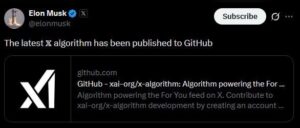
Source: Elon Musk
The newly released repository, published under xAI’s GitHub organization, contains the core ranking and recommendation systems behind X’s timeline. According to the documentation, the platform now relies heavily on Grok-based AI models to determine which posts deserve visibility and which ones quietly disappear into the background.
The release immediately triggered a wave of reactions from developers, creators, growth marketers, and crypto users, many of whom spent hours digging through the code trying to understand how the platform actually rewards content.
And the conclusions they reached painted a much clearer picture of what X wants the platform to become.
X Wants Conversations, Not Spam
According to the published documentation, X’s recommendation system combines posts from followed accounts with AI-selected content pulled from across the platform. Every post then moves through multiple filtering, scoring, and ranking stages before appearing on someone’s feed.
The system tracks a surprisingly wide range of engagement signals.
Likes, reposts, replies, profile clicks, watch time, follows, shares, and even how long someone pauses on a post can all influence distribution. Negative actions such as blocks, reports, mutes, and “not interested” feedback push content down instead.
The documentation also revealed that the platform now relies far less on manually designed ranking rules. Instead, Grok-based AI models handle most of the decision-making by analyzing user behavior patterns directly.
One section of the repository states:
“We have eliminated every single hand-engineered feature and most heuristics from the system.”
In simple terms, X increasingly wants AI deciding what people should see instead of rigid engagement formulas created by engineers.
AI “Slop” and Spam Accounts May Be in Trouble
Some of the strongest reactions came from users analyzing how the algorithm handles low-quality or repetitive content.
Angel investor @Jeremybtc claimed the new system grades posts on “quality,” “slop level,” AI-generated imagery, topic classification, and multiple safety categories before ranking even begins.
He also claimed smaller accounts replying aggressively under viral posts may now face extra spam filtering, while larger accounts appear to bypass some of those checks.
Another creator, @AlexFinn, said he spent two days studying roughly 22,000 lines of code and came away believing follower count matters far less than before.
“Small accounts can now get more engagement than large accounts,” he wrote.
“It’s just about the quality of your content.”
He also argued that X is actively trying to suppress what many users call “AI slop,” referring to mass-produced low-effort AI content designed purely for impressions.
Whether every viral interpretation shared online is fully accurate remains unclear. Still, the broader direction of the algorithm appears obvious. X wants meaningful engagement, longer attention spans, and stronger conversations rather than endless spam posting.
Posting More May Actually Hurt Reach
One of the biggest talking points was the idea that overposting may now reduce visibility.
Several users pointed to code suggesting repeated posts from the same account receive diminishing exposure to the same audience over time. In other words, posting 10 times a day no longer guarantees 10 times the reach.
That theory gained even more attention after reports surfaced claiming free X users may now face daily posting limits, including caps on tweets, reposts, quote posts, and replies.
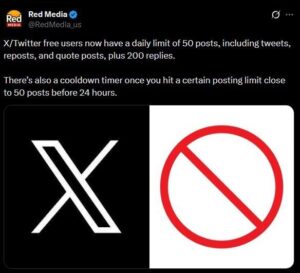
Source: Red Media
Although X has not officially confirmed those limits publicly, many users believe the platform is quietly trying to reduce spam-like behavior and low-quality engagement farming.
At the same time, creators analyzing the algorithm increasingly came to a similar conclusion: X now appears to reward retention and discussion more than raw posting volume.
The Platform Elon Musk Has Been Trying to Build
The timing of the algorithm release also comes as X continues pushing beyond traditional social media.
Just days after publishing the code, Musk celebrated another milestone after the platform reportedly crossed one billion downloads globally.
Taking to his X account on May 18, Musk reposted data shared by Tesla Owners Silicon Valley and wrote:
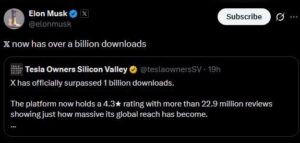
Source: Elon Musk
Since acquiring Twitter in 2022, Musk has repeatedly described his vision for X as an “everything app” combining social media, payments, AI tools, video, hiring, creators, and real-time information into one platform.
The newly released algorithm may offer the clearest look yet into how that vision is being engineered behind the scenes.
And judging by the reaction online, users are already adapting.
Some are now studying posting strategies like SEO experts. Others are trying to reverse-engineer the ranking system line by line. Meanwhile, many longtime users are simply hoping X feels less artificial again.
Ironically, one of the most widely shared reactions to the update may have summed things up best.
“Or forget all of this,” developer @CreeCoder wrote after listing dozens of algorithm tips, “and just have fun and post whatever you want like it’s Twitter again.”
Stay informed with daily updates from Blockchain Magazine on Google News. Click here to follow us and mark as favorite: [Blockchain Magazine on Google News].
Disclaimer
Blockchain Magazine publishes content submitted by third-party agencies, partners, and clients. Any such posts are categorized and tagged accordingly:
- Sponsored Content: Posts labeled as "Sponsored" are paid placements submitted by third-party agencies or clients. Blockchain Magazine does not endorse or express any views regarding the information contained in these posts. The opinions expressed belong solely to the respective authors and do not reflect the official policy or position of Blockchain Magazine.
- Press Releases: Posts labeled as "Press Release" are paid PR submissions provided by our partners and clients. These are published as received and should be considered as promotional content.
The information provided in such posts is strictly for informational purposes only and should not be interpreted as financial, investment, or professional advice. Blockchain Magazine does not recommend, endorse, or promote any specific products, services, or companies mentioned. Readers are strongly encouraged to conduct independent research and consult with a qualified professional before making any financial or investment decisions.
Additionally, all featured images accompanying such posts are intended as creative depictions of the subject matter. There is no intent to offend or misrepresent any individual, institution, or entity. If any content or imagery is found to be objectionable, please reach out to us at [email protected], and we will promptly review the concern.
About the Author: S. Parker

editor's pick




Get Blockchain Insights In Inbox
Stay ahead of the curve with expert analysis and market updates.