
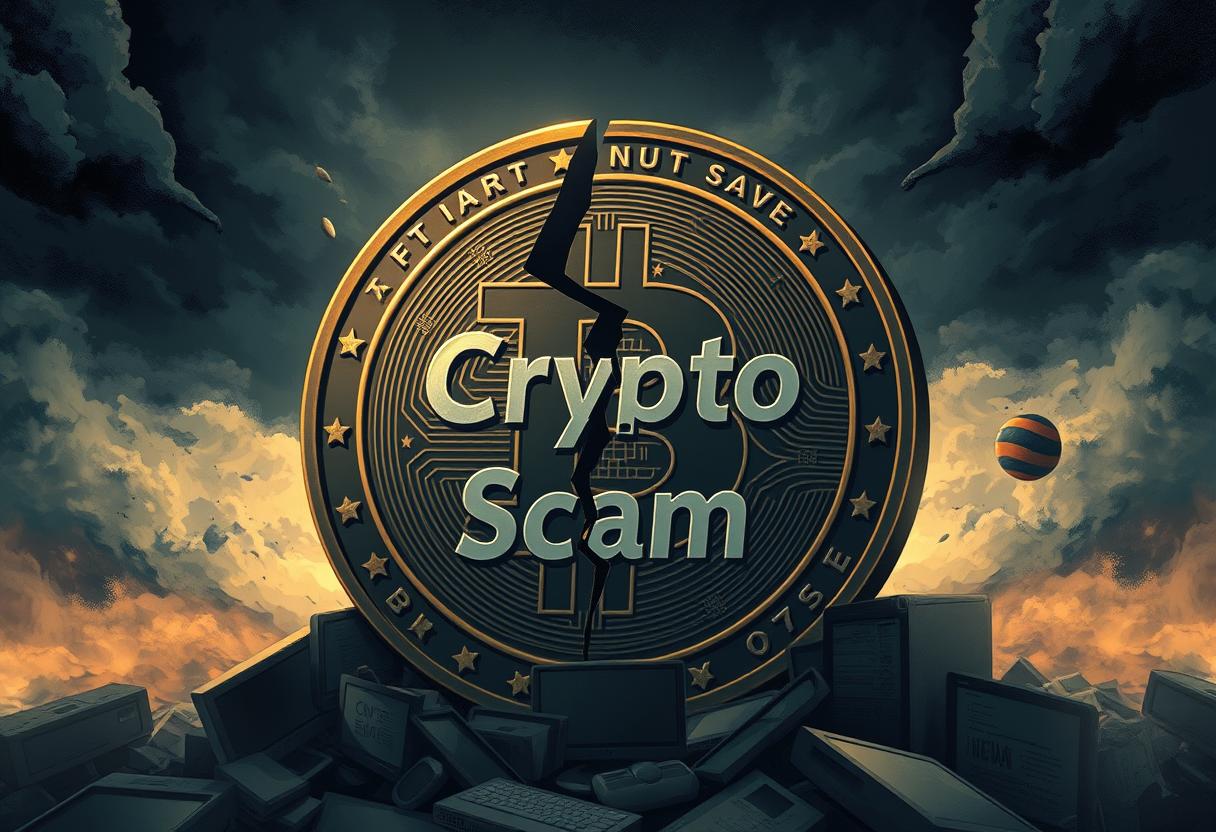
Biggest Crypto Scams Ever: A Deep Dive into the Most Notorious Fraudulent Crypto Schemes
The cryptocurrency revolution has brought unprecedented opportunities, promising decentralization, financial sovereignty, and life-changing profits. Yet, its meteoric rise, coupled with lax regulation and investor enthusiasm, has also created a playground for scammers. From Ponzi schemes to rug pulls, the crypto space has birthed some of history’s most audacious frauds, costing victims billions and shattering trust. This article takes a deep dive into the biggest crypto scams ever, unraveling their intricate workings, the staggering losses they caused, and the enduring lessons for a market still finding its footing.
OneCoin: The Fake Crypto Empire
Topping the list of crypto scams is OneCoin, a fraudulent operation that hoodwinked millions with the allure of a Bitcoin killer. Launched in 2014 by Ruja Ignatova, a Bulgarian entrepreneur with a polished Oxford pedigree, OneCoin was pitched as a groundbreaking cryptocurrency. Ignatova, dubbed the “Cryptoqueen,” dazzled audiences at global seminars, promising that OneCoin’s proprietary blockchain would revolutionize finance. The scam operated as a multi-level marketing (MLM) scheme, selling “educational packages” ranging from $100 to over $100,000, which supposedly granted buyers the ability to “mine” OneCoin tokens. In truth, there was no blockchain—just a centralized database where token values were manipulated by the founders. Promoters earned hefty commissions by recruiting others, fueling a pyramid structure that ensnared over 3 million investors across 175 countries. By 2017, OneCoin had amassed an estimated $4 billion to $15 billion, making it one of the largest financial scams ever. That year, Ignatova disappeared after boarding a flight from Sofia to Athens, just as authorities closed in. Her brother, Konstantin Ignatov, took a plea deal in 2019, while co-founder Karl Sebastian Greenwood received a 20-year prison sentence in 2023. Ignatova remains at large, a ghost haunting the crypto world, with her scheme’s victims left with worthless tokens and shattered dreams.
BitConnect: The Ponzi That Roared
BitConnect stormed onto the scene in 2016, capitalizing on the crypto bull run with promises of guaranteed riches. Marketed as a lending and trading platform, BitConnect claimed its proprietary “volatility software” could deliver daily returns of up to 1%—a tantalizing prospect in a volatile market. Investors swapped Bitcoin for BitConnect Coin (BCC), locking their funds into the platform for months in exchange for these payouts. The catch? Returns weren’t generated by trading but by new investors’ money—a classic Ponzi scheme. BitConnect’s hype was amplified by charismatic promoters on YouTube, like Carlos Matos, whose viral “BitConnect!” scream became a meme. At its peak in late 2017, BCC hit a market cap of $2.6 billion. But the house of cards collapsed in January 2018 when regulators in Texas and North Carolina issued cease-and-desist orders, exposing the scam. The platform shut down overnight, BCC’s value plummeted 92% in hours, and investors lost an estimated $2 billion. Founder Satish Kumbhani fled to India, where he was arrested in 2022, while U.S. promoter Glenn Arcaro pleaded guilty to fraud, underscoring how greed and slick marketing can blind even savvy crypto enthusiasts.
PlusToken: The Asian Crypto Heist
While OneCoin and BitConnect targeted a global audience, PlusToken zeroed in on Asia, particularly China and South Korea, pulling off a scam of staggering scale. Launched in 2018, PlusToken masqueraded as a crypto wallet and exchange, promising monthly returns of 8% to 16% through arbitrage trading. Its mobile app lured users with a sleek interface and referral bonuses, amassing over 3 million accounts by 2019. Investors poured in Bitcoin, Ethereum, and other cryptocurrencies, believing their funds were being expertly managed. Instead, the operators siphoned assets into private wallets, orchestrating a slow bleed that netted them over $3 billion—some estimates suggest up to $6 billion. The scam unraveled in mid-2019 when withdrawals stalled, and the founders vanished. Chinese authorities later arrested 109 suspects, convicting six ringleaders in 2020, but much of the stolen crypto had been laundered through mixers and exchanges. PlusToken’s fallout rippled through markets, with analysts linking its mass sell-offs to Bitcoin’s price dips in 2019. The scam exposed vulnerabilities in Asia’s crypto boom and the difficulty of tracking illicit funds across blockchains.
Mt. Gox: The Hack That Shook Crypto
Not all crypto disasters are outright scams, but Mt. Gox’s collapse blends negligence with suspected fraud, earning it a notorious spot. Launched in 2010 by Jed McCaleb and later run by Mark Karpelès, Mt. Gox became the world’s largest Bitcoin exchange, handling 70% of all BTC trades by 2013. Its dominance made it a prime target, and in 2011, a hack siphoned 2,000 BTC. Karpelès claimed to bolster security, but in February 2014, the exchange halted withdrawals, citing a “bug.” Days later, it declared bankruptcy, admitting 850,000 BTC—worth $450 million then, over $50 billion today—had vanished due to years of undetected hacks. Investigations revealed sloppy accounting and possible insider theft, with Karpelès convicted in Japan of data manipulation in 2019, though he avoided harsher fraud charges. Creditors have recovered only a fraction of their funds, with payouts still trickling out in 2025. Mt. Gox’s implosion rocked early adopters, proving that even “legitimate” platforms could devastate the ecosystem through mismanagement or deceit.
SafeMoon: The Rug Pull Era
Fast forward to the DeFi boom of 2021, and SafeMoon epitomizes the modern “rug pull”—a scam where developers hype a token then abandon it, taking the liquidity with them. Launched in March 2021, SafeMoon promised a novel tokenomics model: a 10% fee on transactions, with half redistributed to holders and half locked in a liquidity pool. Celebrity endorsements from Jake Paul and Lil Yachty fueled its rise, pushing its market cap to $8 billion by April. But red flags emerged—executives like CEO John Karony and CTO Thomas Smith sold off tokens worth millions, while audits revealed vulnerabilities in the smart contracts. In 2022, the project stalled, lawsuits piled up, and the token crashed 99%. In 2023, the U.S. SEC charged SafeMoon’s team with fraud, alleging they misappropriated $200 million for luxury cars and homes. SafeMoon exemplifies how DeFi’s hype, paired with weak oversight, can turn innovation into exploitation.
The Mechanics of Deception
These scams share common threads: promises of easy wealth, opaque operations, and exploitation of trust. OneCoin and PlusToken leaned on MLM tactics, rewarding recruitment over substance. BitConnect and SafeMoon dangled unrealistic returns, preying on FOMO (fear of missing out). Mt. Gox, while not a scam by design, collapsed under mismanagement that bordered on fraudulent negligence. Many hid behind blockchain’s complexity, using buzzwords like “arbitrage” or “tokenomics” to dazzle novices. Social engineering—via charismatic leaders, influencer shills, or fake testimonials—amplified their reach. Meanwhile, the decentralized nature of crypto made recourse elusive; once funds hit a scammer’s wallet, recovery was near impossible, especially with tools like mixers obscuring trails.
The Fallout and Lessons Learned
The human toll of these scams is immense. OneCoin victims included retirees and low-income families, some losing life savings. BitConnect’s crash left investors suicidal, with online forums awash in despair. Collectively, these schemes have stolen tens of billions, eroding faith in crypto’s promise. Yet, they’ve also spurred change. Regulators are tightening rules—think the EU’s MiCA framework or the SEC’s crackdowns—while exchanges now prioritize audits and transparency. Investors, burned by hype, are learning to scrutinize whitepapers, verify teams, and avoid “too good to be true” pitches. Tools like blockchain analytics from Chainalysis help track illicit flows, though scammers adapt fast.
Beyond the Scams: A Resilient Future
Rather than a conclusion, consider this a pivot: crypto’s scam-ridden past doesn’t define its future. Each debacle has exposed weaknesses—centralized points of failure, unvetted projects, blind greed—prompting smarter solutions. Decentralized exchanges (DEXs) reduce reliance on custodians like Mt. Gox. Audited smart contracts, as seen in reputable DeFi protocols, counter SafeMoon-style exploits. Education is spreading; platforms like Coinbase offer guides to spot red flags. The scams of yesteryear—OneCoin’s fake blockchain, BitConnect’s Ponzi mirage—seem crude next to today’s maturing ecosystem. By 2025, crypto’s scars are healing, not with blind optimism, but with hard-earned resilience. The next wave of innovation—be it tokenized assets or cross-chain bridges—could thrive, not because scams vanish, but because the community learns to outsmart them.
Stay informed with daily updates from Blockchain Magazine on Google News. Click here to follow us and mark as favorite: [Blockchain Magazine on Google News].
Disclaimer
Blockchain Magazine publishes content submitted by third-party agencies, partners, and clients. Any such posts are categorized and tagged accordingly:
- Sponsored Content: Posts labeled as "Sponsored" are paid placements submitted by third-party agencies or clients. Blockchain Magazine does not endorse or express any views regarding the information contained in these posts. The opinions expressed belong solely to the respective authors and do not reflect the official policy or position of Blockchain Magazine.
- Press Releases: Posts labeled as "Press Release" are paid PR submissions provided by our partners and clients. These are published as received and should be considered as promotional content.
The information provided in such posts is strictly for informational purposes only and should not be interpreted as financial, investment, or professional advice. Blockchain Magazine does not recommend, endorse, or promote any specific products, services, or companies mentioned. Readers are strongly encouraged to conduct independent research and consult with a qualified professional before making any financial or investment decisions.
Additionally, all featured images accompanying such posts are intended as creative depictions of the subject matter. There is no intent to offend or misrepresent any individual, institution, or entity. If any content or imagery is found to be objectionable, please reach out to us at [email protected], and we will promptly review the concern.
About the Author: Veronica Cruz




Get Blockchain Insights In Inbox
Stay ahead of the curve with expert analysis and market updates.