
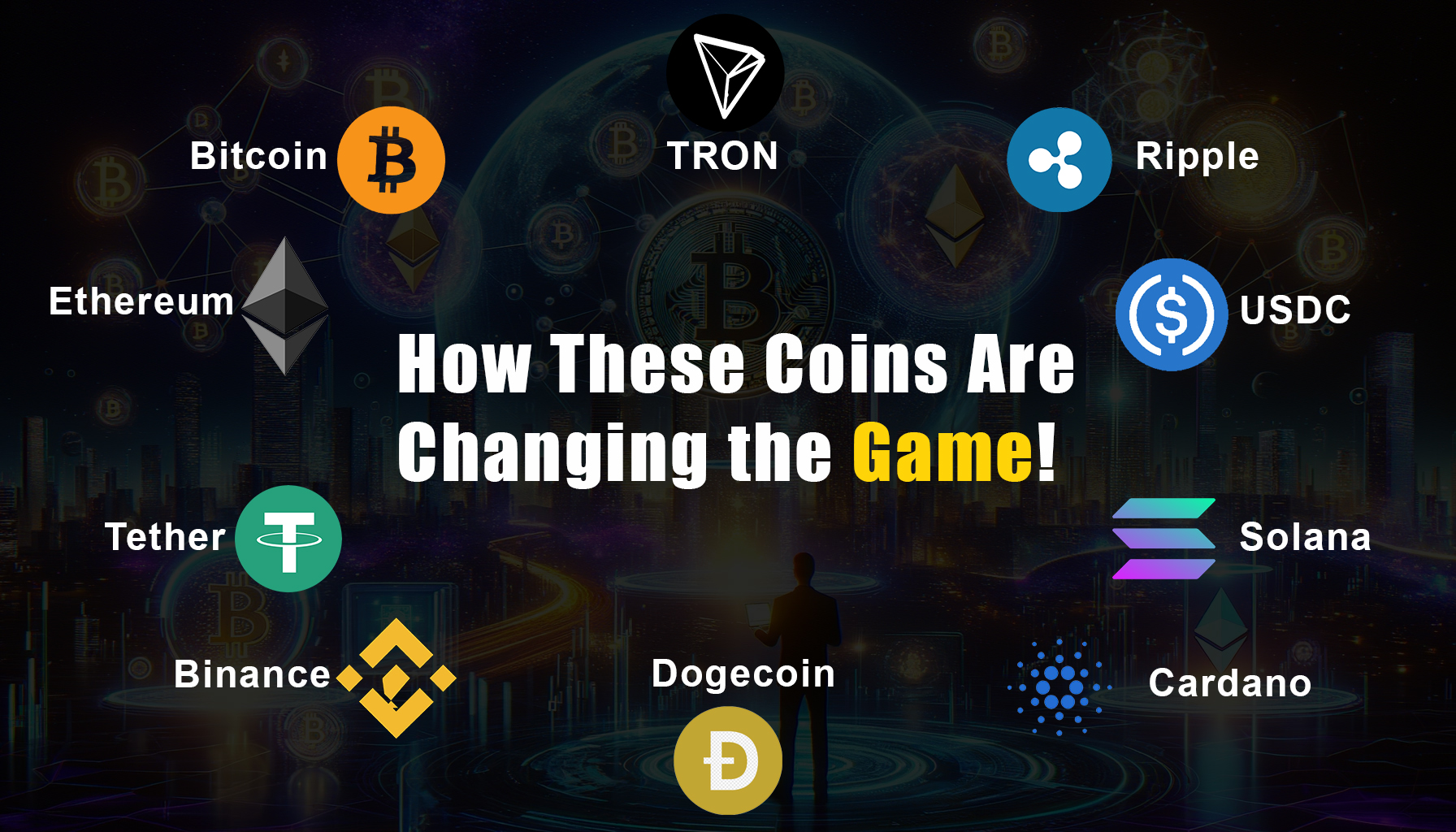
Top 10 Cryptocurrency Leading Crypto Market!
1. Bitcoin (BTC)
Bitcoin remains the undisputed leader of the cryptocurrency market. As the first decentralized digital currency, Bitcoin introduced the world to blockchain technology and the concept of peer-to-peer transactions without intermediaries. Its limited supply of 21 million coins and its role as a store of value have cemented its position as “digital gold.” Despite market volatility, Bitcoin continues to dominate the crypto space and inspire countless other projects.
- Market Cap: Over $500 billion
- Launch Year: 2009
- Founder: Satoshi Nakamoto (pseudonymous)
- Key Features:
- Decentralization: Bitcoin operates on a peer-to-peer network without a central authority.
- Limited Supply: Only 21 million Bitcoins will ever exist, making it a deflationary asset.
- Proof-of-Work (PoW): Miners solve complex mathematical problems to validate transactions and secure the network.
Why It Matters:
Bitcoin is the first cryptocurrency and remains the most widely recognized and adopted. It’s often referred to as “digital gold” because of its store-of-value properties. Bitcoin is used for remittances, investments, and as a hedge against inflation. Its decentralized nature makes it resistant to censorship and government control.
2. Ethereum (ETH)
Ethereum is more than just a cryptocurrency; it’s a platform for innovation. With its smart contract functionality, Ethereum enables developers to build decentralized applications (dApps) and launch new tokens. The recent transition to Ethereum 2.0, which introduced a proof-of-stake (PoS) consensus mechanism, has significantly improved scalability and energy efficiency. Ethereum’s ecosystem is home to thousands of projects, including DeFi platforms, NFTs, and more.
- Market Cap: Over $200 billion
- Launch Year: 2015
- Founder: Vitalik Buterin
- Key Features:
- Smart Contracts: Self-executing contracts that enable decentralized applications (dApps).
- Ethereum Virtual Machine (EVM): A runtime environment for executing smart contracts.
- Transition to Ethereum 2.0: Moving from Proof-of-Work (PoW) to Proof-of-Stake (PoS) for better scalability and energy efficiency.
Why It Matters:
Ethereum is the backbone of the decentralized finance (DeFi) and non-fungible token (NFT) ecosystems. It enables developers to build dApps, create tokens, and launch decentralized organizations (DAOs). Ethereum’s upgrade to Ethereum 2.0 has significantly improved its scalability and reduced energy consumption.
3. Tether (USDT)
Tether is a stablecoin, meaning its value is pegged to a fiat currency—in this case, the US dollar. Unlike volatile cryptocurrencies like Bitcoin, Tether is designed to maintain a stable value, making it a popular choice for traders and investors looking to hedge against market fluctuations.
- Market Cap: Over $80 billion
- Launch Year: 2014
- Founder: Brock Pierce, Reeve Collins, and Craig Sellars
- Key Features:
- Stablecoin: Pegged 1:1 to the US dollar, ensuring price stability.
- Transparency: Backed by reserves, though this has been a topic of controversy.
- Wide Adoption: Used across major exchanges for trading and remittances.
Why It Matters:
Tether provides stability in the volatile crypto market. It’s widely used for trading, hedging against market fluctuations, and transferring value across borders. Its integration with major exchanges and DeFi platforms makes it a cornerstone of the crypto economy.
4. Binance Coin (BNB)
Binance Coin is the native token of Binance, the world’s largest cryptocurrency exchange. Initially created to pay for trading fees, BNB has expanded its utility to include payments, travel bookings, and even financial services.
- Market Cap: Over $40 billion
- Launch Year: 2017
- Founder: Changpeng Zhao (CZ)
- Key Features:
- Utility Token: Used to pay for trading fees on Binance, with discounts for BNB holders.
- Binance Smart Chain (BSC): A blockchain for DeFi and dApps, compatible with Ethereum.
- Token Burns: Regular burns reduce the total supply, increasing scarcity.
Why It Matters:
BNB powers the Binance ecosystem, one of the largest in the crypto world. Its low fees and fast transactions make it a popular choice for DeFi and NFT projects. Binance’s global reach and continuous innovation ensure BNB’s relevance.
5. XRP (XRP)
XRP, created by Ripple Labs, is designed to facilitate fast and low-cost cross-border payments. Unlike many cryptocurrencies, XRP works closely with banks and financial institutions to improve the efficiency of international transactions.
- Market Cap: Over $30 billion
- Launch Year: 2012
- Founder: Ripple Labs
- Key Features:
- Fast Transactions: Settlements in 3-5 seconds.
- Low Fees: Cost-effective for cross-border payments.
- Partnerships: Collaborations with banks and financial institutions.
Why It Matters:
XRP is designed to revolutionize cross-border payments by reducing the time and cost of international transactions. Its partnerships with major financial institutions give it a unique edge in bridging traditional finance and crypto.
6. USD Coin (USDC)
Like Tether, USD Coin is a stablecoin pegged to the US dollar. However, USDC is known for its transparency and regulatory compliance, as it’s backed by fully reserved assets held in regulated financial institutions.
- Market Cap: Over $25 billion
- Launch Year: 2018
- Founder: Circle and Coinbase
- Key Features:
- Regulated Stablecoin: Fully backed by reserves held in regulated financial institutions.
- Transparency: Regular audits ensure trust and compliance.
- Wide Use Cases: Used in DeFi, trading, and payments.
Why It Matters:
USDC is a trusted stablecoin that combines the stability of fiat currency with the efficiency of blockchain technology. Its transparency and regulatory compliance make it a favorite among institutions and retail users alike.
7. Cardano (ADA)
Cardano is a third-generation blockchain platform that aims to solve the scalability, interoperability, and sustainability issues faced by earlier blockchains like Bitcoin and Ethereum. Founded by Ethereum co-founder Charles Hoskinson, Cardano uses a proof-of-stake consensus mechanism called Ouroboros.
- Market Cap: Over $10 billion
- Launch Year: 2017
- Founder: Charles Hoskinson (co-founder of Ethereum)
- Key Features:
- Proof-of-Stake (PoS): Energy-efficient consensus mechanism.
- Peer-Reviewed Research: A scientific approach to blockchain development.
- Scalability and Interoperability: Designed to support complex dApps and cross-chain communication.
Why It Matters:
Cardano aims to create a more secure and scalable blockchain. Its focus on sustainability and real-world use cases, such as supply chain management and identity verification, positions it as a key player in the crypto space.
8. Dogecoin (DOGE)
Dogecoin started as a joke in 2013 but has since become a cultural phenomenon. Inspired by the popular “Doge” meme, Dogecoin has a passionate community and has gained mainstream attention thanks to endorsements from celebrities like Elon Musk.
- Market Cap: Over $10 billion
- Launch Year: 2013
- Founder: Billy Markus and Jackson Palmer
- Key Features:
- Meme Coin: Started as a joke but gained a massive following.
- Inflationary Supply: No cap on the total supply, unlike Bitcoin.
- Strong Community: Known for its passionate and charitable community.
Why It Matters:
Dogecoin proves that community and humor can drive a cryptocurrency’s success. It’s widely accepted as a payment method and has gained mainstream attention thanks to endorsements from celebrities like Elon Musk.
9. Solana (SOL)
Solana is a high-performance blockchain known for its blazing-fast transaction speeds and low fees. Capable of processing over 65,000 transactions per second, Solana is a favorite among developers building decentralized applications and NFT projects.
- Market Cap: Over $10 billion
- Launch Year: 2020
- Founder: Anatoly Yakovenko
- Key Features:
- High Speed: Processes over 65,000 transactions per second.
- Low Fees: Cost-effective for users and developers.
- Hybrid Consensus: Combines Proof-of-Stake (PoS) and Proof-of-History (PoH).
Why It Matters:
Solana is a high-performance blockchain that supports DeFi, NFTs, and gaming projects. Its speed and scalability make it a strong competitor to Ethereum.
10. TRON (TRX)
- Market Cap: Over $7 billion
- Launch Year: 2017
- Founder: Justin Sun
- Key Features:
- Decentralized Content Sharing: Aims to decentralize the entertainment industry.
- High Throughput: Capable of handling 2,000 transactions per second.
- EVM Compatibility: Supports Ethereum-based dApps.
Why It Matters:
TRON empowers content creators by eliminating middlemen in content distribution. Its focus on decentralization and entertainment makes it a unique player in the crypto space.
Final Thoughts
These top 10 cryptocurrencies are at the forefront of the blockchain revolution, each offering unique value propositions and use cases. From Bitcoin’s store-of-value properties to Ethereum’s smart contract capabilities, and from stablecoins like Tether and USDC to high-performance blockchains like Solana, these coins are shaping the future of finance, technology, and the internet.
Whether you’re an investor, developer, or simply curious about crypto, understanding these projects is key to navigating the exciting and ever-evolving world of blockchain technology. Let me know if you’d like to explore any of these coins further!
Stay informed with daily updates from Blockchain Magazine on Google News. Click here to follow us and mark as favorite: [Blockchain Magazine on Google News].
Disclaimer
Blockchain Magazine publishes content submitted by third-party agencies, partners, and clients. Any such posts are categorized and tagged accordingly:
- Sponsored Content: Posts labeled as "Sponsored" are paid placements submitted by third-party agencies or clients. Blockchain Magazine does not endorse or express any views regarding the information contained in these posts. The opinions expressed belong solely to the respective authors and do not reflect the official policy or position of Blockchain Magazine.
- Press Releases: Posts labeled as "Press Release" are paid PR submissions provided by our partners and clients. These are published as received and should be considered as promotional content.
The information provided in such posts is strictly for informational purposes only and should not be interpreted as financial, investment, or professional advice. Blockchain Magazine does not recommend, endorse, or promote any specific products, services, or companies mentioned. Readers are strongly encouraged to conduct independent research and consult with a qualified professional before making any financial or investment decisions.
Additionally, all featured images accompanying such posts are intended as creative depictions of the subject matter. There is no intent to offend or misrepresent any individual, institution, or entity. If any content or imagery is found to be objectionable, please reach out to us at [email protected], and we will promptly review the concern.
About the Author: Peter Raid



Get Blockchain Insights In Inbox
Stay ahead of the curve with expert analysis and market updates.